Experts Warn Climate Overshoot Could Deepen Human Costs as New Study Identifies Five Key Risk Factors
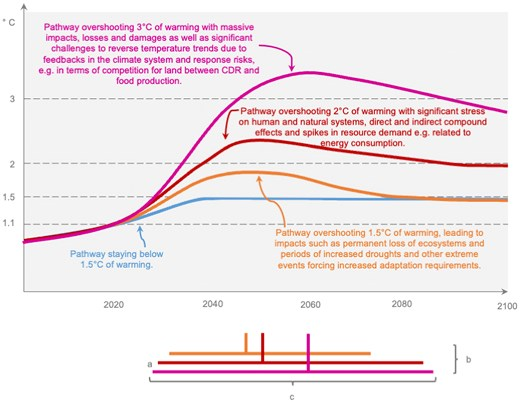
A new Perspective published in PNAS Nexus brings attention to a growing climate concern that’s often mentioned but rarely unpacked: climate overshoot. This is the scenario where global temperatures temporarily rise above the Paris Agreement’s aspirational 1.5°C target before later returning to safer levels. While we already know a lot about the physical consequences of warming, researchers argue that the human and social impacts of overshoot remain mostly unexamined—and that’s a major gap in our understanding.
Led by Andrew Kruczkiewicz and fellow researchers, the study outlines five major factors that governments, planners, and humanitarian organizations should keep in mind as the world appears increasingly likely to surpass the 1.5°C mark before the 2050s. What makes this research particularly urgent is that current global emissions trajectories show a significant overshoot is not just possible but probable, potentially lasting for decades.
Below is a clear breakdown of what the study reveals—and why it matters.
What Climate Overshoot Actually Means
Climate overshoot isn’t simply “warming a bit too much.” It refers to a temporary spike above a chosen temperature limit, followed by efforts to bring global mean temperatures back down. But even if temperatures eventually fall again, the damage during the overshoot period may linger or even become irreversible.
The study emphasizes that pathways involving overshoot come with higher climate risk than pathways that never exceed the target—even if both end up at the same temperature by the end of the century. In other words, the journey matters just as much as the destination.
Overshoot pathways typically include:
- A rise in global temperature above 1.5°C
- A peak warming level whose height determines part of the risk
- A long period before temperatures fall again, influenced by decarbonization and carbon removal
This period of elevated temperature subjects social systems, ecosystems, infrastructure, and humanitarian networks to stresses they may not be able to handle.
The Five Key Factors Identified by the Researchers
The study highlights five specific variables that determine how severe the human impacts of overshoot may be. These factors help visualize the potential challenges humanity could face, instead of treating overshoot as a mere statistical detail.
1. Peak Warming and Duration of Overshoot
The higher the global temperature rises and the longer it stays elevated, the greater the consequences. Even small differences in global averages can translate into massive differences in regional impacts, such as heatwaves, droughts, or crop failures. A few decades of overshoot could reshape economies, infrastructure, and ecosystems in ways that aren’t easily reversible.
2. Localized Amplification of Effects
Not all regions warm at the same rate. Some areas—especially parts of the Arctic, South Asia, and the Middle East—are already warming much faster than the global average. Overshoot could magnify this unevenness and bring harder-hitting local impacts, such as extreme heat, water scarcity, or coastal displacement. Social systems in these regions could face pressures they aren’t sufficiently prepared for.
3. Timing of Arrival
Overshoot isn’t just about how long or how much but also when it happens. If temperatures spike before nations and communities strengthen their adaptation capabilities, impacts could be amplified. This includes everything from disaster preparedness to water management to early warning systems. Arriving too early—or in an unplanned way—could catch governments and humanitarian organizations off guard.
4. Adaptation Limits
Every system has limits. Agriculture, public health, housing, infrastructure, and social services can only be adapted up to a certain point. Some regions may be pushed past these limits during an overshoot period. For example, certain crops cannot survive beyond particular heat thresholds, and extreme weather events may exceed the structural designs of existing buildings. Once adaptation limits are crossed, losses become unavoidable.
5. Dynamics of Overshoot Reversal
This factor is often overlooked. Temperatures will not necessarily drop smoothly after a peak. Instead, the world may see periods of increase, decrease, and stabilization, which complicates long-term planning. Humanitarian agencies, policymakers, and climate-finance plans will need to be flexible enough to handle uncertain and fluctuating warming patterns.
Why Overshoot Could Affect Social and Humanitarian Systems More Than Expected
The researchers stress that overshoot affects people just as much as it affects temperatures. In fact, the human systems most at risk include:
- Public health systems, due to heat stress and disease spread
- Food and water security, particularly in drought-prone regions
- Infrastructure networks, which may be designed for past climates
- Migration and displacement patterns, driven by unlivable conditions
- Economic stability, especially in climate-sensitive sectors
Overshoot could overwhelm humanitarian organizations, requiring more funding, more preparedness, and more flexible planning. But the study notes that these organizations are not currently equipped for decades of heightened risk.
Why Limiting Both Magnitude and Duration is Critical
The authors argue strongly that the global community must limit both how high the temperature rises and how long it stays elevated. Even if temperatures eventually return below 1.5°C, the impacts of overshoot may have already reshaped communities in irreversible ways. The 1.5°C threshold should remain the central global objective—not because of political symbolism but because the science indicates that every fraction of a degree matters for human well-being.
The Need for Post-Peak Climate Planning
One of the biggest takeaways from the study is the urgent need to better understand what happens after we pass the warming peak. Different recovery pathways—rapid decline, slow decline, or fluctuating temperatures—could have very different consequences. The authors call for more research into:
- Overshoot recovery timelines
- Uncertainty communication
- Infrastructure investment pathways
- Humanitarian resource requirements
- Climate-finance allocation
- Adaptation planning for irreversible changes
Without this work, societies may be caught unprepared during the crucial decades ahead.
Overshoot and Its Relevance Ahead of COP30
This research arrives at a time when global climate discussions are intensifying in the lead-up to COP30 in Brazil. There is growing recognition that overshoot risk is no longer an abstract scenario but a real outlook unless global emissions drop sharply. Policymakers, negotiators, and climate advocates will need to confront overshoot directly—not as a possibility to avoid discussing, but as a scenario to actively plan for.
Additional Background: Why the Social Impacts of Overshoot Are Understudied
Even though physical climate sciences have advanced significantly, understanding of social impacts lags behind for a few reasons:
- Climate models traditionally focus on environmental variables, not human systems
- Social impacts vary by region, culture, and economic structure, making them harder to generalize
- Data on long-term humanitarian impacts is limited because overshoot hasn’t happened before at this scale
- Human systems involve complex interactions between governance, inequality, infrastructure, and geography
This makes studies like the one by Kruczkiewicz and colleagues especially important.
What Needs to Happen Next
The authors make several recommendations:
- Expand research on human and social impacts during overshoot
- Improve humanitarian planning for irreversible climate changes
- Strengthen national climate commitments in light of new risks
- Align early warning systems and disaster planning with overshoot scenarios
- Promote international cooperation for resilience and adaptation
The message is clear: understanding how societies will cope during overshoot is essential to developing effective adaptation and risk-reduction strategies.
Research Paper:
The human and social impacts of climate overshoot
https://doi.org/10.1093/pnasnexus/pgaf332