New Deployable Space Structures Could Help Astronauts Maintain Muscle Mass During Long Missions
A team of researchers has developed a new class of high-expansion-ratio deployable structures that could dramatically change how astronauts maintain muscle health during long-duration space missions. These structures, called HERDS (High-Expansion-Ratio Deployable Structures), are designed to unfold from a compact package into systems potentially stretching up to a kilometer in length. The goal is straightforward: create large rotating structures capable of generating artificial gravity, which could significantly reduce muscle atrophy and bone loss experienced in microgravity.
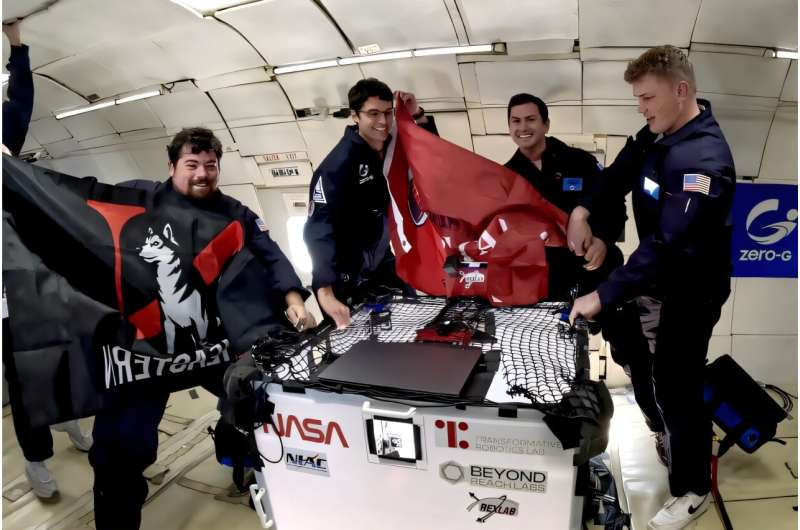
This innovation comes from a collaboration that includes Jeffery Lipton, a mechanical and industrial engineering professor at Northeastern University. His team recently tested the technology during a parabolic flight, which simulates short bursts of microgravity similar to conditions in space. The test allowed the team to evaluate both the hardware and the software required to model the system’s complex movements.
How Microgravity Affects Astronauts
Astronauts face serious physical challenges when they spend months away from Earth. Without constant gravitational force, the body begins to weaken. Muscle atrophy, bone density reduction, balance issues, and fluid buildup are common consequences.
Even with specialized exercise equipment on the International Space Station, the effects can’t be fully prevented. A recent example is NASA astronauts Barry “Butch” Wilmore and Sunita “Suni” Williams, who spent nine months aboard the ISS. They returned with noticeable decreases in muscle mass, balance complications, and bodily fluid redistribution.
Creating artificial gravity has long been seen as a potential solution, but building large, rigid rotating structures in space has been too impractical—until concepts like HERDS.
What HERDS Actually Is
HERDS consists of a series of triangle-shaped pop-up extending trusses, known as PETs (Pop-Up Extending Trusses). These use a scissor-based mechanism to fold flat for storage and then expand to full length when deployed.
Key features include:
- Extremely compact storage volume
- Low mass, which is critical for spacecraft payload limits
- Ability to expand to enormous lengths, even up to kilometer scales
- Structural integrity at high spin rates, a requirement for generating artificial gravity
- Inherent rigidity and stiffness, making them safer than cable-based deployable structures
Traditional tether-based systems rely on ropes or straps that can become slack and dangerous. HERDS remains stable whether folded or deployed, making them more reliable for supporting heavy loads such as human habitats.
Testing the Structures in Microgravity
Earlier this year, Lipton and his colleagues boarded a parabolic flight to evaluate HERDS performance in microgravity. Each parabolic arc creates around 20–25 seconds of weightlessness, followed by periods of double gravity (2Gs).
Lipton described the experience as unusual but essential. Switching between zero gravity and high gravity made even simple movement feel unfamiliar. In microgravity, pushing too hard sends a person drifting quickly, while under 2Gs movement becomes difficult.
For the research team, the microgravity environment was crucial to validate the software modeling that predicts how HERDS behaves when the individual components move in space. Earth-based testing can never fully replicate that environment.
Why Artificial Gravity Matters
Artificial gravity generated by rotating structures could dramatically reduce the physical deterioration astronauts face. Rotating habitats would simulate gravitational force using centripetal acceleration. The bigger the rotating radius, the easier it is to maintain comfortable spin rates without causing motion sickness.
HERDS structures could be deployed to create this large radius—something that’s been nearly impossible to launch directly from Earth.
Long-term missions, such as those traveling to Mars or staying on lunar bases, would particularly benefit from systems that maintain muscle strength, bone density, and overall physiological stability.
Earth-Based Applications
The researchers also mention potential uses outside of space. Because HERDS can expand quickly and maintain rigidity, they could be adapted for:
- Deployable medical stretchers
- Temporary cellphone towers
- Rapidly assembled concert staging
- Emergency infrastructure
Any scenario that requires moving large structures through tight spaces, then deploying them instantly at the destination, could benefit from this technology.
What Makes HERDS Different From Existing Deployable Systems
Other deployable systems often come with trade-offs. Tether-based systems lack rigidity. Inflatable structures can puncture easily. Many scissor-based structures are strong but don’t offer high expansion ratios.
HERDS addresses these issues by providing:
- High expansion ratio
- Stability both folded and expanded
- Load-bearing capability
- Modular and scalable design
- Lightweight construction suitable for spacecraft
It’s not just a new mechanism—it’s a new class of deployable architecture.
What Comes Next for HERDS
Even with promising early tests, the path to full-scale deployment remains long. Lipton points out that no organization would immediately decide to build a kilometer-scale space habitat based on a prototype. The risk and cost are simply too high.
The team now plans to focus on derisking the technology through:
- More thorough software modeling
- Additional microgravity tests
- Earth-based experiments
- Trial applications in both space and terrestrial environments
By demonstrating reliability on smaller scales, they aim to build confidence step by step until HERDS can be trusted for major space structures.
Additional Background: Deployable Structures in Space Engineering
Deployable structures are not new to space engineering. Solar arrays, antennas, and booms often rely on intricate mechanical systems to unfold once in orbit. These systems allow spacecraft to launch compactly and then expand into functional configurations.
However, traditional deployable structures generally fall into the following categories:
- Rigid deployment systems, which are strong but bulky
- Inflatables, which are lightweight but fragile
- Cable/tether systems, which allow huge expansions but lack rigidity
HERDS essentially merges the benefits of multiple approaches while avoiding the typical weaknesses. It sits at the intersection of origami-inspired engineering, scissor mechanisms, and modular truss design.
The hierarchical nature of HERDS makes it particularly efficient. Each small component contributes to an expanding network of linked trusses that grow in strength as they deploy. This kind of geometric engineering could be a major stepping stone toward structures like:
- Rotating habitats
- Large telescopes
- Kilometer-scale antennas
- Deep space communication arrays
The more compactly you can pack these systems before launch, the easier and more affordable they become.
Additional Context: Why Astronauts Need Better Solutions
Current ISS exercise equipment includes devices like the Advanced Resistive Exercise Device (ARED), treadmills, and bicycles. These machines help astronauts slow down degeneration but require significant space and mass, and they still can’t replicate Earth-like gravitational loading.
With missions soon extending beyond low Earth orbit—particularly via NASA’s Artemis program and planned Mars missions—microgravity countermeasures must evolve. Artificial gravity remains the most effective yet most technologically challenging solution.
HERDS bridges the gap between theoretical artificial-gravity habitats and something that can actually be launched and deployed.
Research Paper Reference
High-Expansion-Ratio Deployable Space Structures for Long Duration Space Missions