Texas A&M Researchers Use Parabolic Flights to Explore Microgravity Health Risks and Test Lower Body Negative Pressure Solutions
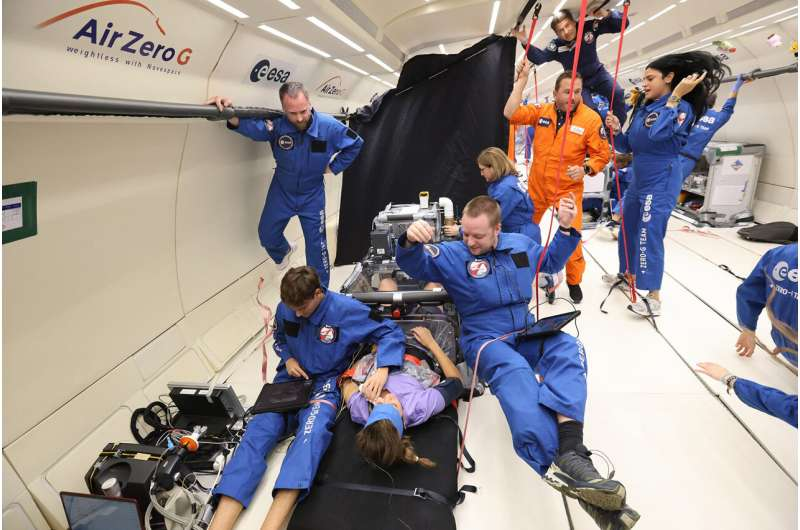
Microgravity has always fascinated scientists, but it also creates a range of challenges for the human body. One of the biggest concerns is how weightlessness affects our cardiovascular system, especially during long missions. A new research effort from Texas A&M University is diving deep into this problem using a platform that allows real microgravity exposure without ever leaving Earth’s atmosphere: parabolic flights.
This project, carried out in collaboration with several international partners, focuses on understanding how bodily fluids shift upward in microgravity and how a technology called Lower Body Negative Pressure (LBNP) might counteract those effects. It’s a straightforward scientific mission with a very practical goal—help astronauts stay healthy on future missions to the Moon, Mars, and beyond.
Below is a clear breakdown of what the researchers are doing, why it matters, and how parabolic flights fit into the larger world of space-health research.
What the Texas A&M Team Is Studying
When astronauts enter microgravity, fluids in the body naturally migrate toward the upper torso and head. This fluid shift can raise blood pressure, increase jugular vein flow, and potentially contribute to issues like jugular vein thrombosis, head congestion, and even longer-term problems related to ocular health.
Because astronauts can’t exactly step into a lab while orbiting Earth, scientists need creative ways to test solutions. That’s where the Texas A&M Bioastronautics and Human Performance Laboratory, led by Dr. Ana Diaz Artiles, comes in.
Their team is using parabolic flights operated by Novespace in Bordeaux, France, which generate short periods of weightlessness—about 22 seconds per parabola—by flying a precise pattern of steep climbs followed by rapid descents. These flights are provided through the European Space Agency, offering real microgravity conditions that Earth-based simulations simply can’t replicate.
The Texas A&M team has been studying fluid shifts and LBNP in simulated microgravity on Earth for years, but now they’re taking that research into actual reduced-gravity environments.
How the Parabolic Flights Work
A parabolic flight follows a repeating up-and-down maneuver:
- The aircraft climbs steeply.
- At the top, the engine thrust and trajectory align to create near-weightlessness.
- The plane then descends, pulling up again at the bottom.
Each parabola produces roughly 22 seconds of true microgravity.
Researchers on board use these short windows to observe physiological responses and measure critical cardiovascular markers. While 22 seconds may feel brief, multiple parabolas over the course of a flight allow scientists to collect dozens of data points across multiple microgravity cycles.
During these intervals, participants wear sensors that capture:
- Jugular vein flow
- Heart rate
- Blood pressure
All of these metrics help the team understand how the body responds with and without countermeasures like LBNP.
What Lower Body Negative Pressure (LBNP) Does
One of the countermeasures being tested is Lower Body Negative Pressure. The device, developed by Technavance, an Austin-based company, encloses the lower half of the body in a sealed chamber. When activated, the chamber reduces air pressure around the legs, pulling fluids downward.
In microgravity, where fluids float freely and accumulate in the head, LBNP helps shift them back into the lower body. This directly addresses problems associated with fluid redistribution, such as:
- Increased central blood volume
- Elevated intracranial pressure
- Changes in blood vessel behavior
- Cardiovascular strain during reentry or landing
The team’s early results are encouraging, showing that LBNP is performing in microgravity as expected. The researchers note that the technique is successfully redistributing fluids and reinforcing its potential value as a reliable countermeasure for astronauts.
However, there are still many questions about how well LBNP can prevent certain conditions—especially those involving the eyes, such as Spaceflight-Associated Neuro-ocular Syndrome (SANS). Previous Earth-based studies suggested mixed results regarding eye-related pressure changes, making microgravity testing essential.
The Scope of the Research Project
The full project involves four parabolic flight campaigns over a period of 18 to 24 months. So far, the team has completed one of these flights.
The goal isn’t just to see whether LBNP works—it’s to understand how different pressure levels affect fluid shifts and cardiovascular markers. By gathering detailed physiological data during microgravity exposure, the researchers can map out which LBNP settings are most effective and safest.
This will eventually help develop personalized countermeasures for astronauts. Since people respond differently to microgravity (just like people respond differently to heat, cold, or altitude), having adjustable, data-driven countermeasures could be a major step forward in astronaut health.
Why Parabolic Flights Are Important
Parabolic flights occupy a unique place in space research. They’re:
- Far cheaper than launching experiments into orbit.
- Accessible to more researchers and students.
- Flexible for repeated tests.
- Capable of providing real microgravity instead of simulations.
The Texas A&M team points out that parabolic flights allow them to validate Earth-based findings. A countermeasure that works during bedrest studies or tilt-table simulations doesn’t always behave the same way in real 0-gravity environments. Without this intermediate step, many technologies might reach orbit only to fail under true space conditions.
Who Else Is Involved
This project includes international collaboration with:
- Universidad Carlos III de Madrid
- University of California, Davis
- University of Florida
- Spanish Space Agency
- Centro de Instrucción de Medicina Aeroespacial
- Lockheed Martin
The research also provides hands-on experience for participating students. Parabolic flights are rare opportunities even for seasoned scientists, and being part of this work gives students a front-row seat to real microgravity experimentation.
Why Fluid Shifts Are Such a Big Deal in Space
One of the biggest health challenges astronauts face is the way microgravity disrupts normal fluid dynamics.
Under Earth’s gravity, blood naturally pools in the legs. In space, the absence of gravity means:
- Fluids move toward the chest and head.
- Veins in the upper body experience increased pressure.
- The heart doesn’t have to work as hard to pump blood upward.
- Over time, the cardiovascular system can weaken.
This redistribution also affects:
- Balance and coordination
- Vision
- Kidney function
- Brain pressure
Understanding and addressing these changes is critical as we prepare for longer missions. A trip to Mars, for instance, could take over six months each way. Without effective countermeasures, astronauts could face serious health challenges by the time they arrive.
The Bigger Picture: What Comes Next
While the early data from the Texas A&M team is promising, the research is still in its early phases. The remaining parabolic flights will refine the understanding of LBNP and help identify the most effective pressure levels.
In the long run, this research could shape how space agencies design astronaut health protocols for years to come. It may also influence commercial spaceflight companies, who will need reliable solutions as civilian space travel becomes more common.