AI-Powered Simulation Recreates the Milky Way With 100 Billion Individual Stars
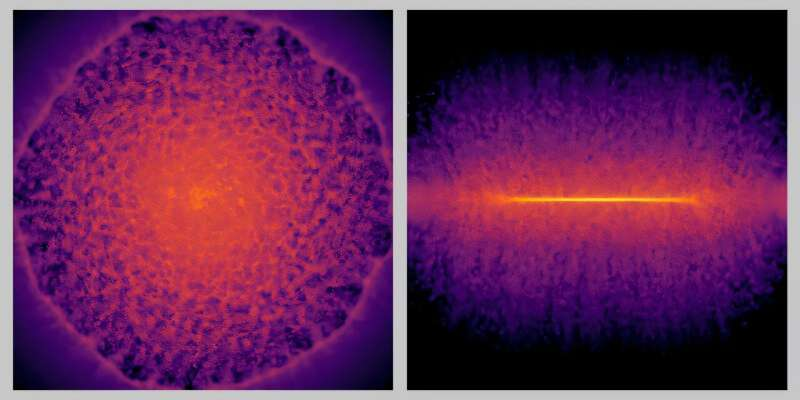
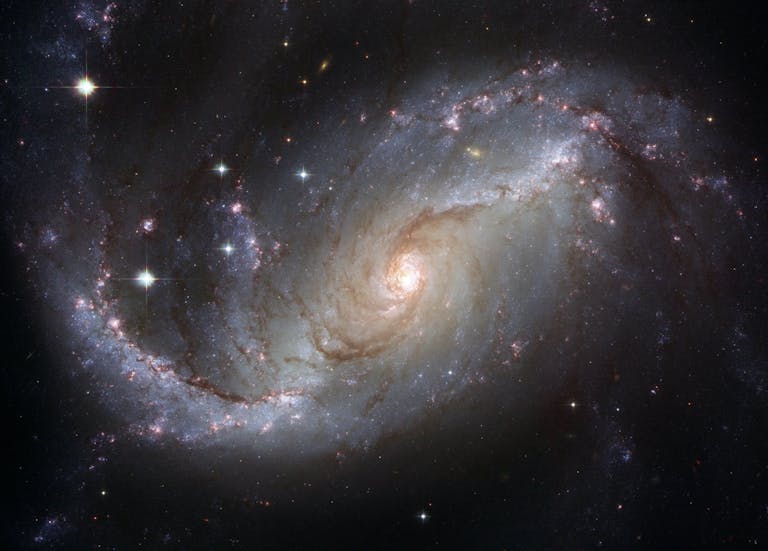
Researchers have created the first-ever simulation of the Milky Way that represents more than 100 billion individual stars, capturing how our galaxy evolves over 10,000 years—and they did it faster and in more detail than any previous attempt. This breakthrough merges high-performance computing with deep learning, allowing scientists to run galaxy-scale simulations at star-by-star resolution instead of using coarse approximations.
This achievement comes from a collaboration led by the RIKEN Center for Interdisciplinary Theoretical and Mathematical Sciences (iTHEMS) in Japan, along with researchers from The University of Tokyo and Universitat de Barcelona. Their work pushes past the long-standing computational limits that prevented large galaxies like the Milky Way from being modeled at such fine detail. Earlier models could only simulate galaxies at a resolution equivalent to clusters of roughly 100 stars, not individual ones. For decades, astrophysicists could study only large-scale motions, because the finer details were averaged out.
In this new simulation, both large-scale galactic dynamics and small-scale events—such as supernova explosions and the rapid expansion of surrounding gas—are represented with extraordinary accuracy. The project required the equivalent of 7.15 million CPU cores, spread across 148,900 compute nodes, to push through previous boundaries. Yet even with this massive computational footprint, the key reason the simulation works so quickly is the introduction of an AI-based surrogate model.
How the AI Surrogate Model Breaks the Simulation Bottleneck
A realistic Milky Way model must capture a vast range of physical processes: gravity, fluid dynamics, star formation, supernova feedback, and element synthesis, all unfolding on dramatically different time and spatial scales. The biggest obstacle has always been time resolution. To track the rapid changes after a supernova, simulations need very small timesteps. But smaller timesteps slow the entire system down. A conventional, full-physics simulation of the Milky Way at star-level resolution would take 315 hours just to simulate 1 million years. At that rate, simulating 1 billion years of evolution would require more than 36 real years of computation.
Throwing more supercomputer cores at the problem is not a sustainable solution—efficiency drops sharply as core counts rise, and energy usage would be enormous.
To solve this, the team developed a deep learning surrogate model trained on high-resolution simulations of supernova explosions. The surrogate learned how the expanding gas behaves in the 100,000 years following a supernova. Instead of calculating every tiny timestep inside the main simulation, the AI model predicts the gas evolution and feeds that result directly into the full galactic model.
This approach removes the slowest part of the computation. With the surrogate in place, simulating 1 million years now takes only 2.78 hours. That reduces the time needed for a 1-billion-year simulation to around 115 days, making long-term star-level studies feasible for the first time.
The team verified the simulation by comparing its output with results produced on major supercomputing systems, including RIKEN’s Fugaku and The University of Tokyo’s Miyabi Supercomputer System, confirming that the AI-powered approach matched the accuracy of brute-force simulations.
Why This Simulation Matters for Astrophysics
Representing each star individually unlocks possibilities that were previously out of reach. Now researchers can examine:
- how supernova explosions redistribute gas and metals into the galaxy,
- how these materials shape the next generation of stars,
- the small-scale structure and turbulence of interstellar gas,
- the fine details of galactic disk evolution,
- and how the distribution of stars influences the long-term stability of the Milky Way.
Because the Milky Way contains over 100 billion stars, each interacting gravitationally and influencing its local environment, a star-resolved simulation provides far more realistic insight into galactic behavior than averaged or clustered models.
This breakthrough could also help scientists test theories of galactic formation, supernova feedback mechanisms, and the evolution of chemical elements throughout the galaxy. As we gather more precise observations from telescopes and space missions like Gaia, a model that simulates stars one-by-one becomes an invaluable comparison tool.
Where AI-Accelerated Modeling Goes From Here
While this simulation covers 10,000 years of evolution at full resolution, the newly achieved computation speed means much longer runs are now possible. The hybrid AI + physics approach is generalizable, and not limited to astrophysics. Similar “multi-scale” problems exist in:
- climate modeling,
- atmospheric and ocean science,
- weather forecasting,
- volcanic and seismic modeling,
- fusion plasma dynamics,
- and complex fluid systems in engineering.
These fields all share a core challenge: tiny, fast events influence massive, slow systems. Traditional simulations struggle to connect these scales efficiently. AI surrogate models, trained on high-resolution local data, can bridge that gap.
If this approach catches on—and it almost certainly will—scientists may soon run simulations that were previously too slow or too expensive to attempt.
Additional Background: Why Simulating Galaxies Is So Hard
Building a galaxy simulation requires tracking billions of independent gravitational interactions. Gravity itself is long-range, meaning every star influences every other star. On top of that, gas dynamics follow partial differential equations that must obey strict stability rules. The Courant–Friedrichs–Lewy (CFL) condition is especially restrictive and forces simulations to use tiny timesteps when modeling rapidly changing fluids.
Supernovae make the problem worse. These explosions inject massive amounts of energy into the surrounding gas, creating sharp shock fronts. Without AI, capturing these accurately demands extremely fine resolution.
Even with some of the most powerful supercomputers on the planet, full-physics simulations at individual-star resolution have always been far too slow. That is why earlier models treated whole clusters of stars as single particles with averaged properties.
The new method bypasses this by letting the AI handle the part that breaks the timestep constraints while still keeping the physics model realistic. It uses real high-resolution data to predict outcomes, not shortcuts based on simple patterns.
Additional Background: The Role of Surrogate Models in Science
Surrogate models—AI systems trained to replace parts of a simulation—are becoming increasingly common in scientific computing. They are often used when a system has:
- a narrow set of inputs,
- a predictable output structure,
- and an extremely expensive internal process.
Once trained, surrogate models deliver predictions in fractions of a second. In this study, the surrogate replaced one of the most expensive modules in the entire galactic simulation: the expansion of gas after a supernova.
This is similar to how climate scientists use AI models to estimate cloud behavior, or how engineers use AI to predict turbulence near aircraft wings. When built carefully, surrogate models preserve accuracy while dramatically accelerating computation.
This Milky Way simulation is one of the largest and most impressive uses of a surrogate model to date, scaling up to more than 300 billion total particles when including gas and dark matter components.
A Technological Milestone for Science
The simulation marks a turning point. It demonstrates that AI-accelerated scientific discovery is not limited to pattern recognition or language modeling. Instead, AI can take on the role of a computational engine, making it possible to explore physical processes at unprecedented detail and speed.
For the scientific community, this represents a new era of multi-physics modeling. For the rest of us, it offers a clearer window into how our galaxy works—and how the elements that make up planets, life, and everything we see were forged and distributed across cosmic time.
Research Paper:
The First Star-by-star N-body/Hydrodynamics Simulation of Our Galaxy Coupling with a Surrogate Model
https://doi.org/10.1145/3712285.3759866