Machine Learning Uncovers Extremely Rare Quasars Acting as Gravitational Lenses
A new study has more than doubled the number of known quasar gravitational lens candidates, and it did so using a clever combination of machine learning, spectroscopy, and real survey data.
Quasars that act as strong gravitational lenses are among the rarest systems in astronomy, and until now only twelve candidates had been found, with just three confirmed. Thanks to this new research led by Everett McArthur and his team, seven additional high-quality candidates have been identified, dramatically expanding the available sample and opening new doors for studying how galaxies and supermassive black holes grow together.
This discovery comes from analyzing over 812,000 quasars recorded in the Dark Energy Spectroscopic Instrument (DESI) DR1 release. The team’s work demonstrates how machine learning can tackle problems that were previously near-impossible due to the extreme brightness of quasars, which usually hide the features of the galaxies hosting them.
Understanding Why These Quasar Lenses Are So Rare
A quasar is an extremely bright object powered by a supermassive black hole feeding on surrounding gas. This brightness is so intense that it normally outshines its host galaxy completely. That makes it almost impossible to measure the mass of the galaxy that surrounds the quasar, because the quasar’s own light overwhelms any detail.
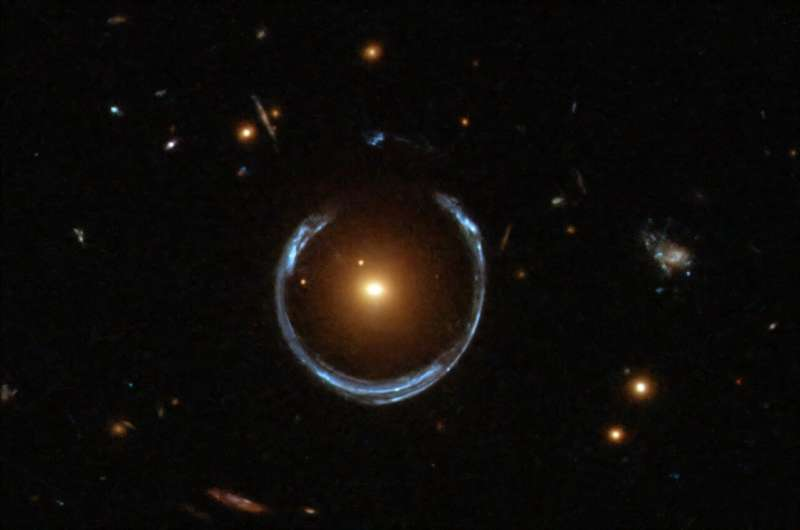
But if a quasar sits almost perfectly in front of an even more distant galaxy, the gravity of the quasar’s host galaxy can bend and distort the background galaxy’s light. This effect is known as gravitational lensing. When the alignment is just right, the background galaxy appears stretched, brightened, or even multiplied into arcs and rings.
These special systems let astronomers measure the Einstein radius, which directly reveals the mass of the foreground host galaxy. For quasars, this is incredibly valuable. You essentially get a natural way to “weigh” something that’s otherwise hidden behind the glare.
However, finding these systems is famously difficult. With nearly 300,000 quasars in older surveys like the Sloan Digital Sky Survey (SDSS) and hundreds of thousands more in DESI, only a tiny handful show signs of lensing. The signs are subtle, and normal imaging often can’t distinguish the faint background galaxy from the blazing quasar.
How the New Machine Learning Strategy Works
Since genuine quasar-lens systems are so rare, there aren’t enough real examples to reliably train a neural network. The team solved this by building synthetic lenses. These are created by combining:
- Real DESI quasar spectra
- Real spectra of high-redshift emission line galaxies (ELGs)
- Realistic lensing conditions such as redshift differences
About 3,000 realistic mock lenses were constructed, along with 30,000 ordinary quasar spectra representing the non-lens majority. These datasets were used to train the network to detect the faint, shifted spectral lines from background galaxies.
Why spectroscopy? Because when both the quasar and background galaxy light enter the same spectrograph fiber, their spectra mix. The foreground quasar shows its own emission lines at a certain redshift, while the more distant galaxy shows its own emission lines at a higher redshift, usually in the form of:
- A strong oxygen doublet (O II)
- Sometimes hydrogen beta (H-β)
- Occasionally oxygen three (O III)
These features don’t appear where quasar lines should be. Spotting them requires very sensitive analysis, which is perfect for machine learning.
The neural network reached a remarkable AUC (Area Under Curve) of 0.99, meaning it was extremely accurate in distinguishing genuine signals from noise.
What the Search Found
After training, the network was unleashed on all 812,118 quasars in DESI DR1. From this massive dataset, it identified:
- Seven Grade-A candidates
- Each with a clear high-redshift [O II] doublet from a background galaxy
- Four of them also showing H-β and [O III] emissions
- Successful recovery of the only previously known quasar lens inside DESI’s survey footprint
“Grade A” here means the spectra strongly support the interpretation that a background galaxy is present and lensed. While follow-up imaging is required to confirm them visually, the evidence in the spectra is strong.
For a field where only twelve candidates were identified after decades of searching, discovering seven more in one automated pass is a major leap forward.
Why These Results Matter for Understanding the Universe
This breakthrough has big implications for several key topics in astrophysics:
1. Measuring Host Galaxy Masses
Quasar brightness normally hides their host galaxies. Lensing changes this by setting up a clean way to measure mass through the Einstein radius. As more systems are found, astronomers can build a much more detailed picture of quasar host galaxies across cosmic time.
2. Studying the Growth of Supermassive Black Holes
Quasars mark periods of intense feeding by supermassive black holes. But understanding how the black hole and its galaxy grow together requires host galaxy mass measurements — something quasar lenses uniquely provide.
3. Improving Machine Learning Techniques in Astronomy
This work is also an important demonstration of how synthetic training data can be used when real examples are scarce. The success of the approach suggests that many other rare astronomical phenomena might also be discoverable this way.
4. Scaling to Future Surveys
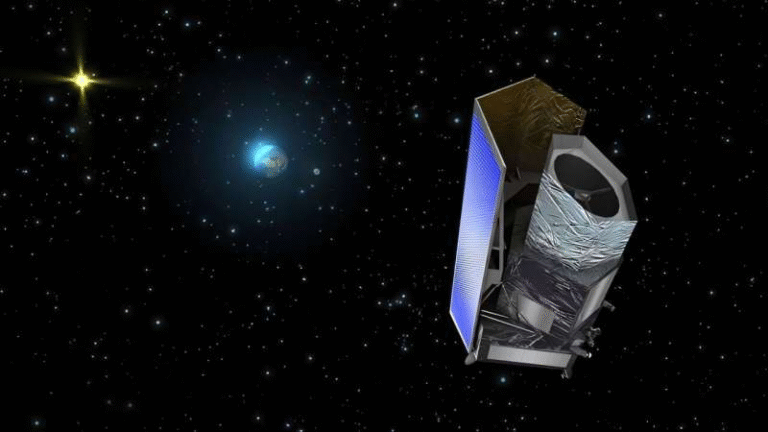
As DESI collects more data, and as next-generation surveys like Euclid and the Vera C. Rubin Observatory LSST begin full operations, the volume of spectra will increase dramatically. Machine learning will be essential for finding more quasar lenses hidden in the data.
Additional Background: What Makes a Good Gravitational Lens?
Not every foreground galaxy can produce strong lensing. Several factors must align:
- The foreground mass must be high enough — typically a massive galaxy or cluster.
- The background galaxy must be almost perfectly aligned behind the quasar.
- The distance difference between them must create a noticeable bending of light.
Quasar lenses are especially rare because they require both:
- A quasar in the foreground
- A galaxy behind it, aligned almost perfectly
Since quasars are already rare objects among galaxies, the chance of such alignment is tiny.
Additional Background: Why DESI Is So Important for This Work
DESI was built specifically to create the most detailed 3D map of the universe ever made. It uses:
- 5,000 robotically positioned optical fibers
- Spectra for tens of millions of objects
- Rapid data collection across a huge region of the sky
Because DESI collects spectra for so many quasars and galaxies, it is perfectly suited for statistical searches for extremely rare systems. This study demonstrates one of the many scientific surprises DESI can uncover beyond its main cosmology goals.
Looking Ahead
The seven newly discovered candidates now stand as promising targets for follow-up observations using:
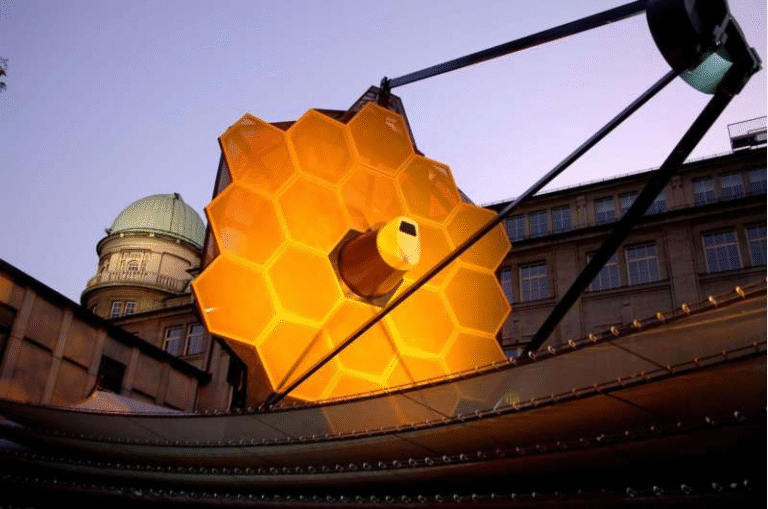
- Space telescopes like Hubble or JWST
- Adaptive optics on large ground-based telescopes
- High-resolution spectroscopy
Confirmation will allow researchers to model the lensing geometry, calculate Einstein radii, and determine precise host galaxy masses.
This is the first major demonstration that machine learning can uncover a significant population of quasar lenses purely from spectral analysis. As techniques improve, astronomers may eventually uncover hundreds of these systems — enough to build powerful statistical samples for studying black hole and galaxy co-evolution.
Research Paper:
Quasars acting as Strong Lenses Found in DESI DR1
https://arxiv.org/abs/2511.02009