Smart Bluetooth Stakes Turn a Utah Wheat Field Into a High-Tech Water-Mapping System
A wheat field in Elberta, Utah has just become one of the most technologically advanced agricultural testbeds on the planet. A team of researchers from Brigham Young University (BYU) deployed 86 solar-powered Bluetooth moisture sensors across a 50-hectare (124-acre) commercial wheat field—an unprecedented scale for this type of experiment. Their goal was simple but ambitious: understand how water actually moves through a large field, minute by minute, and create detailed maps that show exactly where moisture is lacking or overabundant.
These small devices, called Smart Bluetooth Stakes, are designed to gather extremely frequent soil-moisture readings using their two metal prongs inserted into the ground. Each stake is equipped with a credit-card-sized solar panel to power itself long-term, and the entire housing is made waterproof and durable so it can stay outdoors for months. The stakes are intentionally kept low to the ground so that tractors and other farm equipment can pass right over them without disturbing the sensors.
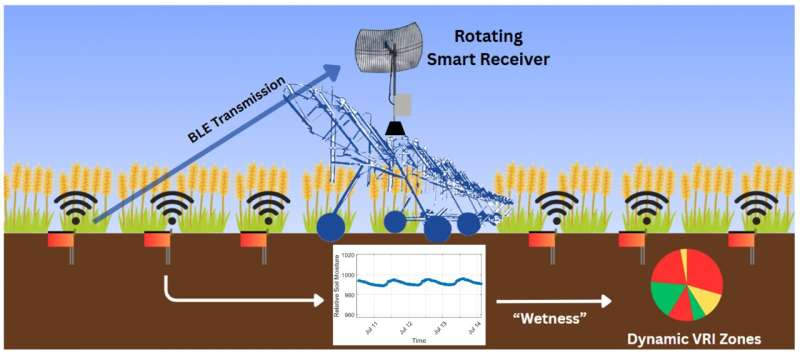
Even though these devices run on the same kind of microchips found in everyday Bluetooth earbuds, the engineering team has turned them into long-range agricultural tools. Instead of forming a traditional mesh network or needing acknowledgment packets, the sensors broadcast unacknowledged BLE signals containing a history of soil-moisture data. These signals are then captured by a Smart Receiver mounted on the arm of a center-pivot irrigation boom.
One of the most significant findings from the field test was how much better the system performed after the team upgraded the receiver with a high-gain parabolic antenna. With this new antenna, the receiver’s maximum data-collection range improved from 300 meters to approximately 600 meters, allowing it to capture readings much more reliably from distant stakes. During the irrigation cycles, the system successfully collected data from 75 of the 86 deployed stakes, and after harvest, all 86 devices were still physically intact.
This experiment is a part of Ph.D. student Samuel Craven’s dissertation work and involved collaboration across multiple departments. BYU electrical engineering professor Brian Mazzeo spearheaded the project, working with colleagues including plant and wildlife sciences professor Neil Hansen and geography professor Ruth Kerry. Together, they explored not just the technology behind the sensors, but broader questions such as how many sensors are needed to meaningfully monitor soil conditions across large landscapes.
The team chose Bluetooth because it’s inexpensive, accessible, wavelength-appropriate, and energy-efficient. However, the project goes beyond simply using common hardware—it seeks to determine how dense a sensor network needs to be in order to produce accurate, actionable water-distribution maps. This is an important challenge, because farmers in drought-prone regions like Utah need better tools to decide when, where, and how much water to apply. Being able to track soil-moisture at a very fine scale could dramatically improve water efficiency, reduce waste, and support sustainable crop production in regions facing long-term water shortages.
The stakes gather data at intervals as frequent as every minute, creating a continuously updated picture of how moisture moves through the soil. When combined, these readings form spatiotemporal maps that show patterns farmers have never been able to see before. This kind of detailed mapping highlights the non-uniform reality of soil hydration. Even within a single field, soil type, plant density, elevation changes, and microclimates can cause large variations in water retention.
Traditional moisture-testing methods—such as spot-checking a few sample locations—miss most of these subtleties. But when a field contains dozens or even hundreds of sensors broadcasting thousands of readings per hour, researchers can observe how water spreads (or fails to spread) across large agricultural landscapes in real time.
The system’s long-term goal is to enable automatic irrigation adjustments based on real data. With enough sensors and a reliable receiver, future irrigation systems could automatically increase or decrease water flow in specific areas of a field. Instead of watering uniformly, smart irrigation could target dry zones while reducing water in already saturated ones. For a region like the American West—where drought is a constant issue—this kind of precision irrigation could be transformative.
As of now, the Smart Bluetooth Stakes are still in the research phase, but they show strong promise for scalability. Each unit is designed to be low-cost, compact, and easy to mass-produce, making it realistic for farmers to deploy hundreds of sensors without a prohibitive investment. Future improvements may include stronger power generation, enhanced durability, more stable wireless transmission, and compatibility with deeper soil-moisture probes.
The system also survived real-world farming conditions. Throughout the growth and harvest cycle, the sensors endured weather changes, sun exposure, irrigation, soil movement, and mechanical farming operations. Their durability suggests they could handle an entire season without replacement, which is a key requirement for any practical agricultural tool.
The project was conducted by an interdisciplinary team because efficient water management isn’t just an engineering issue. It intersects with agronomy, ecological science, and geographic analysis. For example, the team’s geography specialists helped interpret moisture patterns across the landscape, while plant scientists analyzed how those patterns related to crop health.
This kind of cross-disciplinary approach is essential because water usage in agriculture is not simply a technological problem—it’s tied to plant biology, soil chemistry, climate stress, and farming economics. A technology like Smart Bluetooth Stakes is most useful when it seamlessly becomes part of the larger ecological and agricultural system.
Beyond the immediate research outcomes, this project also contributes to a larger conversation about precision agriculture. Farmers around the world are looking for ways to increase crop yields while using fewer resources—especially water, fertilizer, and energy. Ultra-dense sensor networks represent one potential pathway to smarter, more efficient agriculture.
Additional Context: How Soil-Moisture Sensors Help Modern Farming
Soil-moisture sensors are becoming increasingly important in sustainable farming. They measure volumetric water content, or how much water is actually stored in the soil. Different sensors use different sensing methods—capacitive, resistive, neutron probes, and TDR (time-domain reflectometry). The Smart Bluetooth Stakes use capacitive sensing, which is inexpensive and energy-efficient, making it suitable for large-scale deployments.
Accurate soil-moisture data helps farmers:
- Reduce water waste by avoiding unnecessary irrigation
- Improve crop yields by preventing water stress
- Save energy, since pumping water requires electricity or fuel
- Avoid soil erosion and nutrient leaching
- Predict irrigation schedules more precisely
Precision irrigation works best when moisture data is collected at many points across the field. A single sensor cannot represent an entire 50-hectare plot, because soil conditions vary widely even within small distances.
The Smart Bluetooth Stake system pushes this concept further by showing how hundreds of low-cost sensors can outperform a handful of expensive traditional units. Instead of sampling a field sparsely, it maps it densely—similar to going from a few weather stations to a full meteorological satellite image.
Additional Context: Why Bluetooth Works Surprisingly Well for Farming
Bluetooth may seem like an unexpected choice for agricultural sensors, but it offers some real advantages:
- Ultra-low energy consumption, ideal for solar-powered devices
- Cheap, easily available components
- Short, efficient broadcast packets
- Good enough range with the right antenna enhancements
- Compatibility with many receivers and software tools
The BYU team’s biggest breakthrough was improving the receiver antenna. Their parabolic antenna—passive and low-cost—dramatically extended the system’s detection range. Rotating this antenna along the path of a center-pivot irrigation boom lets it scan the entire field, picking up broadcasts from different angles.
Future systems may even integrate machine learning, using the collected data to predict soil-moisture changes and optimize irrigation automatically.
Additional Context: The Challenge of Farming in the American West
Much of the Western United States faces chronic water scarcity. Snowpack levels in the Rocky Mountains—which feed rivers and aquifers—have been decreasing for decades. Utah, where this field test took place, regularly experiences drought conditions. Farmers must balance crop demands with limited water availability. Tools like Smart Bluetooth Stakes can help farmers maintain healthy crops while conserving an increasingly precious resource.
Research Paper Reference
Smart Bluetooth Stakes: Deployment of Soil Moisture Sensors with Rotating High-Gain Antenna Receiver on Center Pivot Irrigation Boom in a Commercial Wheat Field
https://doi.org/10.3390/s25175537