Hurricane Rainfall Can Push Sea Anemones Beyond Their Limit, New Study Finds
A new study published in 2025 takes a close look at how sudden drops in seawater salinity—often caused by heavy hurricane rainfall—affect the sea anemone Exaiptasia diaphana, a model organism frequently used to understand coral biology. As climate change drives stronger hurricanes and more intense coastal rainfall, this research offers timely insights into how marine life copes with rapid environmental shifts.
Two high school researchers from Virginia designed an experiment to simulate the kinds of salinity fluctuations that occur when large amounts of freshwater enter the ocean during and after storms. Their goal was simple and straightforward: find out how organisms that resemble corals respond physiologically when their environment swings from normal salinity to hyposalinity, a condition where the salt content drops sharply. This matters because coral reefs—home to more than 25% of marine species—can suffer bleaching, starvation, and death when exposed to such stress.
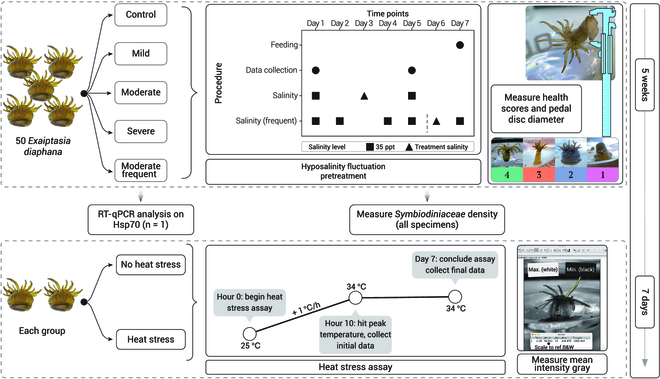
The scientists conducted a five-week experiment using 50 E. diaphana anemones. These anemones were divided into five groups, each subjected to different patterns and levels of salinity fluctuation. Some groups experienced mild shifts, while others endured severe and frequent drops in salinity. After five weeks of this regimen, the researchers randomly selected one anemone from each group for detailed physiological testing. The remaining anemones were analyzed for Symbiodiniaceae, the essential algal partners that support their photosynthetic activity. A reduction in these algal symbionts is a key sign of stress, often preceding bleaching.
Once the initial assessments were complete, half of the anemones from each group were subjected to heat stress, a common method used to test thermotolerance. Throughout the study, the researchers meticulously recorded health markers such as growth, coloration, symbiont levels, and survival rates.
The results were clear and revealed a threshold-dependent response. Anemones exposed to moderate salinity changes showed signs of resilience. They maintained healthier levels of Symbiodiniaceae and even displayed improved thermotolerance, which the researchers linked to elevated levels of Hsp70, a heat-shock protein associated with stress response. In these cases, the stress seemed to activate protective mechanisms that helped the anemones adapt.
However, once the salinity dropped past a critical threshold—specifically 20 parts per thousand (ppt)—those protective mechanisms began to fail. Anemones in the severe-fluctuation groups showed the least growth, highest mortality, and poor overall health. Their symbiont levels fluctuated dramatically, and the bleaching risk increased significantly. It became clear that while moderate stress can sometimes stimulate adaptive responses, extreme or repeated stress overwhelms the organism’s ability to cope.
The researchers say these findings have meaningful implications for real-world coral reef conservation. As hurricanes intensify due to warming oceans, coastal regions will likely experience more frequent and more severe drops in salinity. These freshwater pulses, combined with rising temperatures, could harm coral ecosystems far beyond the immediate impact zone of the storm. Unlike wind damage, which is localized, the effects of low-salinity rainfall and runoff can spread widely and linger long after the storm has passed.
This study builds on the idea that corals and coral-like organisms are sensitive to multiple overlapping stressors. While a single stressor might be manageable, the combination of hyposalinity, heat, and frequency of disturbance can produce cascading and often irreversible damage. Understanding these interactions is essential for designing effective conservation strategies.
The authors emphasize the need for real-world field studies to complement their lab findings. Laboratory experiments allow precise control of conditions, but they cannot fully replicate all the fluctuations and complexities of natural marine environments. Future work could explore how salinity stress interacts with other storm-related factors such as acidification, increased sediment load, or changes in water flow. The researchers hope their work will help broaden the conversation about what truly threatens coral reefs and encourage the development of protective measures that account for these under-recognized stressors.
Additional Insight: Why Exaiptasia diaphana Matters in Coral Research
Although this study focused on sea anemones rather than hard corals, Exaiptasia diaphana plays a crucial role in coral research. It is considered a “model organism” because it shares a similar symbiotic relationship with Symbiodiniaceae, the algae responsible for giving corals their energy through photosynthesis. But unlike reef-building corals, E. diaphana is easy to maintain in laboratory settings, reproduces quickly, and survives without a calcium carbonate skeleton. This makes it an excellent stand-in for experiments that would otherwise be difficult or impossible to perform on actual coral colonies.
Researchers worldwide use E. diaphana to study bleaching, symbiont dynamics, thermal tolerance, and stress responses. Insights gained from these anemones often guide and inform coral conservation efforts. However, it’s also important to remember that real coral reefs are more complex, influenced by a combination of biological interactions, geological structures, and diverse environmental pressures that a single species in a lab cannot fully replicate.
Understanding Hyposalinity and Its Effects on Marine Life
Hyposalinity occurs when freshwater dilutes ocean water, lowering its salt concentration. This can happen during heavy rain events, floods, storm surges, and, as highlighted in this study, hurricanes. While marine organisms are adapted to stable salt levels, rapid or extreme changes can disrupt their internal osmotic balance. This leads to physiological stress, bleaching, interruptions in growth, reduced reproductive success, and in severe cases, death.
Many coastal ecosystems—including mangroves, coral reefs, eelgrass meadows, and oyster beds—are vulnerable to salinity fluctuations. When sudden freshwater influxes occur, organisms must quickly adjust to avoid harmful water movement across cell membranes. Some species handle this better than others. For example, oysters may tolerate short-term low salinity but fail when exposed for extended periods. Corals, on the other hand, are generally much more sensitive.
This makes the increasing intensity of tropical storms a major issue. Stronger hurricanes bring more rainfall, and more rainfall means more runoff entering coastal waters. As a result, hyposalinity events that were once rare can become regular occurrences. This study’s documentation of a clear salinity threshold gives scientists a starting point for identifying when and where intervention might be needed.
Why This Research Matters Now
Coral reefs around the world are already dealing with mass bleaching events, warmer oceans, and acidifying waters. Salinity fluctuations may seem like a minor factor by comparison, but the study shows that they can undermine the very mechanisms corals use to recover from heat stress. As environmental pressures stack on top of one another, reefs face a greater risk of crossing tipping points where recovery becomes unlikely.
By revealing how sea anemones respond to hurricane-driven salinity changes, the researchers highlight a pathway through which climate change may cause damage that is widespread and persistent—not just localized storm destruction but long-lasting environmental instability.
The team hopes their findings inspire more research into how rainfall, runoff, acidity, and wind impacts combine, producing cumulative effects that exceed the damage of any single factor. A more holistic understanding of reef–environment interactions could help guide conservation strategies that are proactive instead of reactive.
Research Paper
Discovery of a Threshold-Dependent Response in Exaiptasia diaphana to Repeated Hyposalinity Stress Simulating Hurricane-Driven Coastal Conditions
https://doi.org/10.34133/olar.0113