Simple Enrichment Tools Are Improving the Health and Welfare of Stabled Horses, According to New UC Davis Research
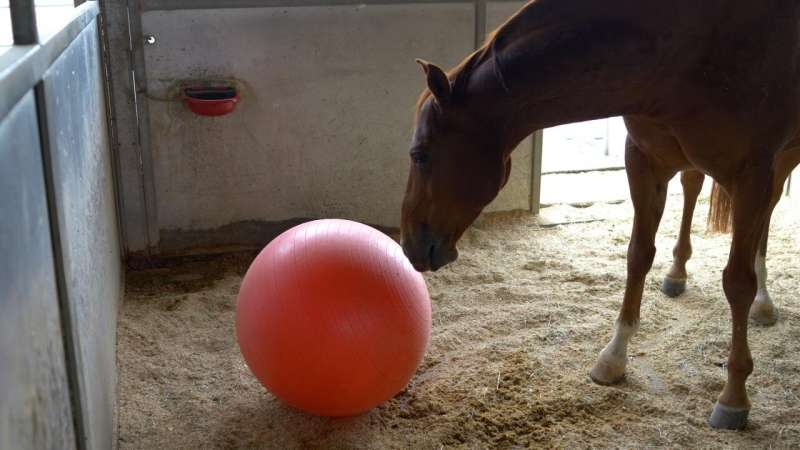
A new study from the University of California, Davis is shedding light on how basic enrichment tools—including hay feeders, large rubber activity balls, and shatter-proof mirrors—can significantly improve the daily lives, behavior, and physical health of stabled horses. The research appears in the journal Animals and offers a clear, practical look at how small, inexpensive additions to a stall can make a measurable difference for horses that spend most of their time in confined spaces.
What the Researchers Wanted to Understand
Horses in the wild typically walk up to 20 miles a day and spend large portions of their time grazing, roaming, and interacting with their environment. In contrast, stabled horses often stand still for long stretches, have limited foraging opportunities, and receive food at fixed times rather than continuously. Their natural instincts do not simply disappear when their environment changes, and this mismatch can lead to stress, boredom, digestive problems, fragile leg bones, and various frustration behaviors.
The UC Davis team wanted to test whether simple enrichment items could stimulate natural behaviors, reduce stress-related actions, and improve overall well-being in everyday stable settings. The goal was not to rely on assumptions but to gather physiological data, behavioral observations, and clear comparisons with and without enrichment present.
How the Study Was Conducted
The research involved nine competition horses—American Quarter Horses and American Paints—living at the UC Davis Equestrian Center. Every horse was equipped with smart halters designed to record heart rate and respiratory rate, giving researchers a way to track emotional and physical responses in real time.
For four weeks, horses were observed four times each day, and enrichment items were introduced during these sessions. In total, the project involved 720 hours of video footage, reviewed by student athletes, volunteers, and lead researcher Miranda Brauns, who completed the project as part of her master’s studies.
Three specific enrichment tools were tested:
- Hay feeders, which encourage foraging behaviors.
- Giant rubber activity balls, often known as jolly balls, providing physical engagement.
- Shatter-proof mirrors, offering visual stimulation.
The timing of enrichment was also important, especially during midday hours when horses were not receiving food. These periods are when boredom and frustration tend to rise in stabled animals.
The study also noted which horses preferred which tools. For example, mares generally disliked mirrors, while geldings showed more interest. One particular horse—referred to as horse number 39—picked up the giant activity ball and moved it around, showing unusually high engagement.
What the Researchers Found
The results were consistent across both physiological and behavioral data:
- Heart rates increased when enrichment was provided, showing heightened engagement rather than stress.
- Movement levels increased, with horses showing more interest in their surroundings.
- Grazing and foraging behaviors rose, especially with hay feeders.
- Frustration behaviors decreased, including tail swishing, kicking, and stomping.
One of the major findings was the importance of timing. When enrichment was offered between meals, horses showed the biggest improvement in mood and activity levels. This suggests that enrichment is most effective when horses would otherwise be waiting, idle, or anticipating something.
Hay feeders in particular stood out by encouraging more natural grazing patterns, similar to what horses exhibit in the wild. This is essential not only for mental engagement but also for reducing the risk of ulcers and supporting digestive health, since horses are naturally adapted to eat small amounts frequently rather than consuming large meals a few times a day.
Support and Contributions
The research was guided by animal science associate professor Amy McLean and conducted in partnership with the UC Davis Intercollegiate Equestrian Team, who assisted with behavioral monitoring and handling. Additional contributions came from researchers Ahmed Ali at Clemson University and Jeannine Berger at Sacramento Veterinary Behavior Services.
Why These Findings Matter
This study highlights a major concern in equine care: even with excellent nutrition and clean stalls, horses can still experience boredom, stress, and behavioral issues if their environment lacks stimulation. The results show that owners and stables don’t need expensive technology or large-scale facility changes to improve welfare. Simply introducing affordable, low-maintenance tools can reshape a horse’s daily experience.
For professionals who work with horses in competition, veterinary care, or rehabilitation, these findings provide actionable insights. The use of enrichment tools can support better mental and physical health, potentially leading to improved performance, more stable behavior, and reduced risk of injury or stress-related conditions.
Additional Useful Information About Horse Enrichment
While this study focuses on hay feeders, balls, and mirrors, enrichment for horses can take many forms. Understanding how horses perceive their environment helps explain why enrichment matters.
Why Horses Need Constant Stimulation
Horses evolved as prey animals, which means their bodies and minds are structured for:
- constant scanning of the environment
- steady walking and grazing
- social interaction within herds
- quick responses to threats
When confined to a small space without stimulation, their natural patterns have nowhere to manifest. This can lead to:
- cribbing
- weaving
- stall walking
- biting or kicking walls
- digestion issues from unnatural feeding schedules
Enrichment helps recreate elements of the wild environment, especially continuous foraging and sensory engagement.
Types of Enrichment Not Covered in the Study
Outside the tools used in the UC Davis research, horse owners frequently use:
- Hanging treat balls with small openings to slow consumption
- Scent-based enrichment, such as herbal bundles
- Rotating toy systems, so horses don’t get bored with a single object
- Different textures for horses to explore
- Auditory enrichment, such as calm music (the study briefly played Beethoven’s Symphony No. 9, though that portion wasn’t included in the published paper)
While not all tools work for all horses, offering variety is key. Horses, like humans, have individual preferences, and what excites one may not interest another.
Benefits for Horse Owners and Facilities
Using enrichment can also reduce the workload on stable staff by lowering the frequency of undesirable behaviors and supporting healthier, calmer horses. This means:
- less risk of self-injury
- cleaner stalls
- fewer fence-chewing or wall-kicking incidents
- more predictable behavior during feeding and training
These are important advantages for facilities that house many horses or manage competitive animals with strict schedules.
Looking Ahead
The research team noted the need for long-term studies involving larger groups of horses. While the results are promising, understanding how enrichment affects long-term bone strength, ulcer incidence, chronic stress levels, and overall longevity will require further investigation.
Still, this study sets a strong foundation and offers immediate, low-barrier solutions for improving daily equine welfare.
Research Paper Reference
Physiological and Behavioral Responses of Stabled Horses (Equus caballus) to Three Types of Environmental Enrichment
https://www.mdpi.com/2076-2615/15/19/2779