Prescribed Burning in the Sierra Nevada Helps Forests Store More Stable Carbon Over Time
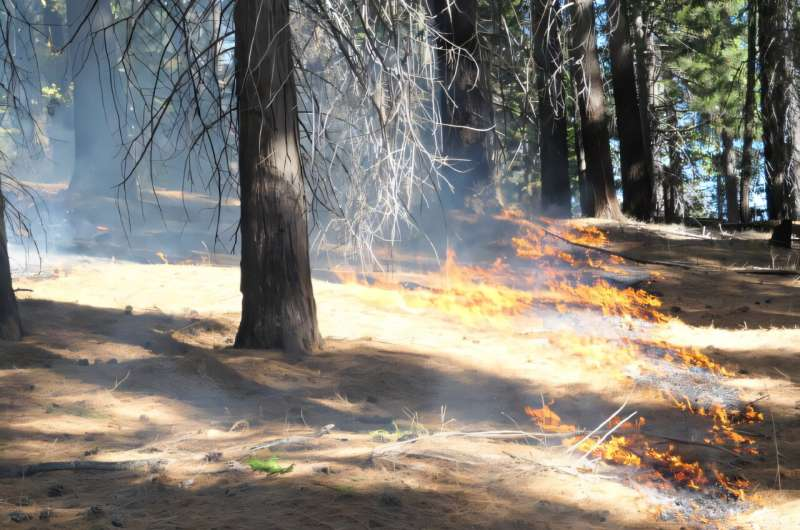
A new long-term study from the Sierra Nevada offers some clear and surprisingly hopeful insights into how prescribed burning affects forest carbon storage. While many people understandably worry about the carbon released when land managers intentionally burn vegetation, this research shows that regular, low-intensity fires can actually help forests maintain — and even regain — their long-term carbon-holding power. The findings come from a rare two-decade experiment at UC Berkeley’s Blodgett Forest Research Station, where scientists have been tracking how different forest management approaches shape carbon storage, wildfire risk, and ecosystem health.
To understand why this matters, it helps to remember the context: California’s forests have gone through more than a century of fire suppression. Fires that once occurred naturally and frequently were eliminated, allowing dense growth of small, shade-tolerant trees like incense cedar and white fir. These trees pack into the understory, creating what researchers call a fuel ladder — a vertical arrangement of vegetation that can easily carry a mild ground fire up into the canopy, triggering the severe wildfires that have become all too common.
The new study, published in Ecological Applications, takes a close look at how prescribed fire, mechanical thinning, and various combinations of the two influence carbon storage in these altered forests. The results offer a blend of nuance and clarity that policymakers, land managers, and climate-minded readers can use to understand the trade-offs at play.
What the 20-Year Study Found
Researchers tracked different carbon pools, including carbon stored in large trees, smaller vegetation, shrubs, surface fuels, and soil. They also measured how carbon leaves the system — through burning, decomposition, and other pathways. This is as comprehensive a carbon accounting effort as you can get in a real forest setting.
Several key results stood out:
1. Control plots stored the most carbon overall
Forests that were left untouched — the “control” plots — held the highest total carbon throughout the study. This makes intuitive sense because nothing was removed or burned. However, these stands also became more crowded and less productive over time.
2. Productivity declined in unmanaged stands
Over two decades, the growth and net productivity of the control plots slowed significantly. Increased tree density means more competition for water, nutrients, and sunlight. Add rising climate stress — hotter droughts, limited moisture — and these forests stagnated.
By the end of the study, control plots were barely accumulating new carbon each year.
3. Prescribed burning boosted long-term productivity
The real surprise came from the plots that had three rounds of prescribed burning. Initially, these areas looked worse — the first burn reduced productivity sharply and released noticeable amounts of carbon. But over time, the pattern flipped.
By the third burn cycle (over 20 years), these fire-treated plots had become far more productive than the unmanaged ones. Their annual carbon uptake nearly canceled out the earlier losses from burning.
This happened because low-intensity fires removed small, fire-susceptible trees and fuels, giving larger, fire-resistant species like ponderosa pine and sugar pine more room and resources to grow.
4. Prescribed fire created “stable carbon”
On a pure numbers basis, treated plots still stored less total carbon than the untouched plots. But here’s the crucial twist: the carbon in the treated forests was held in large, fire-resistant trees that are significantly less likely to be destroyed in wildfires or disease outbreaks.
Researchers refer to this as stable carbon — carbon that is more secure over the long-term because it is stored in resilient parts of the ecosystem.
5. Mechanical thinning plus fire had the highest carbon cost
A separate earlier analysis from the same research site found that combining mechanical thinning with prescribed burning is extremely effective at reducing wildfire hazard quickly. However, it also carries the highest carbon penalty. Heavy thinning removes biomass directly, and prescribed fire adds additional carbon release.
For high-priority areas — near communities or sensitive groves — this combo may be necessary. But in remote forests, prescribed fire alone may be the better carbon-smart choice.
Why These Findings Matter
California has set a target of achieving net-zero carbon pollution by 2045. Forests are one of the most powerful natural tools for achieving that goal, but only if they can retain their carbon stores over the long term. A forest that loses massive amounts of carbon in a megafire doesn’t contribute to climate mitigation — it becomes a major source of emissions.
This study underscores an important reality:
It’s not just how much carbon a forest stores — it’s how safe that carbon is.
Untreated forests store more total carbon in the short term, but much of it is bound up in structures that can be lost quickly and catastrophically. Managed forests store somewhat less carbon overall, but a larger share of it is located in large, sturdy trees that are far more likely to survive fire.
This approach aligns with what climate scientists increasingly call nature-based climate solutions — strategies that take advantage of ecosystems’ natural resilience, rather than relying solely on technological fixes.
Additional Background: Why Prescribed Fire Works
Many readers may be curious about how intentionally setting fires can lead to better forest outcomes, especially in a warming climate. Here are some key ecological mechanisms that make prescribed burning effective:
It prevents fuel buildup
Without periodic burning, flammable materials — fallen branches, needles, shrubs — accumulate rapidly. This turns forests into tinderboxes.
It favors fire-adapted species
Species like ponderosa pine evolved with frequent surface fires. Their thick bark and spreading crowns allow them to survive low-intensity burns.
It restores healthier forest structure
Prescribed fire reduces tree density, increasing spacing between trees and lowering competition.
It interrupts the “fir-ification” process
Shade-tolerant species such as white fir flourish under suppression but are far less fire-resistant. Removing them helps restore historical species composition.
It reduces the chance of catastrophic crown fires
The biggest danger comes when flames reach the canopy. Low-intensity fires prevent small trees from forming vertical fuel ladders.
This ecological reasoning supports the long-term findings of the Blodgett Forest experiment.
What This Means for Forest Management Going Forward
The study highlights several practical pathways for communities and land managers:
1. There’s no one-size-fits-all approach
Different areas have different priorities.
- Near neighborhoods or infrastructure: thinning + burning may be the safest option.
- In wilderness or remote areas: fire-only management may offer the best carbon-fire balance.
2. The carbon cost of prescribed fire is temporary
Carbon is released upfront, but long-term productivity and stability increase over time.
3. The biggest risk is doing nothing
Unmanaged forests may store more carbon today, but they are also far more likely to lose that carbon rapidly in a wildfire.
4. Decisions must weigh both short- and long-term carbon dynamics
Focusing only on immediate carbon numbers misses the bigger picture.
5. This research is rare — and valuable
Very few forest experiments run for 20 years with consistent measurements. That makes these results especially meaningful for climate planning.
Research Reference
Carbon costs of different pathways for reducing fire hazard in the Sierra Nevada (Ecological Applications, 2025)
https://doi.org/10.1002/eap.70111