New Study Shows PRRSV Vaccines Rely on T Cell Immunity for Protection
A new study published in early 2025 sheds important light on how pigs actually gain protection from porcine reproductive and respiratory syndrome virus (PRRSV) — one of the most damaging and expensive viral diseases in the pork industry. The research makes a clear case: current PRRSV vaccines work mainly because they trigger strong T cell responses, not because they generate effective virus-neutralizing antibodies. This discovery is significant because it helps explain why vaccines still provide some level of protection even though PRRSV mutates extremely quickly.
PRRSV remains one of the most costly and stubborn diseases affecting pig farming worldwide, consistently causing economic losses estimated at over $1 billion every year. Despite the availability of modified-live vaccines, their performance has always been mixed and somewhat unpredictable. The rapid evolution of PRRSV means vaccinated pigs often fail to produce neutralizing antibodies that recognize modern circulating strains. Yet farmers and veterinarians still see partial protection in the real world. Until now, the main question was: why do the vaccines help at all if the antibody response doesn’t match the virus?
The research team, led by Michael Rahe of North Carolina State University, set out to test exactly which parts of the immune system are responsible for this protection. And the results point decisively to T cell immunity as the key driver.
Understanding Why PRRSV Is So Difficult to Control
PRRSV isn’t just any virus — it is considered one of the fastest-mutating RNA viruses in veterinary medicine. When a virus mutates rapidly, it constantly changes the components (antigens) that antibodies usually target. This means that even if a pig is vaccinated, the antibodies its immune system produces may not recognize the newer versions of the virus circulating on farms.
Antibodies generally act like molecular tags, marking a virus so the immune system can destroy it. When they fail to recognize the virus, that tagging system collapses.
T cells behave differently. They focus on detecting and killing infected cells, and they often target internal viral components that mutate less frequently. Because of that, T cell responses can offer a more broad and durable layer of protection, even when the virus’s surface proteins keep changing.
The new study builds on this idea and provides direct experimental evidence that T cells — not antibodies — are the heroes in PRRSV vaccine effectiveness.
How the Study Was Designed
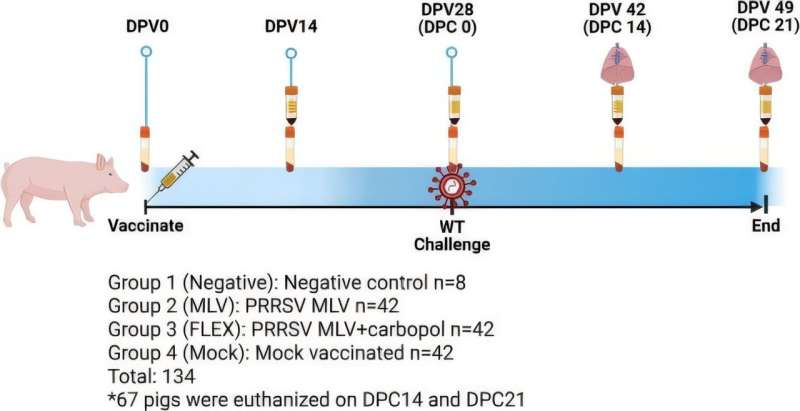
The researchers structured their experiment around four groups of pigs, each serving a specific purpose in understanding how immunity develops:
- Group 1: Unvaccinated and unchallenged pigs — a strict negative control group.
- Group 2: Unvaccinated but exposed to PRRSV — to observe the effects of infection alone.
- Group 3: Vaccinated with one of the most widely used PRRSV modified-live vaccines, then exposed to PRRSV.
- Group 4: Vaccinated with the same PRRSV vaccine combined with a porcine circovirus 2 (PCV2) vaccine, then exposed to PRRSV.
This setup allowed the researchers to observe not just whether the PRRSV vaccine worked, but also whether combining vaccines had any meaningful effect on the immune response.
Using direct detection methods, they measured:
- PRRSV levels in the blood and lungs
- PRRSV-specific T cell activity
- Presence or absence of neutralizing antibodies
- Lung pathology following infection
This multi-layered approach allowed the team to get a complete picture of how the immune system reacts to PRRSV under different conditions.
What the Study Found
The results were remarkably consistent across the vaccinated groups.
Every vaccinated group — whether they received only the PRRSV vaccine or the combined PRRSV + PCV2 vaccine — showed:
- Strong PRRSV-specific T cell responses in blood
- Lower viral levels in the bloodstream
- Lower viral levels in the lung
- Reduced lung damage after infection
- Overall partial but meaningful protection
And here is the crucial part:
The pigs developed this protection without producing neutralizing antibodies that matched the infecting PRRSV strain.
This detail is essential. It confirms that antibodies played almost no role, at least in this scenario. Instead, T cells were responsible for eliminating infected cells and controlling the spread of the virus.
The researchers concluded that current vaccines are helping pigs recognize and attack stable, conserved parts of the virus, the parts that do not mutate quickly. That’s why T cell-based immunity remains effective even when antibody-based immunity breaks down due to viral mutation.
Why These Findings Matter for Future Vaccines
The implications of this research extend far beyond one study.
1. Vaccine design can now focus on conserved viral components
Since T cells tend to recognize parts of the virus that don’t mutate rapidly, future vaccines can be engineered to emphasize these stable regions. This could significantly increase cross-strain protection.
2. A shift in how vaccine success is measured
Traditionally, vaccines are judged by their ability to produce strong antibody responses. But for PRRSV, this standard is misleading. Measuring T cell activation might be a better predictor of true protective immunity.
3. Improved modeling for next-generation vaccines
The study also incorporated machine learning analysis to better characterize immune responses in the lung — the primary site of PRRSV infection. Such high-resolution methods could become standard in veterinary virology.
4. Better control strategies for the swine industry
Farmers may finally see progress toward more consistent and reliable protection, reducing economic losses and improving animal welfare.
Additional Background: Why PRRSV Is a Unique Challenge
To fully appreciate the study’s significance, it’s helpful to understand more about PRRSV itself.
PRRSV’s Mutation Problem
Because of its extremely high mutation rate, PRRSV generates many “escape variants,” making antibody recognition nearly impossible to maintain. This forces vaccine developers to constantly chase new strains, often unsuccessfully.
PRRSV’s Impact on Pig Health
PRRSV affects reproduction and respiratory health — hence the name — and can lead to:
- Late-term abortions
- Stillborn or weak piglets
- Severe respiratory illness in young pigs
- Increased susceptibility to secondary infections
This widespread impact explains the industry’s intense focus on developing stronger vaccines.
T Cell Immunity in Viral Diseases
While antibodies get most of the attention in public discussions about immunity, T cells quietly play an enormous role in many viral infections. They kill infected cells and coordinate the broader immune response. In viruses where rapid mutation hides the pathogen from antibodies, T cells often become the main line of defense.
This study firmly places PRRSV into that category.
The Road Ahead
The authors of the study describe their findings as a foundational step. It does not solve the PRRSV problem overnight — but it clearly identifies a path forward.
Better vaccines will need to:
- Target conserved regions of PRRSV
- Precisely stimulate the right T cell populations
- Maintain safety and practicality for large-scale commercial use
With a clearer scientific roadmap, innovation in PRRSV vaccines could accelerate significantly. If successful, these improvements may eventually reduce the heavy economic burden currently placed on pig farmers around the world.
Research Reference (Study Link):
T cell-mediated clearance of porcine reproductive and respiratory syndrome virus (PRRSV) from the lung characterized by machine learning analysis in vaccinated and unvaccinated pigs
https://doi.org/10.1016/j.vaccine.2025.127793