How Deep-Sea Fishes Evolve into Remarkably Different Body Shapes
The deep sea is often imagined as one endless, dark expanse, but a new large-scale study shows that life thousands of meters below the surface is far more varied—and far more dynamic—than most people think. Researchers analyzed shape data for 2,882 species of deep-sea ray-finned fishes living 200 meters or more below the ocean surface. Their goal was to understand how these fishes evolved such different body plans despite sharing extreme conditions such as cold temperatures, high pressure, and near-total darkness. What they discovered is that deep-sea fish evolution is heavily shaped by where in the deep sea a species lives. Different habitats push evolution in different directions, resulting in highly distinct patterns of body shape and diversity.
The team focused on two major deep-sea habitats: pelagic (open-water) zones and benthic (seafloor) zones. These two environments create dramatically different evolutionary pressures. Pelagic spaces offer openness and unpredictability. Benthic ecosystems, by contrast, are generally calmer, flatter, and structurally simple. These lifestyle differences drive the evolution of different body shapes—and even different rates of evolution—across the deep sea.
The Study Behind the Findings
Researchers used existing datasets containing body shape measurements, evolutionary relationships, and habitat information for deep-sea fishes. By combining all of this information, they were able to understand how body shapes diversified across multiple lineages and depths. Their analysis revealed that increasing ocean depth correlates with greater diversification of body shape, and that evolutionary change happens faster at deeper levels of the ocean.
However, the reasons for these evolutionary patterns differ between pelagic and benthic species. For bottom-dwelling fishes, the fastest evolutionary rates occur at greater depths, but these rapid changes happen mostly within groups of closely related species. These species tend to adapt in place, gradually modifying an already elongate and tapered body plan that works well for muddy, relatively featureless seafloor habitats. The deep seafloor, lacking structures such as coral reefs or kelp forests, does not push fish toward wildly different body shapes. As a result, benthic body types remain relatively consistent, even as species adapt and evolve rapidly.
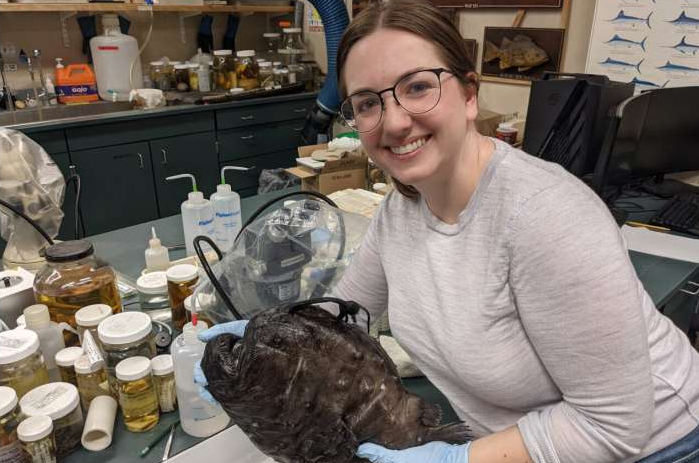
Pelagic fishes show a contrasting pattern: far more diversity of body shapes, but slower evolutionary change within each group. This high diversity is driven not by rapid evolution inside a lineage but by many distantly related species colonizing deep pelagic waters at different times over millions of years. Each newcomer brings its own inherited body plan, resulting in a community composed of very different forms—from round, blobby anglerfishes to extremely slender eels. The pelagic deep sea seems open to newcomers, letting many evolutionary experiments coexist side by side.
Why Darkness Matters
One of the biggest influences on deep-sea fish evolution is darkness. Light barely penetrates below 200 meters, making photosynthesis impossible and altering how animals search for food. Unlike shallow-water pelagic predators such as tuna—strong, fast swimmers capable of speed bursts—the deep pelagic realm is dominated by species that wait for food to come to them. They often drift or remain motionless, relying on low-energy hunting strategies that allow for a wide variety of body shapes.
Different shapes work in darkness. A fish doesn’t need a streamlined, torpedo-like form if it isn’t pursuing prey at high speed. As long as it can conserve energy and detect food, unusual shapes are perfectly acceptable from an evolutionary standpoint. This helps explain why the deep pelagic zone contains some of the ocean’s most bizarre silhouettes.
Darkness also changes the seafloor environment. Without photosynthetic organisms, there are no coral reefs, kelp forests, or seagrass beds—no complex surfaces, hiding places, or structured ecosystems that would encourage fishes to evolve specialized shapes for maneuvering. Instead, the deep seafloor is often flat, open, and muddy, which encourages more uniform body plans among benthic species.
A Rare Look Into Earth’s Largest Habitat
The deep sea covers nearly 90 percent of the ocean’s volume, yet it is the least explored ecosystem on Earth. This study demonstrates that the deep sea is not a single homogeneous space but a patchwork of habitats, each shaping evolution in its own way. Pelagic species diversify through colonization and coexistence of distantly related lineages. Benthic species diversify through fast evolution within families, but the range of possible body shapes remains narrower.
This distinction helps scientists understand why certain deep-sea fishes look so extraordinary while others appear relatively similar. It also emphasizes that evolution operates differently depending on where a species lives, even under equally extreme conditions like crushing pressure and total darkness.
Additional Information About Deep-Sea Fish Diversity
To give more context, here are some broader insights about deep-sea fish biology that help explain the findings in the study:
Unique Adaptations for Life Under Pressure
Deep-sea fishes have special adaptations that support survival in conditions humans consider extreme. Many species have reduced skeletal density, making their bodies more flexible under pressure. Others have gelatinous tissues, which reduce energy expenditure and help with neutral buoyancy. These traits are more common in pelagic fishes, consistent with the study’s finding of highly diverse body shapes in open-water species.
Energy Conservation Is Essential
Food is scarce in the deep sea, especially below the zones where organic matter sinks quickly. As a result, many deep-sea fishes evolve low-energy lifestyles. Large eyes, bioluminescent organs, wide jaws, and expandable stomachs are some of the adaptations that help them seize rare feeding opportunities. These characteristics also interact with body shape—for example, the enormous mouths of some pelagic species contribute to their famously strange silhouettes.
Colonization Patterns in the Deep Pelagic
The idea that many unrelated lineages moved into deep pelagic environments at different times is supported by other research on fish evolution. Open-water zones have fewer physical barriers, making them easier to access for species migrating vertically through the ocean. Over evolutionary time, this has allowed a mosaic community to form—exactly the pattern the study observed.
Benthic Specialization
Although benthic environments do not encourage a wide variety of shapes, they do encourage functional specialization. Many seafloor fishes develop sensory barbels, camouflage adapted to muddy bottoms, or specialized fins that act like supports for resting on sediment. Their body shapes are similar, but their behaviors and feeding strategies can be highly refined.
Why This Study Matters
Understanding deep-sea evolution is important for several reasons. As interest in deep-sea mining and resource extraction grows, scientists need detailed knowledge of how deep-sea species are related and how they adapt. Diverse body shapes reflect diverse ecological roles, and disturbance to deep-sea habitats could have unpredictable effects on evolutionary pathways that have developed over millions of years.
Additionally, this research helps dispel the misconception that the deep sea is biologically dull. Instead, it is a rich, dynamic, and surprisingly diverse environment shaped by habitat type, colonization history, and the evolutionary flexibility of marine life.
Research Paper
Distinct evolutionary signatures underlie body shape diversity across deep sea habitats
https://doi.org/10.1093/evolut/qpaf207