Hawaiian Short-Finned Pilot Whales Need Thousands of Squid Each Year to Stay Energized
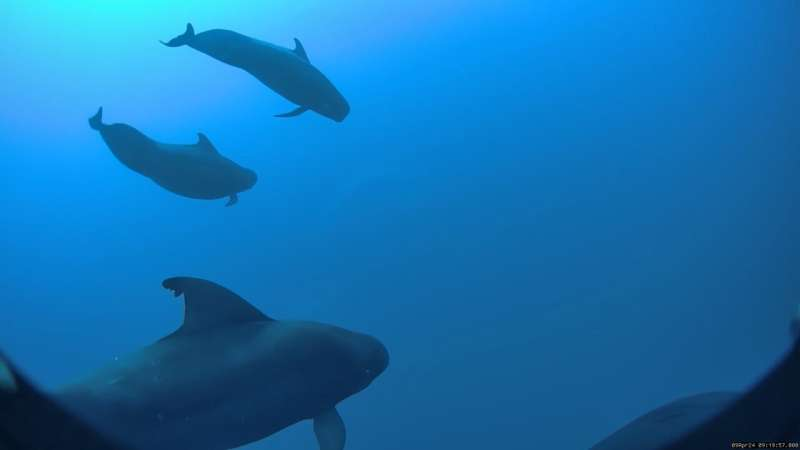
New research has finally answered a long-standing question about how much squid short-finned pilot whales in Hawai‘i actually eat—and the results are both fascinating and surprisingly reassuring for the species. Scientists from the United States, Spain, Australia, and Denmark have documented the energetic demands of these deep-diving whales in unprecedented detail, revealing exactly how many squid they consume, how often they dive, how much energy they expend, and what this means for the broader marine ecosystem.
This extensive study, published in the Journal of Experimental Biology, offers the clearest picture yet of the daily survival requirements of the short-finned pilot whale (Globicephala macrorhynchus), especially those inhabiting Hawaiian waters. Despite being widely distributed in tropical and subtropical oceans, these whales remain one of the least understood deep-diving species—particularly in the Pacific. This research changes that.
How Researchers Tracked Whale Behavior in the Open Ocean
To uncover the energetic demands of these whales, the research team headed out into the Pacific Ocean equipped with suction-cup biologging tags, drones, and a lot of patience. The tags were attached to eight Hawaiian short-finned pilot whales. Because these whales are fast and relatively small, scientists had to wait for the perfect moment to place each tag behind the blowhole—secure enough to hold during dives, yet able to detach safely later.
Each tag carried a suite of sensors, including:
- Motion sensors to track body movement
- A camera with built-in lights to capture interactions at depth
- Hydrophones to record echolocation clicks during hunting
- GPS to log movement and location
The team also flew drones 25 meters above each whale to record body size, which is essential for calculating energy expenditure. Once attached, the tags recorded the whales’ intense diving patterns until they eventually detached and drifted—sometimes as far as 50 miles away—before being retrieved.
During these tagging sessions, researchers collected data on 118 deep dives, reaching depths of up to 864 meters. On average, each whale made around 39 dives every day.
Calculating Energy Use and Estimating Squid Consumption
To understand food needs, researchers had to measure energy output. Using tail-beat patterns and dive data, they calculated that the whales expend:
- 73.8 kJ per minute while diving
- 44.4 kJ per minute at the surface
With those numbers, the team next had to determine how much energy the whales gained by eating squid. That meant identifying hunting behavior within the audio recordings. Echolocation clicks change when a whale homes in on prey, creating what scientists call a “buzz”—a rapid series of clicks during the final attack. By counting these buzzes, they estimated that whales catch around four squid per deep dive.
Each squid was calculated to provide about 560 kJ of energy once digested. Based on all the available data, the researchers concluded that each whale needs to consume between 82 and 202 squid every single day. On an annual scale, this adds up to roughly 73,730 squid per whale per year.
What This Means for the Entire Hawaiian Population
Scientists estimate that the Hawaiian short-finned pilot whale population numbers up to 8,000 individuals. When the daily consumption of each whale is multiplied across the whole group, the result is staggering:
Together, the population eats around 88,000 tons of squid each year.
Despite this massive number, the researchers describe it as “a drop in the ocean” in terms of the total squid available in the region. Current data shows that squid populations around Hawai‘i are healthy, and the whales have access to more than enough prey to meet their energetic needs.
This is good news. It suggests that Hawaiian pilot whales are flourishing, supported by a consistent, abundant, and predictable food source.
Why Understanding Daily Food Needs Matters
Knowing the exact amount of prey a species requires is a fundamental part of conservation biology. Without this knowledge, it’s nearly impossible to predict how a species will respond to changes in the environment—whether due to climate shifts, fishing pressures, or alterations in prey availability.
Short-finned pilot whales rely heavily on deep-sea squid. They are powerful divers, reaching depths beyond 1,700 meters in some regions, although the Hawaiian whales in this study were recorded at a maximum of 864 meters. Deep diving demands enormous energy, so any decline in prey availability forces whales to work harder, dive more often, or travel farther—each of which could lead to long-term stress.
The Hawaiian population has been labeled data-deficient by conservation groups because researchers have historically lacked detailed information on their foraging behavior, reproduction, and threats. This study helps fill that gap and provides a baseline for future monitoring.
What Makes Short-Finned Pilot Whales So Unique?
To add more context for readers, here’s a brief overview of what makes these animals stand out:
They Are Among the Deepest Diving Dolphins
Short-finned pilot whales belong to the dolphin family, not the baleen whale family. They are capable of extraordinary deep dives, chasing prey into near-darkness where pressure is immense and temperatures are cold.
They Live in Strongly Bonded Social Groups
These whales live in tight-knit pods, often consisting of dozens of individuals. Social relationships can last a lifetime, and pods show complex cooperative behavior.
They Rely on Sophisticated Echolocation
Because they hunt in deep, dark waters, pilot whales depend heavily on echolocation—producing sound waves and interpreting the returning echoes. Their ability to track squid at high speed in near-zero visibility is remarkable.
They Are Known for Mass Strandings
Pilot whales are among the species most prone to group strandings. Scientists believe their strong social bonds may contribute: if one whale becomes disoriented or sick near shore, others may follow.
Their Diet Varies by Region
While Hawaiian pilot whales primarily eat squid, populations elsewhere have more varied diets, sometimes including fish such as mackerel, cod, or other cephalopods.
The Bigger Picture: What This Study Helps Us Understand
This research provides more than just the number of squid pilot whales consume—it gives scientists a clearer picture of how these whales fit into the marine ecosystem. Understanding their energetic needs:
- Helps assess how resilient they are to ecosystem shifts
- Supports better management of fisheries that share ocean space
- Allows researchers to model how climate change could affect prey availability
- Strengthens conservation efforts for a species that is still poorly understood globally
With oceans facing increasing pressures, studies like this provide essential data for protecting deep-diving species and preserving ecological balance.
Research Reference
Daily energetic expenditure and energy consumption of short-finned pilot whales
Journal of Experimental Biology (2025)
https://doi.org/10.1242/jeb.249821