Universal Particle Patterns Emerge When Different Materials Are Confined
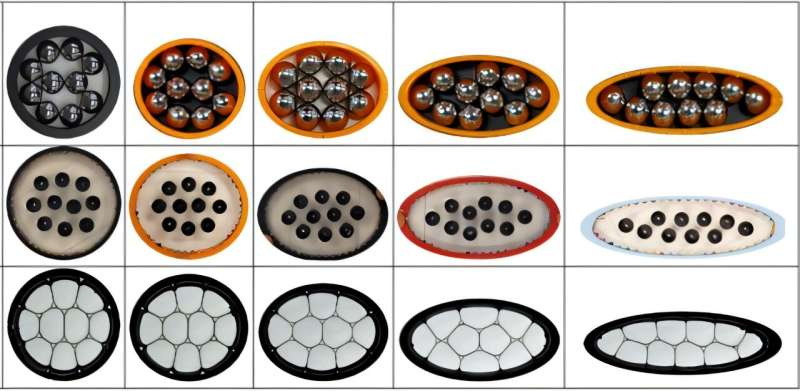
A new study has revealed something genuinely fascinating: particles that have almost nothing in common—soap bubbles, ball bearings, and floating magnets—can end up arranging themselves into exactly the same geometric patterns when placed in confined spaces. This research, carried out by an international team and recently published in Physical Review E, shows how simple rules can lead to surprisingly universal behavior in nature.
The project included scientists from the UK, Brazil, and Ireland, with a major contribution from Professor Simon Cox of Aberystwyth University. The core discovery centers on how different particles that naturally repel each other will self-assemble when placed inside a carefully designed container. Even though the particles interact through totally different physical mechanisms, they end up forming identical structures under the right conditions. This result provides insights not only into materials science but also into applications in medicine, engineering, and even industrial packaging.
How the Researchers Discovered the Universal Patterns
The team built a simple mathematical model to understand how particles behave when they repel each other but are also restricted by boundaries. Two competing forces drive the outcome:
- Repulsion strength between particles
- Confinement tightness of the container
By adjusting these two parameters, the model revealed predictable geometric patterns. What made the finding exciting is that these patterns held true across very different types of materials.
To check whether the model matched real-world behavior, the researchers ran hands-on experiments. They used:
- Small ball bearings that act as hard spheres
- Floating magnets that repel each other through magnetic forces
- Soap bubbles, which interact through surface tension
Despite their different physical properties, all these particles arranged themselves in matching geometric shapes when placed inside containers specifically shaped for the experiment. The researchers even tested different container shapes—from round to elongated—and the particles still followed the same structural rules.
Why This Matters for Future Materials and Medicine
Understanding how self-assembly works opens the door to designing new types of materials, especially those that need very precise internal structures. The researchers highlighted several potential applications:
- Smart drug-delivery systems that depend on how active particles pack together
- Targeted therapies where tiny structures deliver medicine exactly where it’s needed
- Slow-release capsules where particle arrangement controls the release rate
- Tissue engineering, where cells or cell-like particles must organize themselves properly inside tight scaffolds
- Industrial packaging for powders, pellets, and grains, where understanding confined packing improves storage and transport
The power of this study comes from its simplicity. Rather than needing many complicated factors, scientists can focus on just two major parameters—repulsion and confinement—and still predict how particles will settle. This means engineers and designers may one day tune particle behavior by simply changing container shapes or adjusting particle interactions.
The Role of Simple Rules in Complex Systems
One of the big ideas supported by this research is universality in physics. Across many areas of science, very different systems sometimes follow the same rules when viewed through the right framework. Here, a universal pattern appears not because the particles are similar but because their interactions can be captured through a simple mathematical balance.
This is especially interesting when dealing with:
- Soft matter (like bubbles and foams)
- Granular materials (like ball bearings or grains)
- Magnetically interacting particles
- Biological cells, which also interact and rearrange inside confined spaces
Though biological systems are more complex and involve additional forces like adhesion, this model provides a stepping stone toward understanding how cells might behave in tightly packed tissues.
Examples From the Experiments
The researchers observed the same patterns appearing in small groups of particles—sometimes as few as five or ten. These clusters arranged themselves into predictable shapes, such as:
- Rings
- Centralized clusters
- Symmetric patterns that matched simulation predictions
Whether the particles were metallic spheres, magnets floating on water, or 2D foam bubbles, their final positions were remarkably similar. This consistency is what makes the study stand out.
Practical and Industrial Implications
Beyond scientific curiosity, the findings could help with real industrial challenges. For example:
- Packaging companies can better predict how powders or pellets settle inside bags or containers.
- Manufacturers dealing with grains or pharmaceuticals can reduce clogging and improve flow by understanding confined patterns.
- Engineers designing nanoscale materials may use confinement-driven assembly to build new structures without needing expensive or complicated techniques.
Since the model works even when the container shape changes (for instance, becoming longer or flatter), designers might also manipulate geometry to achieve desired outcomes in particle-based systems.
Additional Insight: How Confinement Influences Natural Systems
This study ties into a broader theme in physics—how confinement changes particle behavior. Confinement is everywhere in nature and technology:
- Bacteria confined inside narrow channels
- Polymers inside small pores
- Ions trapped in electric potential wells
- Nanoparticles inside microcapsules
- Colloidal particles inside droplets
Each of these systems behaves differently when the available space shrinks. Confinement can create order out of otherwise random motion, and this research helps explain why.
Additional Insight: Repulsive Forces and Pattern Formation
Repulsive interactions are another recurring theme in physics. Particles often push away from each other due to:
- Electric charge
- Magnetic repulsion
- Surface tension effects
- Elastic deformations (like bubbles pressing against each other)
- Steric hindrance (objects physically blocking one another)
This study shows that the exact nature of the repulsive force isn’t always important. What matters is its general effect combined with confinement. That’s why the researchers could use such different systems and still find common behavior.
What the Research Does Not Claim
The researchers made sure to note the limitations:
- The experiments focus on relatively small clusters, not large-scale assemblies.
- The model assumes only repulsion, not attraction or adhesion.
- Real biological systems include complex factors that the model doesn’t cover.
- The study doesn’t yet demonstrate industrial applications—it lays the groundwork for future developments.
Even so, the universality observed here is a strong foundation for future exploration.
A Step Toward Unified Understanding
Overall, this study provides a straightforward but powerful insight: when particles repel each other and are forced into tight spaces, they follow shared rules that lead to shared patterns. This crosses disciplinary boundaries and could influence several fields at once—from soft matter and granular physics to biomedical engineering.
The collaboration was led by Dr. Paulo Douglas Lima from the Federal University of Rio Grande do Norte in Brazil and included contributions from Trinity College Dublin, Technological University Dublin, and Aberystwyth University.
Research Paper:
Self-assembled clusters of mutually repelling particles in confinement
https://doi.org/10.48550/arxiv.2506.19772