Flu Vaccine Effectiveness Differs by Age and Vaccine Type According to New Immune-Response Study
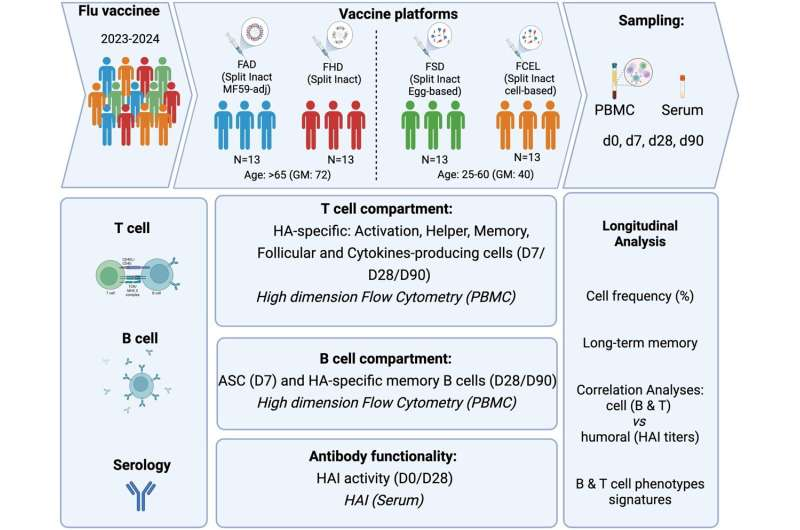
A new study examining four seasonal influenza vaccines has revealed that immune responses to the flu shot can vary widely depending on both age group and vaccine formulation. While all the vaccines generated similar levels of antibodies—the usual benchmark for flu-vaccine success—the researchers found major differences in how well each vaccine activated deeper layers of the immune system, especially cellular immunity, which plays a big role in long-term protection.
This research, published in The Journal of Immunology, arrives after the highly severe 2024–2025 flu season, which caused an estimated 47 million illnesses, 610,000 hospitalizations, and 27,000 deaths in the United States. With such heavy impact, understanding how to optimize flu-vaccine protection has never been more important.
Below is a clear breakdown of what the researchers discovered, how each vaccine performed across ages, why cellular immunity matters, and how this could shape the future of influenza vaccination.
Study Overview and What Was Tested
The study compared four licensed influenza vaccines:
- Fluzone High-Dose
- Fluzone Standard-Dose
- Flucelvax (a mammalian cell-based vaccine)
- Fluad (an adjuvanted vaccine containing MF59)
All four vaccines target the standard four flu strains included in the season’s formulation: H1N1, H3N2, B/Yamagata, and B/Victoria.
Researchers enrolled adult participants between September 2023 and March 2024. Blood samples were collected before vaccination and then at 7 days, 28 days, and 90 days after vaccination. These samples were analyzed to track:
- Antibody production
- Activation of B cells
- Memory B-cell formation
- T-cell responses
- Activation of circulating T follicular helper cells and antibody-secreting cells, which are strongly linked to immune memory
While antibodies are the traditional yardstick for measuring vaccine response, the researchers specifically wanted to look deeper at cellular immunity—something that may predict stronger, broader, and more durable protection.
Why Antibody Levels Aren’t the Whole Story
Antibodies help prevent severe illness, and all four vaccines produced similarly high antibody levels in the study. But having high antibodies does not guarantee complete immunity. Many vaccinated people still experience breakthrough infections, even if those infections are typically milder.
Cellular immunity—especially responses generated by T cells and memory B cells—is essential for:
- Long-lasting protection
- Improving defense against variants
- Supporting rapid immune response the next time a person encounters flu virus
This study highlights that to truly understand vaccine effectiveness, it’s necessary to look beyond antibodies.
Key Findings for Older Adults (65–85)
A major takeaway from the study is how dramatically vaccines differ in performance for older adults, a group especially vulnerable to severe flu.
Fluzone High-Dose showed the strongest overall cellular response
The high-dose vaccine triggered:
- Strong activation of B cells responsible for antibody production
- Early rise of circulating T follicular helper cells (cTfh), which guide long-term immune memory
- Higher levels of antibody-secreting cells
- A more coordinated immune response compared to the other vaccines
This matters because aging weakens the immune system, making it harder for standard-dose vaccines to spark strong cellular responses. The high-dose formulation includes four times the antigen of the standard-dose version, giving older immune systems a stronger push.
How Fluad Compared
Fluad, which contains an adjuvant meant to boost immune response, performed well but still did not match the broad cellular activation seen in Fluzone High-Dose.
Conclusion for Older Adults:
Fluzone High-Dose appears to provide the most robust cellular immunity, potentially making it the best option for adults over 65 who need stronger immune stimulation.
Key Findings for Younger Adults (28–60)
The picture looks different for younger adults, whose immune systems typically respond more vigorously to vaccination.
Flucelvax outperformed the standard-dose egg-based vaccine
The mammalian cell-based vaccine showed:
- Better activation of multifunctional cytokine-secreting CD4⁺ T cells
- Stronger early B-cell responses
- More robust memory B-cell formation over time
These findings support what many scientists have long suspected: cell-based vaccines may offer clearer and more targeted immune responses compared to egg-based vaccines, which can undergo minor antigenic changes during egg adaptation.
Why This Matters for Younger Adults
Younger adults are more likely to have repeated flu vaccinations over their lifetime. A vaccine that induces stronger cellular immunity may:
- Give longer-lasting protection
- Improve defense even when strains drift
- Reduce infections in seasons where antibody match is imperfect
Conclusion for Younger Adults:
Flucelvax may provide superior cellular immunity compared to standard egg-based vaccines, making it a promising option for adults under 60.
What This Means for Flu-Vaccine Recommendations
These findings could help shape more personalized influenza-vaccination guidelines in the future. Instead of recommending the same vaccine for everyone, healthcare providers may begin emphasizing:
- High-dose vaccines for older adults
- Cell-based vaccines for younger adults
- Adjuvanted vaccines when immune activation needs support
The study’s authors suggest that these insights should influence both current recommendations and the design of next-generation vaccines.
Implications for Future Flu Vaccines
Researchers, including senior author Dr. Ted M. Ross, say these results demonstrate how important it is to evaluate cellular immune markers when assessing flu vaccines.
This will likely guide the development of:
- Universal flu vaccines
- Longer-lasting multi-strain protection
- Vaccines optimized for age-specific immune responses
A universal flu vaccine—something that offers broad, lasting immunity across most influenza strains—has been a major scientific goal. Strong cellular immunity is a key ingredient in making that possible.
What Happens Next in This Research
The research team plans to:
- Expand the study to a larger and more diverse population
- Examine how vaccine formulations affect long-term immune memory
- Identify biomarkers of durable immune protection that predict how well someone might respond to vaccination
These steps could eventually lead to flu vaccines that are more reliable and more effective across all age groups.
Extra Background: Why Age Impacts Immune Response
Age is one of the strongest predictors of how well a person responds to vaccines.
In Older Adults
Factors include:
- Immunosenescence (the gradual decline of immune function)
- Reduced production of new immune cells
- Weaker inflammatory signaling
- Slower or incomplete formation of memory B and T cells
This is why high-dose and adjuvanted vaccines exist—to help overcome these hurdles.
In Younger Adults
Their immune systems:
- Are more flexible
- Generate stronger T-cell responses
- Produce memory cells more efficiently
This allows vaccines like Flucelvax to take full advantage of robust cellular immunity.
Extra Background: What Are cTfh Cells and Why Do They Matter?
The study highlighted circulating T follicular helper (cTfh) cells, which are crucial because they help B cells turn into:
- Antibody-secreting plasma cells
- Long-lived memory B cells
Higher activation of cTfh cells is strongly associated with more durable immunity after vaccination.
Fluzone High-Dose particularly excelled in activating these cells in older adults.
Research Reference
Comparative analysis of cellular immune responses to four seasonal inactivated influenza vaccines in younger and older adults
https://doi.org/10.1093/jimmun/vkaf286