Self-Guided Hypnosis Shows Major Promise in Reducing Menopausal Hot Flashes, New Clinical Trial Finds
A newly published clinical trial has brought encouraging news for women dealing with one of the most disruptive symptoms of menopause: hot flashes. Researchers have found that a simple, daily audio-based hypnosis routine can reduce both the frequency and intensity of hot flashes by more than 50%, offering a nonhormonal, low-cost and accessible option for relief. The study appears in JAMA Network Open and was conducted across multiple centers, led by Gary R. Elkins, Ph.D., a professor at Baylor University and director of the Mind-Body Medicine Research Laboratory.
Below is a clear, specific, and comprehensive breakdown of everything this new research uncovered, along with additional context on hot flashes, hypnosis as a therapeutic tool, and what this could mean for women seeking alternatives to hormone therapy.
What the Study Did and Who Participated
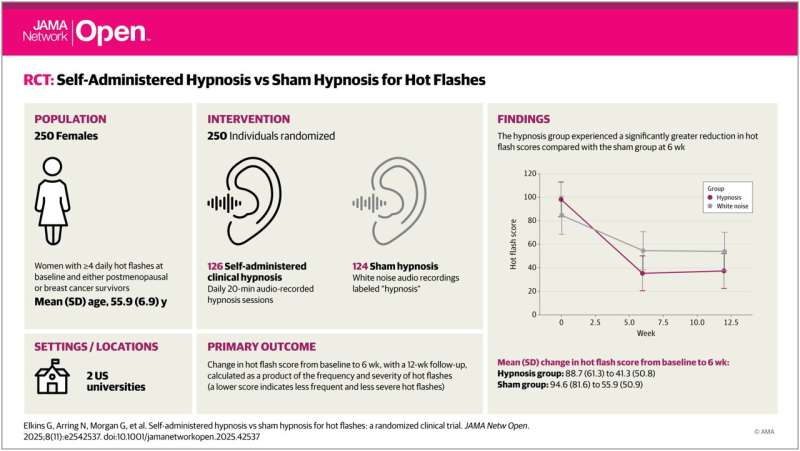
The trial included 250 postmenopausal women who were experiencing frequent hot flashes, defined as either at least 4 hot flashes per day or 28 per week. Their average age was 55.9 years. Importantly, nearly 25% of the participants had a history of breast cancer, a group that is often discouraged from using hormone replacement therapy because it can increase health risks.
Participants were randomly assigned to one of two groups:
- Self-Guided Hypnosis Group
Women in this group listened to a daily 20-minute hypnosis audio recording for six weeks. These sessions involved guided relaxation and cooling imagery, a technique that has been used in previous clinical settings to help the mind create sensations of coolness. - Active Control Group (Sham Hypnosis)
Instead of hypnosis, this group listened to white noise recordings, also for 20 minutes daily over six weeks. This served as an active control to help researchers distinguish real therapeutic effects from the placebo effect or from simple relaxation.
Both groups kept daily diaries to record the frequency and severity of their hot flashes. Researchers used this information to create what they call a hot flash score, calculated by multiplying the number of hot flashes by their average intensity. Additional measurements included sleep, mood, concentration, and overall quality of life.
Key Results After Six Weeks
The findings were striking:
- The hypnosis group saw a 53.4% reduction in hot flash frequency and intensity.
- The control group saw a 40.9% reduction, a meaningful drop but significantly less than the hypnosis group.
- Women with a history of breast cancer saw an even stronger effect, with a 64% reduction after six weeks of self-guided hypnosis.
These differences were statistically significant and suggest that the hypnosis techniques used in the audio sessions delivered benefits beyond simple relaxation.
In addition to hot flashes themselves, the researchers found:
- Women in the hypnosis group reported greater improvements in sleep, including fewer nighttime disruptions.
- They also reported improvements in mood, mental focus, and overall daily functioning.
- Nearly 90% of women in the hypnosis group said they felt better overall, compared to 64% in the control group.
Notably, the hot flash reductions for the hypnosis group continued to improve even after treatment ended.
Sustained Benefits at the 12-Week Follow-Up
At the three-month follow-up, women in the hypnosis group maintained and even improved their results:
- Hot flashes were reduced by 60.9% from the beginning of the study.
Meanwhile, the control group remained at about 40.9% reduction.
The sustained improvement suggests that once women learn how to use hypnosis techniques, they can keep applying them without needing further professional instruction. The authors point out that this makes hypnosis especially attractive as a long-term strategy.
Why This Matters for Women Seeking Nonhormonal Options
Hot flashes affect about 80% of women during the menopause transition. Among women with breast cancer, that number jumps to 96% during or after anti-cancer treatment. For many, hormone replacement therapy works very well — but it is not safe for everyone, especially those at higher risk for cancer or cardiovascular issues.
That’s why nonhormonal treatments are so important. Behavioral therapies, medications, supplements, and mind-body interventions are often recommended, but few have demonstrated the level of improvement seen in this trial.
In fact, according to Elkins and his team, hypnotherapy is the only behavioral treatment consistently shown across studies to reduce hot flashes to a clinically meaningful degree in both postmenopausal women and breast cancer survivors.
The fact that this study used a self-guided method — requiring no in-person therapist — is part of what makes these findings notable. A therapy that is easy to learn, inexpensive, and convenient could be widely accessible for millions of women who otherwise struggle to find safe and effective solutions.
What Exactly Is Self-Guided Hypnosis?
Self-guided hypnosis does not involve being “put under” or losing control. Instead, it uses focused attention, guided relaxation, and mental imagery to shift how the body responds to sensations and stress.
The hypnosis scripts in this study included:
- Breathing and relaxation cues
- Focused attention exercises
- Cooling mental imagery, such as imagining a snowy landscape or cool breeze
These techniques are designed to help the brain regulate the thermoregulatory centers linked to hot flashes. While the precise mechanisms are not fully understood, previous research suggests hypnosis may influence how the brain interprets and responds to internal heat signals.
Since the sessions were audio-based, participants could listen at home, at a time that worked best for them. This is one of the reasons researchers believe self-guided hypnosis could become a practical tool for women in everyday life.
Additional Context: What Causes Hot Flashes?
Hot flashes are believed to originate from changes in the brain’s hypothalamus, which acts as the body’s thermostat. During menopause, declining estrogen levels can tighten the “thermoneutral zone” — the range in which the body is comfortable.
A narrow thermoneutral zone causes the body to interpret even minor temperature shifts as overheating, which triggers:
- Sudden dilation of blood vessels
- Increased heart rate
- Sweating
- A wave of heat that can last from 30 seconds to several minutes
These episodes can occur dozens of times per day and night, severely affecting sleep, mood and daily functioning.
While medications like hormone therapy or certain antidepressants can help, many women prefer natural, non-drug solutions. That’s where mind-body approaches like hypnosis get attention — they may help widen the thermoneutral zone or alter how sensations are perceived, without introducing chemicals into the body.
Why This Study Is Considered a Breakthrough
Several details make this trial stand out:
- It used an active control group, not just a waiting list or placebo.
- The hypnosis protocol was fully self-administered, which tested real-world usability.
- It included breast cancer survivors, a key population needing nonhormonal options.
- It measured not just hot flashes but also sleep, mood, concentration and overall well-being.
The researchers say these elements provide strong evidence that daily self-hypnosis is a reliable, safe and effective tool for managing menopausal symptoms without the need for medication or frequent clinical sessions.
Other Potential Uses of Self-Guided Hypnosis
Beyond hot flashes, hypnosis is often used to help manage:
- Anxiety
- Chronic pain
- Stress
- Sleep problems
- Habit change (e.g., smoking cessation)
Since the women in the trial saw improvements in sleep and mood, this supports what other studies have suggested: when people learn hypnosis skills, they can apply them in multiple areas of their lives.
The affordability and flexibility of audio-based sessions also make it a technique that could be integrated into broader health and wellness routines.
Final Thoughts
This study presents a compelling case for giving self-guided hypnosis a place among evidence-based, nonhormonal treatments for menopausal hot flashes. With its measurable effects, low cost, and ease of practice, it offers an appealing option for women looking for relief without medication — especially those who cannot safely use hormone therapy.
As more research emerges on mind-body medicine and menopausal health, self-guided hypnosis may become a widely recommended tool for improving comfort, sleep and overall quality of life during the menopause transition.
Research Paper:
Self-Administered Hypnosis vs Sham Hypnosis for Hot Flashes – JAMA Network Open
https://jamanetwork.com/journals/jamanetworkopen/fullarticle/2841242