Brain Activity Reaches Extreme Highs and Lows in Soccer Fans During Rivalry Moments, New Neuroimaging Study Shows\
Soccer fandom has always been known for its passion, intensity, and deep emotional swings—but a new functional MRI (fMRI) study reveals just how dramatically the brain reacts when fans watch their favorite team win or lose, especially against historic rivals. Researchers examined 60 healthy male soccer fans, aged 20 to 45, using brain-imaging techniques to understand how emotions and social identity shape neural activity during high-stakes moments in matches. The findings provide strong evidence that the brain’s reward circuits, cognitive-control systems, and social-identity pathways can shift within seconds depending on what unfolds on the field.
The study, titled Brain Mechanisms across the Spectrum of Engagement in Football Fans: A Functional Neuroimaging Study, was published in Radiology and was conducted by researchers led by biologist Francisco Zamorano at Clínica Alemana de Santiago and Universidad San Sebastián in Chile. They set out to explore how the brain processes the emotional highs and lows of fandom and whether the same mechanisms could explain other forms of group-based fanaticism.
What the Researchers Did
The participants—all committed supporters of one of two historic rival teams—were evaluated using the Football Supporters Fanaticism Scale (FSFS), a 13-item tool designed to measure how strongly someone identifies with a team. The scale covers two major dimensions: Sense of Belongingness and Inclination to Violence. Based on this evaluation, the researchers could classify fans across a spectrum from casual supporters to extreme fanatics.
Once inside the fMRI scanner, the participants were shown 63 goal sequences taken from real matches. These clips featured:
- Their favorite team
- Their most intense rival
- A neutral team with no emotional attachment
The sequences were arranged to create controlled emotional conditions: a significant victory (favorite team scoring against the rival), a significant defeat (rival scoring against their favorite team), and neutral or non-rival goals for comparison.
The researchers then conducted a whole-brain analysis to compare neural responses between these conditions. This approach allowed them to identify which brain regions became more active—or surprisingly, less active—during highly emotional moments.
What They Found Inside the Brain
The results showed very clear and rapid differences in brain activity depending on the scenario.
When fans witnessed a significant victory, there was strong activation in regions connected to:
- Reward processing
- Motivation
- Social bonding
This specifically included higher activity in the brain’s reward circuitry compared to when goals happened against non-rival teams. These reactions suggest that rivalry intensifies feelings of pleasure, triumph, and group identity reinforcement.
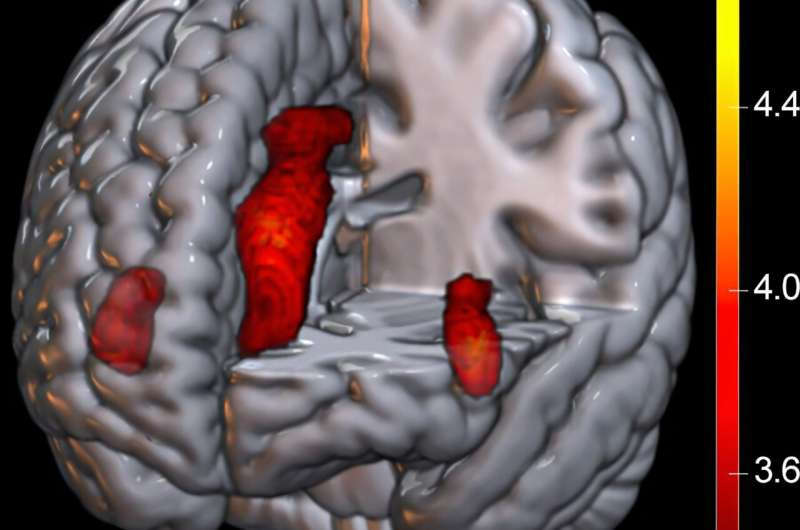
But the opposite scenario revealed something even more striking. When fans watched their rival score against their team, the dorsal anterior cingulate cortex (dACC)—a region central to cognitive control and emotional regulation—showed reduced activation. This phenomenon is referred to as paradoxical suppression, where the brain’s attempt to manage emotions ironically leads to weaker control signals. In other words, fans may be more vulnerable to impulsive or extreme emotional reactions at precisely the moment their identity feels threatened.
At the same time, areas associated with social cognition, personal reflection, and visual attention showed increased activity. This combination—reward circuitry downshifted and self-regulatory circuitry suppressed—suggests that the emotional blow of seeing a rival score can destabilize the balance between emotional drive and rational control.
Notably, these effects were strongest among the most fanatical participants. For the fans with the highest FSFS scores, the imbalance between reward and control systems became more pronounced, meaning that the neural foundations of fanaticism directly correlate with how intensely supporters experience these moments.
Why These Findings Matter
The researchers emphasize that soccer is not just entertainment—it’s a rare real-world model of fanaticism with measurable emotional and behavioral effects. Because the emotional stakes are high and the outcomes happen in real time, soccer rivalries allow scientists to observe how group identification influences neural activity under pressure.
One major takeaway is that rivalry can rapidly reshuffle the brain’s internal priorities. Within seconds, the brain shifts between reward-driven enthusiasm and reduced self-control. This dynamic, the study suggests, isn’t confined to sports. The same neural pattern—reward signals amplified, control signals dampened—could help explain why people in political or sectarian conflicts sometimes behave irrationally or aggressively when their identity group is threatened.
The researchers even point out that major real-world events, including political clashes like the January 6, 2021 U.S. Capitol incident, display characteristics similar to what was seen in the scanner: compromised cognitive control during identity-charged moments.
Another important point is developmental. The circuits involved in reward and control are shaped in early childhood by experiences related to caregiving, stress, and social learning. According to the authors, individuals who grow up without stable emotional regulation models may be more vulnerable to intense identity fusion and fanaticism later in life. This suggests that broader societal issues—like polarization and group conflict—could be addressed partly through improving childhood environments.
What This Study Adds to Our Understanding of Fans
Soccer fandom is often treated as a cultural curiosity, but this study speaks to deeper psychological and neurological mechanisms. It highlights how powerful social identity can be and how deeply our brain reacts when that identity is rewarded or challenged.
When viewed as a model for group dynamics, fandom gives scientists a chance to study phenomena like:
- In-group bonding
- Out-group hostility
- Self-regulation failures
- Emotional swings under pressure
Because soccer offers an ethically safe way to observe these reactions, the researchers suggest using it to test interventions for conflict management, such as event design changes, “cool-off” periods, fairness cues, or social framing techniques.
Extra Insight: Why Our Brains React So Strongly to Group Identity
Beyond this specific study, neuroscience has shown that humans are wired for group belonging. Our brains treat threats or rewards to our group almost as if they were personal. Several brain systems contribute to this:
- The ventral striatum, which processes reward, lights up when our group succeeds.
- The amygdala becomes active during emotional or threat-related situations involving rivals.
- The prefrontal cortex, responsible for self-control, can weaken under emotional stress.
- The default mode network, involved in social meaning and self-reflection, becomes more active when processing group dynamics.
These are the same systems involved in political partisanship, tribalism on social media, and even extremist group behavior. This is why sports, although harmless in comparison, provides a powerful window into how identity shapes behavior on a neurological level.
The Bigger Picture
By showing how quickly the brain’s equilibrium shifts during emotionally intense rival moments, this study provides a scientific basis for understanding fanaticism at any level. When reward systems spike and control systems dip, people are more likely to make impulsive decisions, lash out, or feel overwhelming emotional highs and lows. This also explains why normally calm individuals can suddenly become aggressive or irrational during matches.
The authors argue that studying these neural patterns isn’t just about understanding fans—it’s about finding ways to reduce group-based conflict, improve crowd safety, and build healthier societies. Protecting childhood development is especially important, since the formation of reward-control circuits early in life may be the single most powerful long-term strategy to prevent harmful forms of fanaticism.
Research Paper:
https://pubs.rsna.org/doi/10.1148/radiol.242595