Calcium Waves in Developing Fruit Fly Eyes Reveal a Universal Blueprint for Building Visual Systems
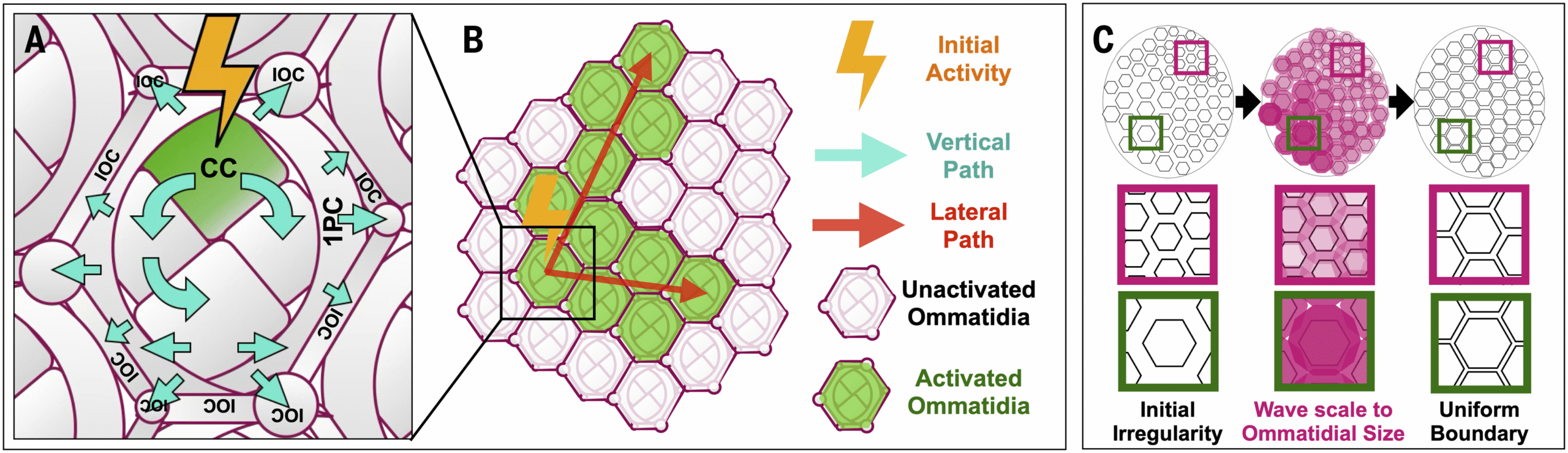
A new study from researchers at New York University uncovers how brief, shimmering waves of calcium play a crucial role in shaping the developing eyes of fruit flies. These waves move across non-neuronal cells in the immature retina for only a few hours, yet they help determine the precise architecture of the compound eye. The discovery not only expands what scientists know about fruit fly development but also hints at a shared biological mechanism that could influence how eyes and other sensory organs form across species, including humans.
Understanding What Calcium Waves Are Doing in the Eye
For decades, scientists have known that spontaneous calcium waves appear in the developing retinas of mammals, including humans, long before an eye can detect light. These waves help refine connections in the visual system, acting like early communication pulses that coordinate the assembly of neural circuits. What had been unclear until now was whether such waves also help construct the actual physical structure of the eye itself.
The NYU team confirmed that fruit flies also display these retinal calcium waves during development. The important twist is that in flies, these waves appear not in neurons but in supporting cells—the non-neuronal cells that form the eye’s outer structure. This shows that the waves are not limited to helping neurons coordinate; they also influence how tissues shape themselves into functional visual equipment.
How the Waves Begin and Spread
The team discovered that the waves start when calcium is released from intracellular stores inside developing retinal cells. The signal then travels through gap junctions, the channels that allow neighboring cells to pass ions and small molecules directly between them.
This means the eye does not wait for external triggers—no light, no external stimulus. It simply activates an internal series of calcium releases that synchronize across large patches of cells. These coordinated waves create a rhythm of cellular activity that influences how the retina molds itself into its final form.
A noteworthy detail is that these waves occur in the fly’s non-neuronal retinal cells, not in the photoreceptor neurons. Their job is structural rather than sensory at this stage. According to the findings, the waves contribute to shaping a uniform and optimized array of lenses—a critical requirement for the precise optics of a compound eye.
Shaping the Eye Through Mechanical Changes
The waves generate retina-wide calcium patterns that lead to subtle but important shape changes in developing cells. These changes help sculpt the outer surface of the eye, allowing the tissue to form a highly ordered lattice of ommatidia, the individual hexagonal units that make up the compound eye.
The researchers observed that the waves are involved in adjusting lens sizes across different regions of the eye. This is important because different parts of the eye serve different visual needs. For instance, the lower portion of the eye tends to receive less light because it faces the ground. The calcium waves in that region were found to be biased in a way that leads to larger lenses, which help capture more light. The upper region, which faces the sky, develops smaller lenses.
This regional tuning allows the fly to maintain efficient vision by adjusting its eye architecture based on the environmental light distribution it is likely to experience once it hatches.
A Universal Mechanism in Sensory Development
The researchers propose that these calcium waves might represent a universal developmental mechanism. The idea is that synchronized calcium activity during early development may help shape tissues across species, not just in flies. Calcium signaling already plays major roles in muscle contraction, cell communication, and neural function. Now, evidence suggests it also plays a part in mechanically shaping tissues, especially sensory structures that depend on precise geometry.
This new understanding could expand to studies of human development. Although the details differ across organisms, the presence of spontaneous calcium waves in both insects and vertebrates suggests a conserved strategy for organizing tissue. Understanding how these waves guide the formation of retinal architecture might also shed light on developmental eye disorders or degenerative diseases where structural organization breaks down.
Why Fruit Flies Are So Important for This Research
Fruit flies have long been a cornerstone of biological research. They share about 75% of the genes associated with human disease, making them valuable models for studying genetics, development, and neurobiology. Their compound eyes also provide a clear, geometric system for examining structural patterning.
Because the fly eye develops in a predictable and highly ordered manner, even small deviations in its pattern are easy to observe. This makes it an ideal system for studying how coordinated cellular behavior—like calcium waves—affects the final shape of a complex tissue.
What the Findings Mean for Future Research
This study broadens our understanding of how tissues self-organize during development. It also suggests that structural patterning is not simply a genetic blueprint unfolding but a dynamic interplay of chemical signals, mechanical feedback, and coordinated cellular communication.
Future research may explore:
- Whether similar calcium wave mechanisms occur in other insect species.
- How wave disruptions affect overall eye structure and function.
- Whether human retinal tissue uses any version of this mechanism during development.
- How these findings can inform regenerative medicine or tissue engineering.
If calcium waves help guide structural patterning in other organisms, understanding them could help scientists design better approaches for rebuilding damaged tissues or controlling how cells organize themselves in synthetic biological systems.
Additional Context About Calcium Signaling
Calcium is one of the most universal signaling molecules in biology. Its concentration inside cells is tightly regulated, and even small changes can trigger significant responses. Here are a few places calcium plays essential roles:
- Regulating muscle contraction
- Triggering neurotransmitter release in the brain
- Activating immune cells
- Driving developmental processes in embryos
- Coordinating metabolic activity
Because calcium is such a versatile molecule, it is not surprising that evolution has used it repeatedly for different functions, including the patterning of complex tissues like eyes.
Additional Context About Fruit Fly Vision
A fruit fly’s compound eye contains around 800 ommatidia, each acting like an individual lens with its own photoreceptors. This arrangement gives the fly a wide field of view and excellent motion detection. For such a system to work properly, the spacing of the lenses and their alignment must be extremely precise. Even slight irregularities can distort incoming light.
That is why the discovery that calcium waves organize this patterning is so important. It shows how the fly ensures structural consistency during development without requiring external visual cues.