A New Comprehensive Tool Aims to Dramatically Cut the High Costs of Kelp Farming
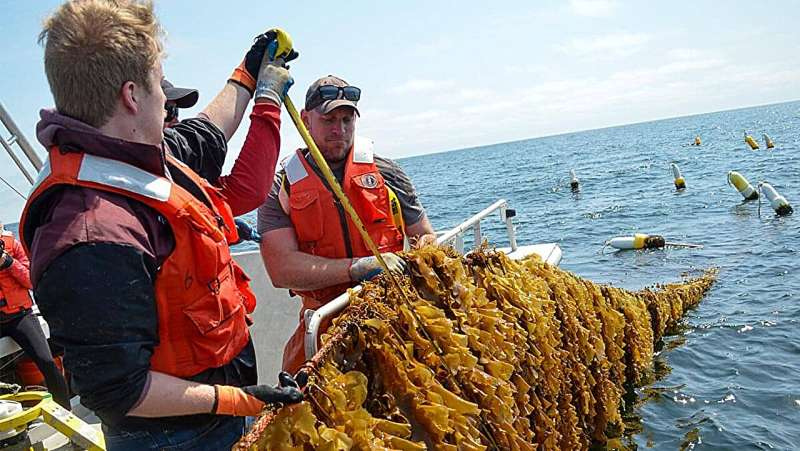
Kelp farming has been growing steadily as demand rises for seaweed in food products, cosmetics, fertilizers, and various industrial uses. Yet for all this interest, starting and maintaining a kelp farm remains expensive—especially in regions like Maine, where conditions can be challenging and offshore operations are increasingly common. One of the biggest obstacles for both new and existing farmers has been the absence of a clear, detailed way to analyze costs and understand how specific farm design choices affect the bottom line. Now, a newly developed resource from researchers at Kelson Marine and the University of Maine is poised to change that.
This new tool provides an extremely detailed economic breakdown for kelp farms, whether they operate near the coast or in deeper, rougher offshore environments. It is built to help farmers evaluate how different factors—such as site location, equipment choices, labor structures, vessel types, or processing strategies—interact with one another financially. Instead of looking at one decision in isolation, the tool reveals how each choice influences the entire operation, allowing users to identify improvements that truly reduce costs rather than shifting them from one area to another.
The developers designed the model to include the many elements that make kelp farming complex. It incorporates ocean conditions, weather exposure, species-specific growth rates, workboat requirements, maintenance schedules, and shore-side logistics. Farmers can test scenarios involving different farm layouts, operational methods, crop sizes, and technologies. The result is an analytical system that illustrates the real financial consequences of each decision and highlights strategies that can significantly lower the cost of production.
To demonstrate the tool’s capabilities, researchers applied it to a hypothetical large-scale sugar kelp farm covering 1,000 acres, situated 12 miles from shore, and positioned 330 feet below the water’s surface. They evaluated numerous farm designs and operational models to see how each variation changed the overall cost structure. The baseline model—one focused on maintaining low structural costs while maximizing production volume—showed that producing fresh kelp in that configuration would cost around $2,618 per ton. But the real value of the tool emerged when researchers began testing refinements. By combining several targeted improvements, they identified a pathway to slash production costs by 85%, bringing them down to $383 per ton.
These improvements included using deeper cultivation lines, adopting mechanized systems for both seeding and harvesting, processing the kelp directly on-site into slurry rather than transporting it whole, and optimizing vessel types and sizes to reduce unnecessary labor time and fuel use. Each of these adjustments contributes individually to lowering expenses, but the true savings came from understanding how they worked together—a perspective the tool makes possible.
The project did not develop in isolation. In addition to the core team from Kelson Marine and the University of Maine, scientists from the University of New Hampshire, Woods Hole Oceanographic Institution, and Vertical Bay Maine contributed their expertise. The research also benefited from earlier structural analysis tools created under the U.S. Department of Energy’s ARPA-E MARINER program, which supported advances in offshore seaweed systems.
According to the researchers, the model is the most detailed and comprehensive cost assessment of offshore kelp cultivation completed in the United States so far. It provides a clearer picture of where money is spent, where inefficiencies occur, and where investments in technology could produce the greatest financial impact. This matters for both small-scale and commercial farmers, because a better understanding of true production costs is essential for long-term industry sustainability.
In places like Maine, kelp farming has become increasingly important not only as a coastal economic opportunity but also as part of a broader shift toward climate-friendly aquaculture systems. Kelp grows rapidly, requires no fertilizers or freshwater, absorbs carbon dioxide, and can improve local marine ecosystems by providing habitat and reducing nutrient levels. For these reasons, the industry has attracted entrepreneurs, researchers, and policymakers who view it as a promising sector for future economic and environmental benefits. However, without realistic and detailed cost models, many potential farmers face uncertainty about whether they can operate profitably—especially in offshore zones where gear, labor, and vessel requirements escalate quickly. This new tool directly addresses that gap.
Additional Background on Kelp Aquaculture
Kelp aquaculture has expanded worldwide over the past decade. The majority of global production comes from Asia, where seaweed farming has been practiced for centuries. In contrast, the U.S. industry is relatively young and still navigating the challenges of scaling up. Offshore farming, in particular, is appealing because it avoids conflicts near shore, provides more space, and often offers better water quality for kelp growth. But moving operations offshore introduces higher risks from storms, larger waves, and deeper waters. It also demands more specialized equipment and longer travel distances for farm crews.
Because of these challenges, cost-analysis tools are especially valuable. They help farmers understand how different line depths affect storm stability, how vessel choice influences labor hours, how mechanization reduces manual bottlenecks, and how on-site processing can eliminate costly repeat trips. Economics is central to determining whether offshore farming is feasible, and tools like this contribute directly to making the industry more accessible.
Another important aspect is species selection. The case study examined sugar kelp, a commonly farmed species in the North Atlantic known for its fast growth and versatility in products. But the tool can be adapted for different species with varying growth curves, environmental needs, and harvest cycles. This flexibility makes the model useful not only in Maine but across different regions experimenting with seaweed aquaculture.
Why This Development Matters for the Future of Seaweed Farming
As climate concerns push the search for sustainable food and material sources, seaweed farming stands out for its low environmental impact and potential to support coastal economies. Tools that reduce financial uncertainty will make it easier for new farmers to enter the field and for existing farms to grow. Lower production costs also make farmed seaweed more competitive against imports, creating opportunities for domestic processors and product manufacturers.
The publication of this framework in the journal Algal Research ensures that the broader scientific and farming communities have access to the methodology. By laying out the model’s structure and data inputs, the research enables others to build upon the tool, adapt it, or test it in new conditions. This openness is expected to accelerate innovation and help refine best practices for seaweed farming across the United States.
For an emerging industry with significant environmental potential, developments like this represent important progress. They help transition kelp farming from a niche activity into a scalable, economically viable part of the blue economy. With clearer cost insights, better technology, and collaborative research, the path toward more affordable and resilient seaweed production becomes far more achievable.
Research Paper:
Comprehensive quantification of production costs for large-scale kelp aquaculture and cost reduction opportunities