Drone-Powered AI Monitoring Brings a New Level of Behavioral Tracking to Turkey Farms
A new wave of smart farming technology is taking shape as researchers at Penn State successfully demonstrate a drone-based AI system capable of identifying and tracking a wide range of turkey behaviors with notable accuracy. This development blends unmanned aerial vehicles, computer vision, and practical animal science into a monitoring method designed to reduce labor, improve welfare oversight, and scale more efficiently across commercial poultry operations.
The research was carried out at the Penn State Poultry Education and Research Center and represents the first confirmed test of using overhead drone footage combined with a trained computer vision model to automatically detect turkey behaviors in a real barn environment. The system uses a commercially available drone fitted with a standard RGB camera, and the researchers designed flight patterns that ensured complete visual coverage of the turkey pens during each monitoring session. Flights were conducted four times per day, tracking 160 young turkeys between 5 and 32 days old.
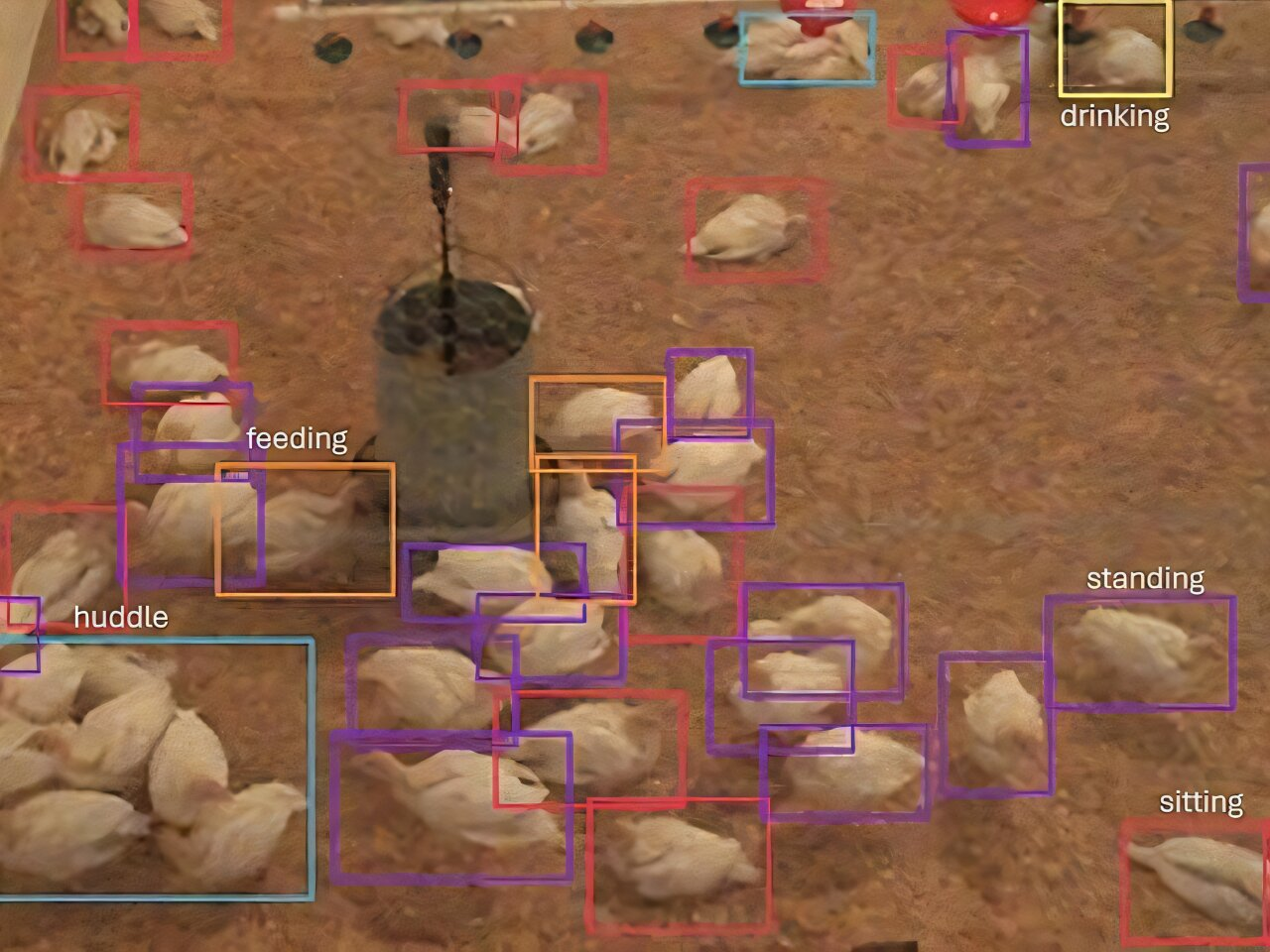
To build the AI model, the team extracted image frames from drone video and manually labeled turkey behaviors. This produced a dataset containing over 19,000 annotated behavior instances, including feeding, drinking, sitting, standing, perching, huddling, and wing flapping. In some technical summaries of the work, annotations also included the dead class for comprehensive welfare monitoring. The labeled dataset was then used to train and validate multiple versions of the YOLO (You Only Look Once) object-and-action detection model, a widely used real-time vision architecture in robotics and autonomous systems.
Among the YOLO variants tested, the best model achieved strong performance metrics. It correctly identified around 87% of all behaviors present, with behavior-specific accuracy of about 98%. In more detailed technical evaluation, the top-performing version (YOLOv11-l) produced a precision of roughly 90%, recall of about 87%, F1-score close to 0.89, and mAP50 around 0.89, all at a confidence threshold of 0.20. These are high numbers for real-world farm settings, where visual clutter, overlapping birds, lighting inconsistencies, and rapid movement can make automated detection difficult.
The system’s success is important because traditional poultry monitoring requires frequent human observation, which is labor-intensive, time-demanding, and prone to inconsistency. Large commercial farms often house thousands of birds, so evaluating welfare indicators like agitation, inactivity, crowding, or changes in feeding and drinking patterns can quickly overwhelm human staff. The drone-AI method not only reduces the need for constant human presence but may also help detect early signs of stress or disease without disturbing the birds. As the researchers emphasized, this technology could become a low-labor, non-invasive, and scalable monitoring tool that simplifies welfare compliance and improves operational efficiency.
The research also notes that indoor drone use is not without challenges. GPS signals are unreliable or nonexistent inside poultry barns, which complicates autonomous navigation and requires careful flight planning. However, the experiment still proved that drones can be flown safely and consistently in enclosed environments when controlled by trained operators. In follow-up work, the team plans to explore larger drones and additional sensor types, such as thermal cameras, which could offer deeper insights into body temperature, crowding stress, or environmental irregularities like hot and cold spots. Expanding the system beyond RGB imagery could help identify abnormalities even when visual cues are subtle.
While this project focuses specifically on turkeys, the broader concept has wide relevance to livestock systems. Poultry producers worldwide are under pressure to track animal welfare more rigorously, respond to disease risks faster, and manage staffing shortages. Automated behavioral monitoring is already emerging in other species—such as chickens, cows, and pigs—using stationary cameras, RFID tags, and wearable trackers. However, drones offer a unique mobility advantage, allowing coverage of large flock areas without installing extensive hardware throughout the facility. This makes drone-based systems potentially cheaper to deploy and easier to scale across multiple barns.
To give broader context, computer vision in agriculture has been expanding rapidly. Similar detection models have been used for identifying cattle lameness, tracking broiler chicken gait patterns, counting animals, and even monitoring wildlife populations. YOLO architectures in particular have become popular for their ability to process images in real time, making them suitable for drone integration where rapid interpretation is essential. As models improve and hardware becomes more affordable, AI-driven monitoring is likely to become a mainstream tool in modern farming, especially for large operations that benefit most from automation.
Understanding turkey behavior specifically is also important for welfare and productivity. Young turkeys exhibit clear behavioral indicators that correlate with flock health. For example, increased huddling may suggest poor temperature regulation or fear responses. Reduced feeding or drinking can signal illness or environmental stress. Wing flapping and perching patterns may provide data about space use and enrichment quality. A system that recognizes these behaviors automatically can help producers pinpoint problems earlier and take corrective action without waiting for visual cues during manual checks.
This research fits into a larger trend where precision livestock farming aims to gather continuous data rather than sporadic human observations. Real-time environmental sensors, automated feeding systems, and AI-driven health predictions all contribute to farms becoming smarter and more proactive rather than reactive. The drone-AI turkey project adds another piece to that ecosystem, demonstrating that overhead behavioral monitoring is not only feasible but highly accurate.
Another valuable aspect of this study is the creation of a large, well-labeled dataset of turkey behaviors, which may support future computer vision research. Datasets for agricultural applications are often scarce, and having more high-quality examples of behavior classes improves the development of better models later. It also opens pathways for researchers to move toward multi-action detection, tracking individual birds over time, or integrating drone footage with stationary cameras for hybrid systems.
The research team’s findings also highlight the potential for reducing worker burden. Many poultry facilities struggle with high employee turnover, and training new staff to recognize subtle welfare indicators can be challenging. An automated system standardizes observation, offering consistent data collection that doesn’t depend on staffing levels. This could help producers maintain high welfare standards even during labor shortages.
Overall, this project demonstrates that AI-equipped drones can provide accurate, efficient, and scalable monitoring of turkey behaviors in real farm environments. It lays a foundation for more advanced autonomous systems that could eventually perform continuous welfare assessments throughout the entire production cycle. While there is more work to be done—especially regarding autonomous indoor navigation, sensor expansion, and large-scale deployment—the results show strong promise for the future of technology-enhanced animal husbandry.
Research Paper:
Aerial Monitoring of Turkey Behavior Using Unmanned Aerial Vehicles and Computer Vision
https://doi.org/10.1016/j.psj.2025.106103