Purdue University Scientists Create a Single-Photon Switch That Could Make Photonic Computing Practical
Controlling light with extreme precision is one of the foundations of modern technology. From fiber-optic internet and lasers to sensors and imaging systems, photons quietly do much of the heavy lifting behind today’s digital world. Yet one major challenge has lingered for decades: making light control light itself at the most fundamental level. In simple terms, scientists have long wanted a way for a single photon to switch or modulate another beam of light, much like a transistor uses one small electrical signal to control a larger current.
Now, researchers at Purdue University report that they have finally crossed this threshold. They have demonstrated what they describe as a photonic transistor operating at single-photon intensities, a breakthrough that could push photonic computing from theory into reality. Their findings were published in Nature Nanotechnology and show optical nonlinearity levels that are several orders of magnitude higher than those found in conventional materials.
Why Single-Photon Control Has Been So Difficult
In traditional photonics, interactions between light beams rely on a property called optical nonlinearity, where one beam can influence another by changing the refractive index of a material. The problem is that these nonlinear effects are usually extremely weak. To see any noticeable interaction, researchers typically need very strong, macroscopic light beams with high power.
This approach simply does not work at the quantum scale. Single photons do not carry enough energy to trigger meaningful nonlinear responses in ordinary materials. As a result, most optical switches today operate far above the single-photon level, limiting their usefulness for quantum technologies and energy-efficient photonic logic.
Previous attempts to overcome this relied on delicate quantum systems, such as single-photon emitters coupled to optical cavities. While impressive, these systems are often fragile, difficult to scale, and usually require cryogenic temperatures, making them impractical for real-world computing or industrial use.
The Core Idea Behind Purdue’s Photonic Transistor
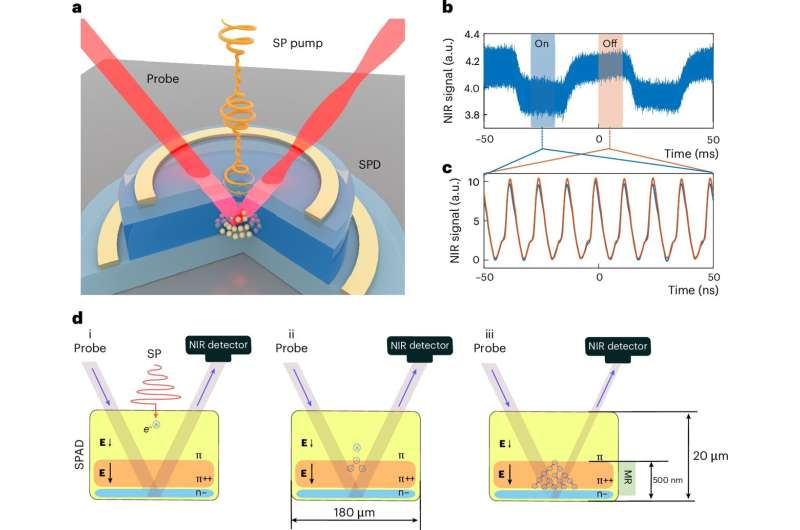
The Purdue team took a very different approach by borrowing a concept from an unexpected place: single-photon avalanche detectors (SPADs). These devices are widely used in photon counting, quantum optics, and LiDAR systems.
In a SPAD, when a single photon hits silicon, it creates one electron. Under a strong electric field, that single electron can trigger an avalanche multiplication process, producing up to one million electrons. This is how an almost invisible quantum event becomes a clear, measurable electrical signal.
The researchers realized that this avalanche effect could be repurposed—not just for detecting photons, but for creating an enormous optical nonlinearity. By integrating this avalanche process into an optical system, a single photon in a control beam can dramatically alter the refractive index of silicon. That change, in turn, affects a second, much stronger probe beam.
The result is a true single-photon optical switch, where one photon effectively turns another light beam on or off.
What Makes This Approach Stand Out
The Purdue photonic transistor offers three major advantages over existing methods.
First, it works at room temperature. Many quantum-based nonlinear systems are extremely sensitive to temperature fluctuations and require complex cooling setups. This new approach avoids that limitation entirely.
Second, the technology is CMOS-compatible, meaning it can be fabricated using standard semiconductor manufacturing processes. This is a critical point. Compatibility with existing chip-making infrastructure makes large-scale integration far more realistic.
Third, the system operates at gigahertz speeds, with the potential to reach hundreds of gigahertz. This is dramatically faster than most current optical switching approaches and far beyond what electronic transistors can achieve in practical CPUs.
Together, these features make the device compact, fast, scalable, and far more practical than earlier single-photon nonlinear systems.
How the Device Works in Practice
In the experimental setup, the researchers used a commercial SPAD as a proof of concept. A weak control beam containing single photons interacts with the avalanche diode. When one photon is absorbed, it initiates an electron avalanche inside the silicon.
This avalanche changes the local optical properties of the device, particularly the refractive index. A separate, stronger probe beam passing through the same region experiences this change, allowing its intensity or phase to be modulated.
In effect, the control photon acts as a gate, similar to how a transistor gate controls electrical current. This is why the researchers describe the device as a photonic transistor rather than just a detector or modulator.
Why This Matters for Photonic Computing
Photonic computing has long promised faster speeds and lower energy consumption than electronic computing. Photons move faster than electrons and do not generate heat in the same way. In theory, photonic processors could operate at terahertz clock rates, compared to the few gigahertz achieved by today’s best electronic CPUs.
The missing piece has always been an efficient optical switch that works at low power. Without such a switch, photonic circuits cannot perform logic operations reliably.
This new single-photon switch directly addresses that problem. By enabling strong photon-photon interactions without high optical power, it removes one of the biggest obstacles standing in the way of practical photonic processors.
Implications for Quantum Technologies
While classical computing stands to benefit, the impact on quantum technologies could be just as significant. Single-photon control is essential for quantum communication, quantum networking, and advanced sensing.
The ability to modulate light with individual photons could improve single-photon sources, enable faster quantum teleportation protocols, and enhance photon-based quantum logic gates. Because the device works at room temperature and uses standard materials, it could integrate more easily with existing quantum photonic platforms.
The Research Team and Their Journey
The project was led by Vladimir Shalaev, a distinguished professor of electrical and computer engineering at Purdue University. The first author of the study, Demid Sychev, spent years refining the concept, with Peigang Chen, a Ph.D. student, joining the effort during the experimental phase.
The work was carried out at Purdue’s Birck Nanotechnology Center, with contributions from multiple researchers who handled optical measurements, device fabrication, data analysis, and finite-element simulations. The project unfolded over four years, involving multiple experimental designs before the final breakthrough was achieved.
What Comes Next
The current demonstration relied on commercially available avalanche diodes that were not specifically designed for this purpose. The next step is to fabricate custom SPAD-based devices optimized specifically for single-photon switching rather than detection.
The team also plans to explore different materials and geometries to further enhance performance and scalability. While the work does not instantly deliver a photonic computer, it clearly establishes a new experimental platform for controlling light at its most fundamental level.
A New Playground for Light-Based Technology
This breakthrough opens what the researchers describe as a new playground for physics and engineering. By bridging the quantum and classical worlds through avalanche amplification, they have shown that single photons can meaningfully influence macroscopic systems.
As demand continues to grow for faster, more efficient computing and communication technologies, the ability to manipulate light with light—down to the level of individual photons—could prove transformative across both industry and fundamental science.
Research Paper:
https://www.nature.com/articles/s41565-025-02056-2