Exceptional Points Can Change Which Laser Mode Turns On First, Challenging Long-Held Assumptions in Laser Physics
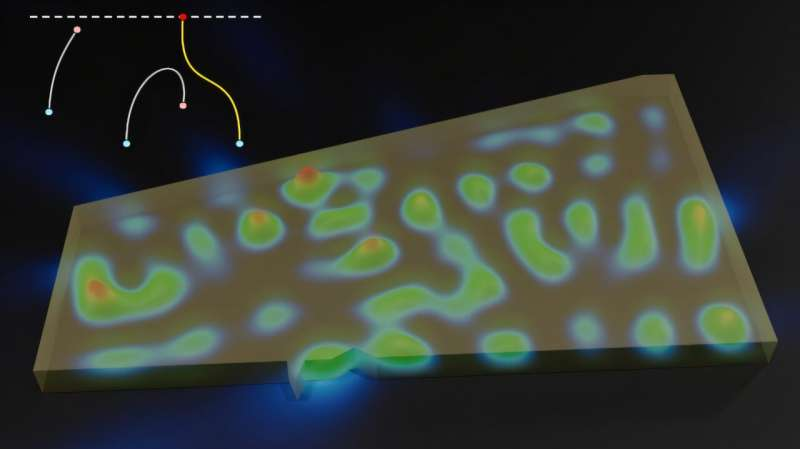
A new study published in Physical Review Letters has revealed a surprising and counterintuitive effect in laser physics: under certain conditions, laser modes that are not expected to win can reach the lasing threshold first. The reason behind this unexpected behavior lies in a mathematical and physical concept known as exceptional points, a feature of non-Hermitian systems that has been steadily reshaping how scientists think about open and lossy physical systems.
For decades, laser engineers and physicists have relied on a straightforward rule. In a laser cavity that supports multiple modes within the gain bandwidth, the first mode to start lasing should be the one with the highest quality factor (Q) and the fastest increase in gain as pumping is applied. This assumption has guided the design of lasers across applications ranging from telecommunications to sensing and imaging. The new research shows that this intuition does not always hold.
What Are Exceptional Points and Why They Matter
Exceptional points, often abbreviated as EPs, occur in systems that are non-Hermitian, meaning they exchange energy with their surroundings through gain and loss. At an exceptional point, two or more eigenvalues and their corresponding eigenstates merge, causing the system’s eigenspace to collapse in dimensionality. This behavior has no direct counterpart in conventional Hermitian physics.
Over the past decade, EPs have been associated with a range of unusual optical effects. These include loss-induced lasing, pump-induced laser shutdown, enhanced sensing performance, and the design of quasi-parity-time-symmetric laser systems that combine high output power with stable single-mode operation. The new study adds another unexpected phenomenon to this growing list: the reordering of lasing thresholds.
The Central Question the Study Asked
The researchers started with a simple but fundamental question. In a multimode laser cavity, is the first lasing mode always the one with the strongest gain advantage? Traditional laser theory would answer yes. However, the authors suspected that mode interactions near exceptional points might disrupt this clean hierarchy.
They investigated scenarios where two modes with relatively low quality factors approach one another as gain increases. Instead of remaining separate, these modes can coalesce at an exceptional point or undergo an avoided crossing in its vicinity. The key insight was that this interaction could dramatically alter the effective gain experienced by the modes, allowing one of them to reach threshold before a mode that initially appeared more favorable.
How Lower-Q Modes Can Win
The study shows that when two lower-Q modes merge at or near an exceptional point, their hybridization can lead to accelerated gain evolution for one of the resulting modes. Even though these modes start off with higher losses, the non-Hermitian interaction reshapes their trajectories as the material gain is increased.
As a result, a mode that would normally be expected to lase later can cross the threshold first. This overturns the conventional assumption that the highest-Q mode always dominates the onset of lasing. Importantly, this effect does not rely on exotic pumping schemes. The authors demonstrate that it can occur even under uniform pumping, making it highly relevant to real-world laser systems.
Single-Cavity and Coupled-Cavity Demonstrations
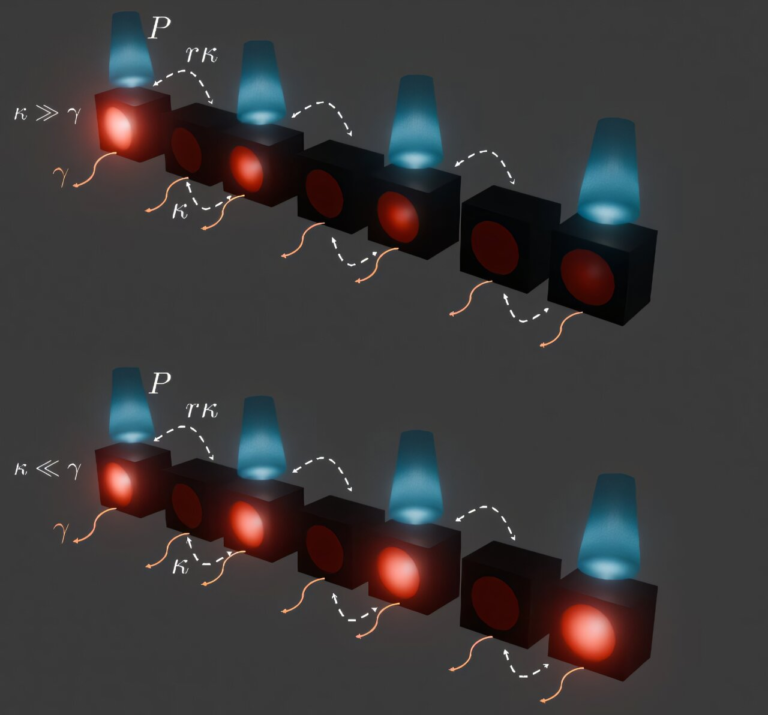
To ensure the robustness of their conclusions, the researchers explored multiple physical realizations of the effect. One part of the work focused on single-cavity systems, showing that even a single uniformly pumped cavity can exhibit lasing threshold reordering due to exceptional points.
In parallel, the team also designed and analyzed discrete photonic systems composed of coupled cavities. These coupled systems provide a clearer and more controllable setting in which to engineer exceptional points. In both cases, the results consistently showed that exceptional-point physics can override traditional gain-based mode selection.
A Collaboration Sparked by Scientific Exchange
The idea behind the study emerged during discussions at a scientific meeting organized by the Mathematisches Forschungsinstitut Oberwolfach (MFO) in Germany, focused on nonlinear optics. Conversations between researchers from different institutions led to the realization that exceptional points might play a role in reordering lasing thresholds, an effect that had not been carefully examined before.
Following the meeting, researchers at Otto-von-Guericke University in Magdeburg and Saint Louis University independently developed complementary approaches to demonstrate the phenomenon. Their combined efforts resulted in a comprehensive theoretical and numerical investigation that firmly established the effect.
Why This Finding Is Important for Laser Engineering
This discovery has significant implications for both fundamental physics and practical laser design. From a theoretical standpoint, it reinforces the idea that non-Hermitian effects are not niche curiosities, but can fundamentally reshape well-established principles in optics.
From an engineering perspective, the results suggest that mode control strategies based solely on quality factors and gain slopes may be incomplete. Designers of multimode lasers may need to account for exceptional points when predicting which modes will lase first. At the same time, this effect opens up new opportunities. By deliberately engineering exceptional points, it may be possible to select or suppress specific modes in ways that were previously thought impossible.
A Broader Look at Non-Hermitian Physics in Optics
Non-Hermitian physics has become a major research area over the last decade, especially in photonics. Unlike closed systems, optical devices naturally involve loss, radiation, and gain, making them ideal platforms for exploring non-Hermitian phenomena. Exceptional points are among the most striking features of these systems, leading to behaviors that challenge classical intuition.
This study adds to a growing body of evidence that exceptional points can influence not just steady-state properties, but also dynamic processes like threshold behavior. As researchers continue to explore these effects, it is likely that more foundational assumptions in optics will be revisited and refined.
Revisiting Old Rules with New Tools
One of the most striking aspects of this work is that it shows how even mature fields like laser physics can still yield surprises. The assumption that the highest-Q mode always lases first has been treated as almost self-evident. By examining the problem through the lens of non-Hermitian physics, the authors reveal that reality can be more nuanced.
This kind of insight underscores the importance of revisiting established ideas using new theoretical frameworks. Exceptional points, once considered mathematical oddities, are now proving to be powerful tools for understanding and controlling physical systems.
Research Paper Reference
Exceptional Points and Lasing Thresholds: When Lower-Q Modes Win
Physical Review Letters (2025)
https://arxiv.org/abs/2510.23846