Scientists Uncover How Ocean Microbes Control the Fate of Carbon Sinking Into the Deep Sea
Oceanographers from Florida State University have introduced a new scientific framework that helps explain what actually happens to carbon as it sinks from the ocean surface into the deep sea—a question that has puzzled researchers for decades. Their work connects tiny microbial processes happening at microscopic scales with large-scale carbon storage that influences Earth’s climate, offering fresh insight into how the ocean functions as the planet’s largest active carbon sink.
The research was led by Heather Forrer, a recent Ph.D. graduate from FSU’s Department of Earth, Ocean and Atmospheric Science, and involved collaborators from multiple institutions. The study spans several ocean regions and was published in Proceedings of the National Academy of Sciences (PNAS), one of the world’s most influential scientific journals.
At its core, the research shows that conditions in the upper ocean—such as nutrient levels and microbial activity—leave a lasting chemical imprint on carbon-rich particles, even after those particles sink thousands of meters into the deep ocean. This imprint ultimately determines how long carbon remains stored away from the atmosphere.
Why the Ocean’s Role in Carbon Storage Matters
The ocean plays a critical role in regulating Earth’s climate by absorbing carbon dioxide from the atmosphere. Much of this carbon enters the ocean through photosynthesis, carried out by microscopic marine plants known as phytoplankton. These organisms form the foundation of the marine food web and convert carbon dioxide into organic matter.
Some of that organic matter becomes particles that sink downward through the water column, a process known as the biological carbon pump. When carbon sinks deep enough and remains there for long periods—ranging from decades to thousands of years—it is effectively removed from the atmosphere, helping moderate global temperatures.
However, scientists have long struggled to understand why some carbon is efficiently stored while other carbon is quickly recycled back into the ocean and atmosphere. This new study addresses that gap.
Tracking Carbon at the Molecular Level
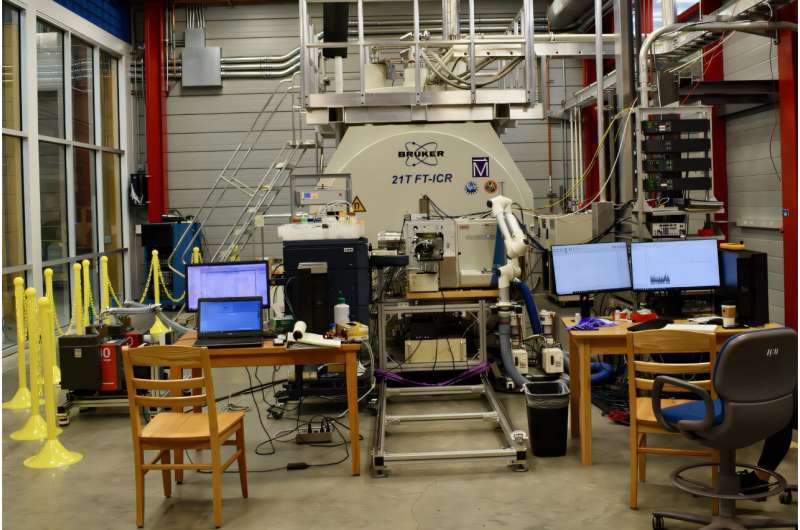
One of the most significant aspects of this research is the technology used to analyze sinking carbon particles. The team relied on an ultrahigh-resolution mass spectrometer known as the 21-tesla Fourier Transform Ion Cyclotron Resonance Mass Spectrometer (21T FT-ICR MS), housed at the FSU-headquartered National High Magnetic Field Laboratory.
This advanced instrument allowed researchers to identify individual molecules within sinking particles with unprecedented precision. For the first time, scientists could directly compare the molecular composition of sinking organic matter collected from different ocean regions and depths.
By examining particles at the molecular level, the team could determine how “fresh” or altered the carbon was, shedding light on how much microbial processing had occurred during its descent.
What the Researchers Studied
The team collected sinking particles from three distinct ocean regions:
- The Gulf of Mexico, a relatively nutrient-poor environment
- The California Current Ecosystem, a nutrient-rich upwelling region
- The tropical Indian Ocean, representing a different open-ocean system
These regions were chosen specifically because they differ in nutrient availability, biological activity, and sinking particle behavior. By comparing them, the researchers could isolate how surface ecosystem conditions influence carbon transformation.
Key Findings: Not All Carbon Sinks the Same Way
One of the most striking findings was that surface ocean conditions strongly shape the fate of carbon, even at great depths.
In nutrient-rich regions like the California upwelling system, particles tend to form quickly and sink rapidly. Because they move through the water column faster, microbes have less time to break them down. As a result, more chemically “fresh” carbon reaches the deep ocean, making these regions especially effective at long-term carbon sequestration.
In contrast, nutrient-poor regions such as the Gulf of Mexico produce particles that sink more slowly. These slower-moving particles are more heavily processed by microbes, undergoing significant molecular changes before reaching deep waters. This extensive microbial degradation reduces the amount of carbon that can be stored long-term.
Perhaps most surprisingly, the researchers found that the molecular fingerprints of surface ecosystems persist even in deep ocean samples. This means the deep ocean carries a chemical record of what was happening at the surface when the particles formed.
Introducing the “Molecular Diagenetic Clock”
The study introduces the concept of a molecular-level diagenetic clock, a framework that tracks how organic matter changes chemically as it sinks. “Diagenesis” refers to the suite of physical, chemical, and biological changes that occur after organic material is produced.
By analyzing molecular complexity and composition, the researchers could estimate how extensively particles had been altered since formation, effectively timing their degradation history. This approach allows scientists to compare carbon processing across regions in a more standardized and meaningful way.
The Role of Microbes in Carbon Fate
Microorganisms play a central role in determining whether carbon is stored or recycled. As particles sink, microbes feed on them, reshaping, fragmenting, and chemically transforming the organic matter. These processes affect both sinking speed and chemical stability.
This study reinforces the idea that microbial activity is not just a background process, but a primary driver of how the biological carbon pump operates. Small-scale interactions between microbes and particles can ultimately influence climate-scale carbon storage.
Why This Research Is Important for Climate Science
Understanding how carbon moves through the ocean is essential for accurate climate modeling. Current global climate models struggle to represent the biological carbon pump with precision, largely because the processes involved are complex and vary across regions.
By linking molecular chemistry, microbial ecology, and ecosystem-scale dynamics, this research provides a clearer framework for predicting how ocean carbon storage might respond to future changes such as ocean warming, nutrient shifts, and altered plankton communities.
As the climate continues to change, knowing how resilient marine carbon storage pathways are becomes increasingly important.
Collaboration Behind the Study
The research was a collaborative effort involving experts from multiple institutions. In addition to Heather Forrer, contributors included Michael Stukel (FSU), Robert Spencer (FSU), Amy Holt (University of Alaska Southeast), Sven Kranz (Rice University), Amy McKenna (National High Magnetic Field Laboratory and Colorado State University), and Huan Chen (National High Magnetic Field Laboratory).
The study also highlights the scientific power of interdisciplinary collaboration, combining oceanography, microbiology, and advanced analytical chemistry.
Expanding Our Understanding of the Ocean Carbon Pump
Beyond the immediate findings, this research adds to a growing body of evidence that the ocean’s carbon sink is highly sensitive to biological and chemical details. It is not simply a matter of how much carbon is produced at the surface, but how it is packaged, processed, and transported.
As scientists continue refining these frameworks, we gain a better understanding of how the ocean regulates Earth’s atmosphere—and how it might do so in a rapidly changing world.
Research Paper:
Forrer, H. J. et al. (2025). The molecular-level diagenetic clock of sinking marine organic matter. Proceedings of the National Academy of Sciences.
https://doi.org/10.1073/pnas.2504769122