Scientists Track How Powerful Solar Flares Recently Disrupted Earth’s Ionosphere
Scientists have been closely monitoring a remarkable burst of solar activity that recently shook Earth’s upper atmosphere, and the findings highlight just how deeply connected our planet is to what happens on the Sun. In mid-November 2025, a rare sequence of extremely powerful solar flares not only produced dazzling auroras across unusually wide parts of the globe, but also caused significant disturbances in Earth’s ionosphere — a critical layer of the atmosphere that supports radio communication, GPS navigation, and satellite operations.
Researchers at the New Jersey Institute of Technology’s Center for Solar-Terrestrial Research (CSTR) captured detailed observations of this event using a new and increasingly capable network of radio telescopes. While the auroras were the most visible effect for people on the ground, the real scientific story unfolded invisibly above our heads, in the electrically charged plasma of the ionosphere.
A Rare Cluster of X-Class Solar Flares
Between November 9 and November 14, 2025, the Sun unleashed an unusually intense series of solar flares from a single active region known as AR4274. What made this period stand out was not just the strength of the flares, but how many powerful eruptions occurred in such a short span of time.
During these six days, AR4274 produced four X-class solar flares, the most powerful category on the solar flare scale:
- X1.7 flare on November 9
- X1.2 flare on November 10
- X5.1 flare on November 11, the strongest solar flare recorded so far in 2025
- X4.0 flare on November 14
Seeing even one X-class flare is notable. Observing four from the same region within days is rare and signals an exceptionally productive and unstable solar environment. These flares released enormous bursts of X-ray and ultraviolet radiation, which travel at the speed of light and reach Earth in about eight minutes.
Radio Blackouts and Geomagnetic Storms on Earth
As the radiation from these flares struck Earth, it immediately affected the lower ionosphere, increasing ionization and disrupting radio signal propagation. The result was R3-level radio blackouts, classified as strong, across parts of Africa and Europe. High-frequency radio communications, often used in aviation and maritime operations, were particularly vulnerable during this time.
In addition to the radiation, several of the flares were associated with coronal mass ejections (CMEs) — massive clouds of charged particles and magnetic fields launched from the Sun. Unlike radiation, CMEs take one to three days to reach Earth, but their impact can be far more disruptive.
When these CMEs collided with Earth’s magnetic field, they triggered a G4 geomagnetic storm on NOAA’s five-point scale, placing it in the “severe” category. One of the clearest indicators of the storm’s strength was the Dst index, a measure of how much Earth’s magnetic field is compressed by solar wind. During this event, the index plunged from around –40 nanoteslas to nearly –250 nanoteslas in just a few hours, signaling an intense disturbance in Earth’s magnetosphere.
Auroras Far Beyond Their Usual Range
One of the most dramatic and widely noticed effects of the storm was the appearance of auroras at unusually low latitudes. Normally confined to high-latitude regions near the poles, the northern lights during this storm were visible across northern Europe, large parts of the United States, and as far south as Florida.
These auroras were caused by charged particles funneling into Earth’s atmosphere along magnetic field lines, where they collided with atmospheric gases and produced vivid light displays. For scientists, the widespread auroras were a visible confirmation of just how strong the geomagnetic storm had become.
How Scientists Observed the Ionospheric Disturbance
Although some of the flares occurred during nighttime in California, placing them out of direct view of NJIT’s Big Bear Solar Observatory, researchers were still able to capture the event’s full impact using radio instruments located at the Owens Valley Radio Observatory in the Eastern Sierra.
Two key facilities played a major role:
- The Expanded Owens Valley Solar Array (EOVSA), which observes microwave radio frequencies similar to those used by Wi-Fi and satellite communications
- The Long Wavelength Array at Owens Valley (OVRO-LWA), which detects longer radio waves comparable to FM radio frequencies
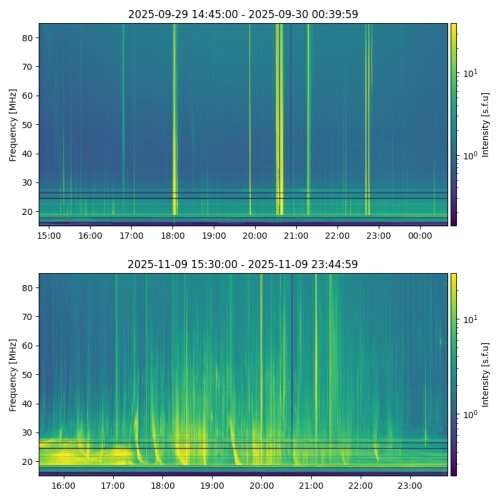
Together, these instruments tracked atmospheric changes across a wide range of frequencies. Under normal conditions, OVRO-LWA data show clean, nearly vertical features known as Type III radio bursts, which are signatures of energetic electrons traveling through the solar atmosphere.
After the flares and CMEs hit Earth, those same radio bursts became curved, distorted, and chaotic, especially at lower frequencies. This behavior is a clear indicator that the ionosphere had been significantly disturbed by solar activity.
Measuring the Impact on GPS and Technology
To better understand how these ionospheric changes affect everyday technology, researchers added another tool to their observational arsenal. Over the summer, NJIT scientists deployed a high-precision GPS receiver next to OVRO-LWA. The instrument, nicknamed FLUMPH (Field-deployed L-band Unit for Monitoring Phase Hiccups), is designed to measure subtle disruptions in satellite navigation signals.
By pairing GPS data with radio telescope observations, scientists were able to examine both sides of the problem: how solar activity disturbs the ionosphere, and how those disturbances translate into real-world impacts on GPS accuracy and radio communication. Plasma irregularities caused by geomagnetic storms can introduce errors, signal delays, and even complete dropouts in navigation systems.
Why the Ionosphere Matters So Much
The ionosphere extends roughly from 60 to 1,000 kilometers above Earth’s surface and plays a crucial role in modern life. It reflects and refracts radio waves, enabling long-distance communication, and it directly affects satellite signals traveling between space and the ground.
When solar radiation suddenly increases ionization, or when geomagnetic storms stir up plasma irregularities, the ionosphere becomes unpredictable. This can disrupt:
- Aviation and maritime radio communication
- GPS-based navigation and timing systems
- Satellite orbits due to increased atmospheric drag
- Spacecraft operations and astronaut safety
Events like the November 2025 storm offer scientists a rare opportunity to observe these processes in extreme conditions.
Solar Activity and the Bigger Picture
This series of flares occurred while the Sun is near the peak of its 11-year solar activity cycle, a period when large sunspots, flares, and CMEs are more common. While not every powerful flare leads to a geomagnetic storm — many CMEs miss Earth entirely — this time, the alignment was just right for a direct hit.
As solar activity gradually declines over the coming years, events of this intensity will become less frequent. However, they are expected to return in the next solar cycle. Understanding them now is especially important as humanity becomes increasingly dependent on space-based technology and pushes further into space exploration.
Looking Ahead
Scientists are still analyzing the full dataset from this storm, and the combination of EOVSA, OVRO-LWA, and GPS measurements represents a major step forward in space weather research. By tracking solar eruptions from their origin in the Sun’s corona all the way to their effects in Earth’s ionosphere, researchers are building a more complete picture of how space weather works — and how to better prepare for future storms.
As this event made clear, what happens on the Sun does not stay on the Sun. It can ripple all the way to Earth, lighting up our skies, shaking our magnetic defenses, and reminding us that our planet is part of a much larger and dynamic cosmic system.