Starquakes Reveal the Turbulent Past of a Rapidly Spinning Red Giant Orbiting a Quiet Black Hole
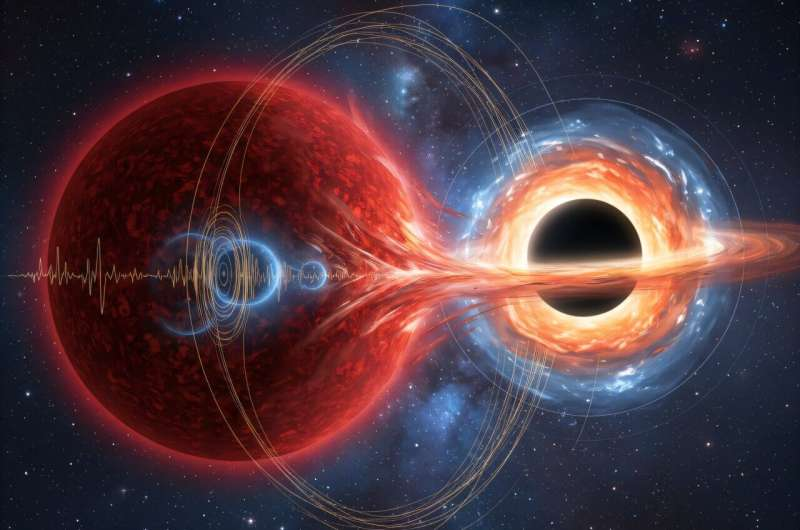
Astronomers have uncovered an unexpectedly dramatic history hidden inside a distant red giant star, all by listening to subtle vibrations rippling through its surface. This star, which orbits a quiet, non-feeding black hole in a system known as Gaia BH2, is helping scientists rethink how stars evolve, interact, and sometimes survive violent cosmic events.
The research was carried out by astronomers at the University of Hawaiʻi Institute for Astronomy (IfA) using data from NASA’s Transiting Exoplanet Survey Satellite (TESS). Their findings show that the red giant has characteristics that simply should not exist together: chemical traits of an ancient star combined with the internal structure of a much younger one. Even more intriguing, the star is spinning far faster than expected, hinting at a turbulent past involving stellar mergers or intense gravitational interactions.
Gaia BH2 and the Discovery of a Quiet Black Hole System
The Gaia BH2 system was first identified in 2023 using precise stellar motion data from the European Space Agency’s Gaia mission. Unlike many black hole systems that reveal themselves through bright X-ray emissions, Gaia BH2 is considered dormant. Its black hole is not actively pulling material from its companion, which means it remains invisible except through its gravitational influence.
In this system, the black hole is paired with a red giant star, a late evolutionary stage of a star that has exhausted hydrogen fuel in its core and expanded dramatically. The two objects orbit each other over a long period, forming one of the clearest known examples of a non-interacting black hole binary in our galaxy.
What makes Gaia BH2 particularly valuable to astronomers is that the companion star can be studied in detail, offering rare insights into how such black hole systems form and evolve without the complications of intense radiation or active accretion.
Listening to Starquakes With TESS
Using TESS, researchers detected faint oscillations in the brightness of the red giant. These oscillations, known as starquakes, are the stellar equivalent of earthquakes. They occur when sound waves bounce around inside a star, causing rhythmic expansions and contractions that slightly change its brightness.
By analyzing these vibrations, scientists can perform asteroseismology, a technique that reveals what is happening deep inside a star. This method allows researchers to measure core density, mass, internal layering, and even estimate stellar age with impressive precision.
In the case of Gaia BH2’s red giant, the starquakes provided an unusually clear window into the star’s internal structure, leading to some surprising conclusions.
A Star That Looks Old but Isn’t
Chemically, the red giant is classified as alpha-rich. This means it contains elevated levels of elements such as oxygen, magnesium, and silicon. Stars with these chemical signatures are typically very old, formed early in the Milky Way’s history when these elements were more abundant relative to iron.
Based on chemistry alone, astronomers would expect the star to be ancient. However, the asteroseismic data told a very different story. The internal structure revealed by the starquakes shows that the star is only about 5 billion years old.
This mismatch between chemical age and physical age is highly unusual. Young, alpha-rich stars are rare, and their existence challenges traditional models of stellar evolution.
Evidence of a Violent Past
The most likely explanation for this contradiction is that the star did not evolve in isolation. Instead, it probably gained extra mass during its lifetime. One leading scenario involves a stellar merger, where two stars collided and combined into a single object. Another possibility is that the star absorbed material from a companion during the event that led to the black hole’s formation.
In either case, the star would appear chemically old because it inherited material enriched by earlier generations of stars, while its internal structure would reflect its newer, more massive configuration.
This kind of mass gain effectively resets the stellar clock, making the star look younger on the inside while retaining the chemistry of an older population.
A Red Giant Spinning Faster Than Expected
Adding to the mystery is the star’s rotation. Observations from ground-based telescopes show that the red giant completes one rotation roughly every 398 days. For an isolated red giant of this age and size, such a rotation rate is unexpectedly fast.
Red giants usually rotate very slowly because they expand dramatically as they age, spreading out their angular momentum. The relatively rapid spin of this star strongly suggests it was spun up by external forces.
Tidal interactions with a close companion, especially during earlier evolutionary stages, could have transferred angular momentum to the star. This supports the idea that Gaia BH2 has experienced a complex and interactive history rather than a quiet, uneventful evolution.
Comparing Gaia BH2 With Gaia BH3
The research team also studied Gaia BH3, another dormant black hole system with a giant star companion. Based on theoretical models, the companion in Gaia BH3 should have shown detectable oscillations similar to those seen in Gaia BH2.
Surprisingly, no such oscillations were observed. This absence suggests that current models may not fully capture how extremely metal-poor stars behave, particularly when paired with black holes. The contrast between Gaia BH2 and Gaia BH3 highlights how much remains unknown about these rare systems.
Why Dormant Black Hole Systems Matter
Most known black holes have been discovered because they are actively feeding and emitting X-rays. Dormant systems like Gaia BH2 are far harder to find, yet they may represent the majority of black holes in the Milky Way.
Studying these quiet systems helps astronomers understand:
- How black holes form without destroying their companions
- How binary systems survive supernova events
- How stars can be altered through mergers and mass transfer
Gaia’s ability to detect black holes through stellar motion is opening a new window into this hidden population.
The Power of Asteroseismology
This study also highlights the growing importance of asteroseismology in modern astronomy. By measuring starquakes, scientists can:
- Accurately determine stellar ages
- Probe stellar cores directly
- Test and refine models of stellar evolution
In systems like Gaia BH2, where traditional clues can be misleading, starquakes provide some of the most reliable evidence available.
What Comes Next
Future observations from TESS are expected to provide even more detailed measurements of the red giant’s oscillations. These data could help confirm whether a stellar merger truly shaped the system and clarify how often such events occur in black hole binaries.
As more quiet black hole systems are discovered, studies like this one will play a crucial role in reshaping our understanding of both stars and black holes in our galaxy.
Research Paper:
https://doi.org/10.3847/1538-3881/ae0e25