Scientists Reveal the Earliest Steps of Human Placenta Formation and the Crucial Role of the VGLL1 Gene
Scientists have taken a major step toward understanding one of the most mysterious and critical stages of human development: how the placenta begins to form in the earliest days after conception. In a new study led by researchers at the University of California, San Diego, scientists uncovered how a specific gene, called VGLL1, plays a central role in kick-starting placental development. This research sheds light on a process that has long been difficult to study due to ethical and technical limitations.
The placenta is a temporary but absolutely essential organ. It supplies the developing fetus with oxygen, nutrients, hormones, and protective antibodies throughout pregnancy. It also removes waste products from the fetus’s bloodstream. Despite its importance, scientists have known surprisingly little about how the placenta first forms in humans, particularly during the earliest days after fertilization.
Why Early Placenta Formation Matters
Placental development begins very early—roughly six to twelve days after conception, right around the time the embryo implants into the uterine wall. When this process fails, the consequences can be severe. Incorrect placental formation is the second leading cause of early miscarriage, surpassed only by genetic abnormalities that make fetal development impossible.
Understanding these early stages is therefore crucial not only for basic biology, but also for reproductive health, fertility treatments, and pregnancy outcomes. However, studying human embryos at this stage is highly restricted, leaving scientists with limited direct evidence of what happens during implantation and early placental development.
How Researchers Modeled Early Placental Development
To overcome these barriers, the research team turned to human pluripotent stem cells. These cells have the ability to develop into almost any cell type in the human body, making them an ideal model for early development.
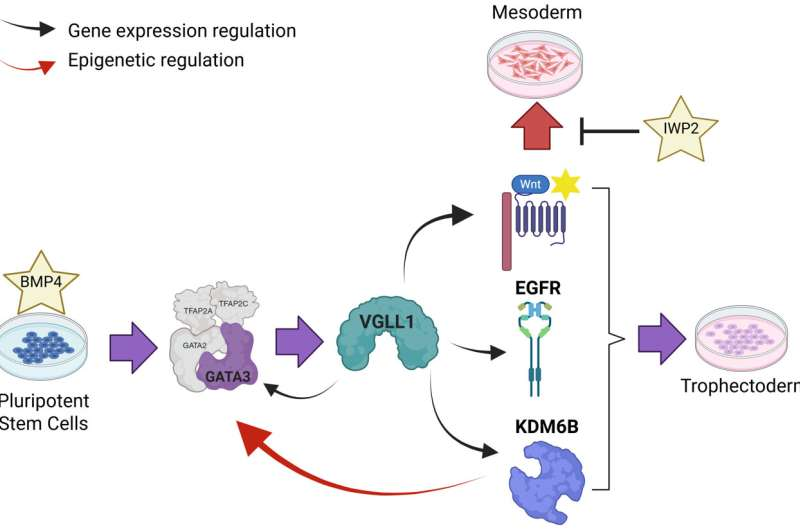
The researchers treated these stem cells with BMP4 (bone morphogenetic protein 4), a signaling molecule known to guide early embryonic cell differentiation. This treatment encouraged the stem cells to develop into cells resembling the trophoblast, the outer layer of the early embryo. The trophoblast is critically important because it eventually forms the placenta and plays a key role in implantation.
By carefully observing how these cells changed over time, the scientists were able to recreate and analyze the earliest molecular events involved in human placental formation—something that has not been possible before at this level of detail.
The Discovery of VGLL1’s Central Role
One of the most important findings of the study was the identification of VGLL1 (vestigial like family member 1) as a gene that turns on extremely early during placental development. The researchers found that VGLL1 is not just present, but essential for the process.
When VGLL1 was active, pluripotent stem cells successfully differentiated into various types of placental stem cells. However, when the researchers reduced or suppressed VGLL1 activity, the cells stopped differentiating altogether. Placental development effectively stalled.
This showed that VGLL1 is not a minor player, but a key regulator that enables cells to transition from a flexible, undifferentiated state into specialized placental cells.
How VGLL1 Works at the Molecular Level
Further investigation revealed that VGLL1 influences placental development through multiple interconnected mechanisms:
- VGLL1 strengthens several signaling pathways that are crucial for placenta formation. It does this by coordinating with other regulatory proteins to activate placenta-specific genes.
- The protein directly regulates an enzyme called KDM6B (lysine-specific demethylase 6B). KDM6B removes chemical tags from DNA-associated proteins, effectively “unlocking” genes that are normally kept silent. This process allows placental genes to become active at the right time.
- VGLL1 and KDM6B were found to be highly active in the outer cell layer of the early embryo, especially in regions directly involved in implantation into the uterus.
Together, these findings show that VGLL1 helps control both the transcriptome (which genes are turned on) and the epigenome (how accessible those genes are), making it a master regulator of early placental identity.
Why This Discovery Is Important for Fertility Research
Although the research is still in the preclinical stage, its implications are significant. Problems with implantation and early placental development are major contributors to failed pregnancies and unsuccessful IVF cycles. By identifying specific genes and molecular pathways involved in these processes, scientists now have clearer targets for future research and potential therapies.
Understanding VGLL1’s role opens the possibility that, one day, clinicians could improve embryo viability or enhance implantation success by influencing similar genetic pathways. While such applications are not imminent, this research provides a strong foundation for future advances in reproductive medicine.
What This Study Adds to Placenta Biology
The placenta is unique among human organs. It forms rapidly, functions intensely for a limited time, and is then discarded after birth. Unlike many other organs, it must also mediate communication between two genetically distinct individuals—the mother and the fetus.
This study adds valuable insight into how placental cells establish their identity so quickly and efficiently. It also highlights how human placental development differs from that of other species, underscoring the importance of using human-specific models rather than relying solely on animal studies.
Broader Context: The Placenta and Pregnancy Health
Abnormal placental development has been linked not only to miscarriage, but also to conditions such as preeclampsia, fetal growth restriction, and preterm birth. By better understanding the earliest steps of placental formation, researchers may eventually be able to trace how subtle molecular errors early in development lead to serious complications later in pregnancy.
This kind of foundational research is essential for connecting molecular biology with real-world clinical outcomes.
Looking Ahead
The discovery of VGLL1’s role in placental development represents a major advance in developmental biology. It shows how a single gene can coordinate complex genetic and epigenetic processes at a critical moment in human development. As scientists continue to refine stem cell-based models of early pregnancy, studies like this will help unravel long-standing mysteries about how life establishes itself in the earliest days.
For now, this research stands as a clear example of how innovative laboratory techniques can overcome ethical and technical challenges—and dramatically expand our understanding of human biology.
Research paper:
https://www.pnas.org/doi/10.1073/pnas.2508432122