AI Tool NeuroBridge Helps Neurotypical People Better Understand How Autistic Individuals Communicate Through Language
Communication differences between autistic and non-autistic people have long been recognized, but they are still widely misunderstood. Autistic individuals often process language, tone, and implied meaning in ways that differ from neurotypical norms. These differences can lead to confusion, misinterpretation, and unnecessary social friction—especially in workplaces, classrooms, and everyday conversations. A new AI-based tool called NeuroBridge aims to address this gap, not by changing how autistic people communicate, but by helping neurotypical individuals learn to communicate more clearly and effectively across neurotypes.
Developed by researchers at Tufts University, NeuroBridge uses large language models (LLMs) to create interactive learning experiences that expose users to common cross-neurotype communication challenges. The research behind the tool was presented at the 27th International ACM SIGACCESS Conference on Computers and Accessibility (2025), where it received the Best Student Paper Award—a strong endorsement from the accessibility research community.
Understanding the Communication Gap Between Autistic and Neurotypical People
Autistic people often excel in areas such as pattern recognition, attention to detail, memory, and logical reasoning. However, many experience challenges with aspects of communication that neurotypical people tend to take for granted. This includes interpreting nonverbal cues, understanding indirect requests, recognizing sarcasm or irony, and decoding figurative language.
For example, when a neurotypical person makes an indirect request like “When you get a chance, can you send that file?”, they may intend it as urgent. An autistic listener, however, might interpret it literally as non-urgent and respond accordingly. Similarly, a phrase like “That idea has legs” could be taken at face value rather than as a metaphor.
On the flip side, autistic individuals often prefer direct, explicit, and unambiguous language. While this can make communication clearer, neurotypical people sometimes misinterpret this directness as bluntness or lack of empathy. These mismatches can create frustration on both sides, even when no one intends harm.
Why NeuroBridge Takes a Different Approach
Most existing communication interventions focus on training autistic people to adapt to neurotypical communication styles. While well-intentioned, this approach can be exhausting and emotionally draining for autistic individuals, forcing them to mask their natural communication preferences.
NeuroBridge flips this model. Instead of asking autistic people to change, it helps neurotypical users develop perspective-taking skills, allowing them to better understand how their words may be interpreted by autistic people. This design choice aligns with the social model of disability, which argues that disability arises from mismatches between individuals and their environment—not from deficits within the individual.
The research team emphasizes that NeuroBridge is not a real-time assistive tool, like a translator used during live conversations. Instead, it functions as a learning environment, helping users gain insight and apply that understanding in future real-world interactions.
How NeuroBridge Works in Practice
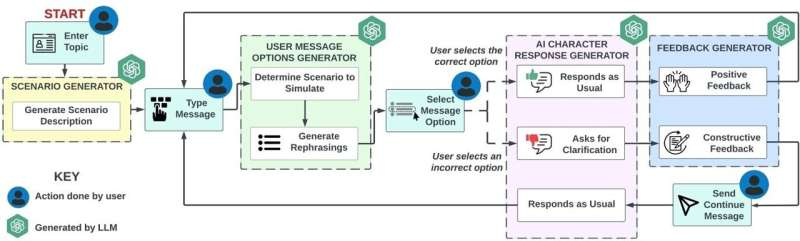
NeuroBridge creates customized conversational scenarios based on information provided by the user. These scenarios are designed to feel relatable and relevant, whether the context is work, school, or casual conversation.
At key points in the dialogue, the system presents the user with three different response options. Each option conveys a similar meaning but differs in phrasing, clarity, or tone. The user selects one, and NeuroBridge then explains how each version could be interpreted by an autistic person.
For instance, if the user wants advice on speeding up snow shoveling, the tool might offer:
- A question framed as “Is there a way…”
- A question framed as “Do you know how…”
- A direct question asking explicitly for methods or advice
NeuroBridge explains that the first two can be interpreted as yes-or-no questions, while the third is clearer because it directly states the information being requested. This feedback helps users recognize hidden ambiguities in everyday language that they may never have noticed before.
The system subtly trains users toward communication principles known as Gricean maxims, which emphasize clarity, relevance, brevity, and order in conversation.
Research Design and Evaluation
The project was led by Rukhshan Haroon, a Ph.D. candidate in the Department of Computer Science at Tufts University, under the supervision of Fahad Dogar, an associate professor in computer science and at Tufts’ Tisch College for Civic Life.
A crucial part of the development process involved iterative feedback from autistic volunteers, who served on an advisory board. Their input helped refine the system’s accuracy, tone, and overall design, ensuring it reflected real communication experiences rather than stereotypes.
The researchers tested NeuroBridge with 12 neurotypical participants. The results were encouraging. Participants reported that the tool helped them better understand how certain phrases, tones, and structures could be interpreted differently by autistic individuals. Many users noted that, in hindsight, the interpretations seemed obvious—yet they had never consciously considered them before.
Importantly, participants described the feedback as constructive and non-judgmental, making the learning process approachable rather than corrective or critical.
Potential Applications and Future Plans
The research team sees NeuroBridge as a tool with broad social impact. At Tufts University, they are already exploring ways to use it to support neurodiverse students and collaborate with campus organizations such as the StAAR Center, which provides academic and accessibility resources.
Beyond academia, the tool has clear potential in workplace training, education, healthcare, and any environment where effective communication across neurotypes matters. Because it is built on AI and scalable technology, NeuroBridge could eventually reach a wide audience without requiring extensive one-on-one training.
The researchers also acknowledge limitations. Large language models cannot perfectly capture the full diversity of autistic communication styles, and no single system can represent every autistic experience. However, they view NeuroBridge as a starting point, not a definitive solution—one that opens space for reflection, learning, and mutual understanding.
Why Tools Like NeuroBridge Matter
As conversations around neurodiversity become more visible, there is growing recognition that inclusion is not just about accommodation, but about shared responsibility. Clear communication benefits everyone, not just autistic individuals. By encouraging neurotypical people to reflect on how they speak and what they imply, NeuroBridge helps reduce misunderstandings at their source.
Rather than framing autism as something to be fixed, this approach treats communication differences as natural variations—and positions understanding as a skill that can be learned.
Research Paper Reference:
https://doi.org/10.1145/3663547.3746337