NASA Tests Advanced Drones in Earth’s Harshest Deserts to Prepare for Future Mars Flights
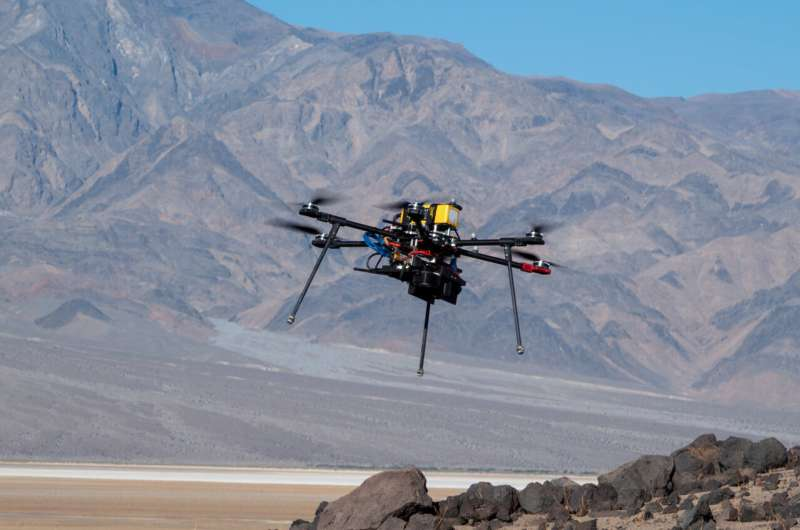
NASA is once again turning to some of the most unforgiving landscapes on Earth to prepare for exploration far beyond our planet. Earlier this year, engineers and researchers from NASA’s Jet Propulsion Laboratory (JPL) carried out an intensive series of drone tests in Death Valley National Park and the Mojave Desert, aiming to solve one of the trickiest problems faced by aerial vehicles on Mars: navigating over vast, featureless terrain.
These tests are not just routine experiments. They are a direct response to the challenges encountered by Ingenuity, NASA’s pioneering Mars Helicopter, during the final phase of its historic mission. By recreating Mars-like conditions here on Earth, NASA hopes to make future flying robots more capable, more autonomous, and far more versatile.
Why Earth’s Deserts Matter for Mars Exploration
Mars is often imagined as a rocky, red world filled with dramatic landscapes. While that’s true in many places, large portions of the planet are covered in bland sand dunes and low-contrast terrain that can be surprisingly difficult for autonomous vehicles to interpret. On Earth, environments like Death Valley closely resemble these conditions, making them ideal natural laboratories.
NASA’s team selected barren desert dunes because they closely mimic the visual monotony that confused Ingenuity’s navigation system on Mars. In simple terms, when the ground looks the same in every direction, it becomes harder for onboard cameras and software to track motion accurately. That exact issue played a role in several of Ingenuity’s later flights, including its 72nd and final mission on the Red Planet.
The Drone Test Campaign in Death Valley
During the campaign, JPL engineers deployed three research drones equipped with experimental navigation software. The flights took place across multiple locations in Death Valley National Park, including areas known for smooth sand and minimal surface features.
The goal was to refine navigation algorithms so future Mars rotorcraft can safely fly over terrain that lacks strong visual cues. Unlike Ingenuity, which was designed primarily for well-textured ground, these new systems are being developed with greater flexibility in mind.
By repeatedly flying the drones, adjusting the software, and flying again, the team gathered real-world data that simply cannot be replicated in computer simulations alone. These field tests allow researchers to see how lighting, shadows, wind, and subtle surface changes affect autonomous navigation in real time.
Expanding the Tests to the Mojave Desert
To add more variety to the experiment, the team also traveled to the Dumont Dunes in California’s Mojave Desert. This location has a long history with NASA. In 2012, it served as a testing ground for the Curiosity rover’s mobility system, helping engineers understand how rover wheels interact with loose sand.
At Dumont Dunes, the sand features gentle ripples rather than perfectly smooth surfaces. This provided a useful contrast to Death Valley’s flatter areas and allowed the team to evaluate how the navigation software performs across slightly different types of featureless terrain.
Testing in multiple environments helps ensure that future Mars drones won’t be optimized for just one scenario but can handle a wide range of conditions.
Lessons Learned From Ingenuity’s Mars Mission
Ingenuity was never meant to be a long-term aircraft. It was a technology demonstration, designed to prove that powered flight was possible in Mars’ thin atmosphere. Over time, however, it far exceeded expectations, completing 72 flights and scouting terrain for the Perseverance rover.
Despite its success, Ingenuity revealed important limitations. Its navigation system relied heavily on identifying visual features on the ground to estimate movement. When it crossed low-contrast dunes, the system struggled, making flight more risky.
NASA’s current drone tests are directly informed by these lessons. Engineers want future aerial explorers to operate confidently over dunes, rocky fields, and other challenging landscapes without needing constant intervention or ideal conditions.
Field Testing Versus Computer Models
While simulations and satellite imagery play a crucial role in mission planning, NASA researchers emphasize that field testing offers a deeper understanding. Real landscapes introduce unpredictable variables such as shifting sands, glare from the Sun, and subtle textures that don’t always appear in models.
These tests help scientists prepare for the reality that scientifically interesting locations on Mars are not always easy to reach. Future drones may need to fly over risky terrain to access valuable geological features, and robust navigation systems are essential for that mission.
Robot Dogs Join the Mars Technology Effort
Drone testing is only one part of NASA’s broader push to develop new Mars exploration tools. In August, another team from NASA’s Johnson Space Center traveled to White Sands National Park in New Mexico with a very different kind of robot.
The robot, known as LASSIE-M (Legged Autonomous Surface Science In Analogue Environments for Mars), resembles a robotic dog. Instead of flying, it walks. Sensors in its legs measure surface properties such as firmness and texture, allowing it to adjust its gait in real time.
These measurements can reveal subtle changes in terrain that often signal scientifically valuable areas. The long-term vision is for legged robots like LASSIE-M to scout ahead of astronauts or rovers, reaching places that wheeled vehicles might find too dangerous.
A Winged Alternative to Mars Helicopters
Another intriguing concept under development is the Mars Electric Reusable Flyer (MERF), being designed at NASA’s Langley Research Center in Virginia. Unlike Ingenuity’s compact helicopter design, MERF trades size for range.
MERF resembles a single wing with twin propellers, capable of vertical takeoff and hovering. A traditional fuselage and tail are omitted to reduce weight, which is critical in Mars’ thin atmosphere. When in forward flight, the vehicle can skim the Martian sky at high speed while instruments mounted underneath map the surface below.
At full scale, MERF would be about the length of a small school bus. For now, engineers are testing a half-scale prototype, focusing on aerodynamics and lightweight materials. These tests are helping determine whether a winged aircraft could complement or even replace rotorcraft for certain Mars missions.
Why These Technologies Matter for the Future of Mars Exploration
Together, drones, legged robots, and winged flyers represent a shift in how NASA thinks about exploring Mars. Instead of relying solely on rovers, future missions could involve teams of autonomous machines, each designed for a specific role.
Aerial drones could quickly scout terrain, identify hazards, and map large areas. Legged robots could climb rocky slopes or cross unstable ground. Winged vehicles could cover long distances efficiently, opening up entirely new regions of the planet.
All of this work is part of NASA’s ongoing Mars Exploration Program, which continues to invest in power systems, drilling tools, sampling equipment, and advanced autonomous software. The ultimate goal is to make Mars exploration safer, more efficient, and scientifically richer.
Looking Ahead
NASA’s desert drone tests may look modest at first glance, but they represent a critical step toward the next generation of Mars exploration. By learning from past missions and pushing technology forward in realistic conditions, engineers are laying the groundwork for future vehicles that can explore Mars with greater freedom than ever before.
As these technologies mature, the skies above Mars may one day be filled with machines that owe their success to long days spent flying over Earth’s hottest and most desolate deserts.
Research reference: https://www.jpl.nasa.gov/news/nasa-tests-drones-in-death-valley-preps-for-martian-sands-and-skies