Ancient Earth’s Skies May Have Helped Create Life by Raining Down Essential Sulfur Molecules
New research suggests that Earth’s early atmosphere played a far more active role in the origin of life than scientists previously believed. Instead of life having to assemble all its basic chemical components from scratch on the planet’s surface, the sky itself may have been supplying some of the most important ingredients. According to a recent study from researchers at the University of Colorado Boulder, ancient skies could have produced and delivered sulfur-containing biomolecules—key building blocks of life—long before the first living organisms appeared.
This research challenges long-standing assumptions about how and where life’s chemistry began, and it also has important implications for how scientists interpret possible signs of life on other planets.
Why Sulfur Matters for Life
Sulfur is one of the essential elements of biology, alongside carbon, hydrogen, oxygen, nitrogen, and phosphorus. It is found in all known life forms, from bacteria to plants to humans. In particular, sulfur plays a crucial role in:
- Amino acids such as cysteine and methionine, which are building blocks of proteins
- Enzymes, where sulfur helps control chemical reactions
- Metabolism, including energy transfer and cellular regulation
For decades, scientists assumed that while early Earth contained sulfur in volcanic gases and minerals, complex organic sulfur compounds—the kind used by living cells—only appeared after life had already begun. In other words, sulfur biochemistry was thought to be a biological invention, not a prebiotic one.
This new study strongly questions that idea.
Simulating Earth Before Life Existed
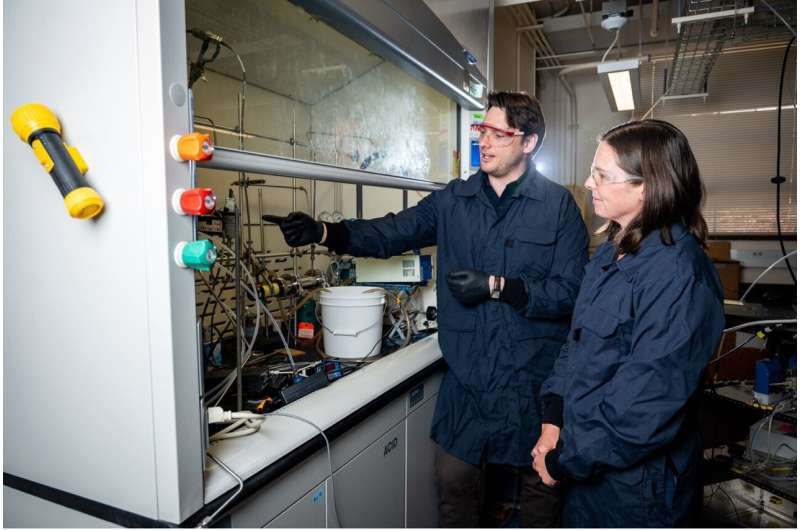
To investigate what Earth’s atmosphere might have been capable of billions of years ago, the research team recreated early Earth–like atmospheric conditions in the laboratory. Their simulated atmosphere included gases that scientists believe were common before life emerged:
- Methane
- Carbon dioxide
- Nitrogen
- Hydrogen sulfide, a sulfur-bearing gas likely released by volcanoes
The mixture was then exposed to light, mimicking the energy from the young Sun. This kind of light-driven chemistry, known as photochemistry, is known to trigger complex reactions in planetary atmospheres.
Working with sulfur is especially difficult because sulfur compounds tend to exist at very low concentrations and often stick to laboratory equipment. To overcome this, the researchers used extremely sensitive mass spectrometry instruments capable of detecting tiny traces of chemical products.
What they found was striking.
A Surprise Mix of Sulfur Biomolecules
The simulated early atmosphere produced a diverse collection of sulfur-containing organic molecules that are directly relevant to biology. Among them were:
- Cysteine, a sulfur-based amino acid essential for protein structure and function
- Taurine, an amino acid–related compound important for cellular processes
- Coenzyme M, a molecule critical for metabolism in some modern organisms
These are not simple chemicals. They are biomolecules, previously believed to require living systems to form. Yet here they appeared through purely atmospheric chemistry, with no biology involved.
This result suggests that Earth’s atmosphere itself could have been a global chemical reactor, producing biologically useful molecules under widespread, non-specialized conditions.
How Much Could the Sky Really Produce?
To understand whether these reactions mattered on a planetary scale, the team took their laboratory measurements and scaled them up to an entire early Earth atmosphere.
The calculations showed that the ancient sky could have produced enough cysteine to supply roughly one octillion cells—that is, 1 followed by 27 zeros. For comparison, modern Earth is estimated to host about one nonillion cells, or 1 followed by 30 zeros.
While the early amount is smaller than today’s total biomass, it is still an enormous quantity for a planet where life had not yet begun. According to the researchers, this could have been more than sufficient to support the emergence of early microbial ecosystems.
Raining Ingredients Onto the Surface
Once formed in the atmosphere, these sulfur biomolecules would not have stayed in the sky forever. The researchers propose that they likely fell back to Earth’s surface through rain or atmospheric deposition, delivering ready-made organic compounds to oceans, lakes, and land.
This idea reshapes how scientists think about early environments thought to be crucial for life’s origin, such as:
- Hydrothermal vents
- Volcanic regions
- Shallow seas and tidal pools
While these locations may still have been important, life might not have needed to invent every complex molecule locally. Instead, some essential chemistry may have already been globally available, supplied from above.
Rethinking Long-Held Assumptions
Earlier simulations of early Earth often failed to generate meaningful amounts of sulfur-based biomolecules unless researchers used highly specialized or unrealistic conditions. As a result, sulfur chemistry was largely excluded from mainstream origin-of-life models.
This new work suggests that assumption was incomplete. Under realistic atmospheric conditions, sulfur chemistry appears to be both robust and widespread.
That realization also helps explain puzzling findings beyond Earth.
Implications for the Search for Life Elsewhere
Sulfur molecules play an important role in astrobiology, especially when scientists search for possible signs of life on exoplanets. One compound that has received attention is dimethyl sulfide (DMS), which on Earth is produced mainly by marine algae.
When DMS was detected in the atmosphere of the exoplanet K2-18b, it was initially viewed as a potential biosignature, or sign of life. However, earlier laboratory work by the same research group showed that DMS can form abiotically, using only light and simple gases.
The new findings strengthen the idea that organic sulfur compounds are not automatically proof of life. Instead, they may sometimes be products of atmospheric chemistry alone. This does not rule out life on other worlds, but it does mean scientists must be more cautious and precise when interpreting atmospheric data.
What This Means for Origin-of-Life Science
Taken together, these results support a growing view that life may have had more chemical help than previously assumed. Instead of starting from the simplest possible molecules, early life on Earth may have inherited a rich prebiotic chemical environment, shaped by atmospheric reactions driven by sunlight.
This makes the emergence of life feel less improbable, not because it was easy, but because the planet itself was actively preparing the stage.
Looking Ahead
The researchers emphasize that life still required very specific conditions to actually begin. Atmospheric chemistry alone did not create living cells. However, by supplying complex sulfur biomolecules across the planet, the early sky may have lowered the barrier for life to get started.
Future research will explore how these atmospheric processes interacted with surface environments and whether similar chemistry could occur on other planets with sulfur-rich atmospheres.
Research paper:
An Archean atmosphere rich in sulfur biomolecules – Proceedings of the National Academy of Sciences (2025)
https://www.pnas.org/doi/10.1073/pnas.2516779122