A Newly Discovered Companion Star May Finally Explain the Mystery of Extreme Cosmic Dust Around Kappa Tucanae A
Astronomers studying a nearby star system have uncovered a discovery that could finally explain one of the strangest and most persistent mysteries in planetary science: how extremely hot cosmic dust can survive in places where physics says it should not. The system in question is Kappa Tucanae A, located about 70 light-years from Earth, and the key to the mystery appears to be a previously hidden companion star moving through the heart of the dust-filled region.
For years, Kappa Tucanae A has puzzled scientists because it hosts unusually large amounts of hot exozodiacal dust—microscopic particles orbiting incredibly close to the star at temperatures exceeding 1,000 degrees Fahrenheit. At such extreme heat and proximity, these grains should either vaporize or be blown away by intense stellar radiation. Yet, against expectations, the dust persists.
Now, researchers from the University of Arizona’s Steward Observatory, working with international collaborators, have identified a companion star whose orbit may be the missing piece of the puzzle. Their findings were published in The Astronomical Journal and represent a major step forward in understanding how dust behaves in extreme stellar environments.
Why Hot Exozodiacal Dust Is Such a Big Problem
Exozodiacal dust is similar in concept to the zodiacal dust in our own solar system—the fine debris scattered between planets that reflects sunlight and creates a faint glow in the night sky. However, hot exozodiacal dust is far more extreme. These particles orbit much closer to their stars, where temperatures soar and radiation pressure is relentless.
From a theoretical standpoint, such dust should be short-lived. If astronomers observe large quantities of it, something must be either constantly replenishing the dust or preventing it from dispersing as expected. Until now, no convincing explanation fully accounted for the observations.
The issue is not merely academic. Hot exozodiacal dust is a major obstacle for future missions aimed at finding Earth-like exoplanets. NASA’s planned Habitable Worlds Observatory, expected to launch in the 2040s, will rely on advanced coronagraphs to block starlight and directly image faint planets. Dust close to a star can scatter light into these instruments, creating what scientists call coronagraphic leakage, which can hide or mimic planetary signals.
Understanding where this dust comes from—and how it survives—is critical for the future of exoplanet discovery.
The Unexpected Discovery of a Companion Star
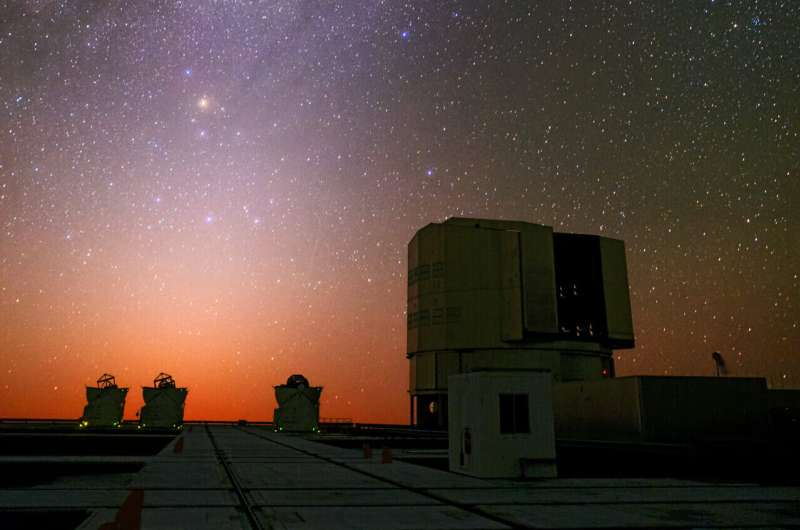
The research team used interferometry, a technique that combines light from multiple telescopes to achieve extremely high resolution. Observations were carried out between 2022 and 2024 using the MATISSE instrument at the European Southern Observatory’s Very Large Telescope Interferometer in Chile.
The goal was originally to monitor the dust itself. Instead, the team made a surprising discovery: a low-mass companion star orbiting Kappa Tucanae A. This detection set a new record as the highest-contrast stellar companion detection ever achieved with MATISSE.
The companion follows a highly eccentric orbit, meaning it does not move in a neat circle. At its closest approach, it comes within 0.3 astronomical units of the primary star—closer than Mercury ever gets to the Sun. It then swings far outward before plunging back through the dust-rich inner region.
This orbital behavior strongly suggests that the companion star is dynamically interacting with the dust, either stirring it up, creating new dust through collisions, or enabling mechanisms that extend the dust’s lifetime.
Turning a Mystery Into a Natural Laboratory
With the discovery of this companion, Kappa Tucanae A has effectively become a natural laboratory for studying hot exozodiacal dust. Scientists now have a real system where they can observe how extreme dust environments form and persist, rather than relying solely on theoretical models.
The system itself is part of a hierarchical quintuple star system, meaning it contains five stars arranged in nested orbital relationships. The newly detected subcomponent adds another layer of complexity—and opportunity—for research.
According to the researchers, it is extremely unlikely that the companion star is unrelated to the dust. Its repeated passages through the dust zone make some form of interaction almost unavoidable.
Possible Explanations for the Dust’s Survival
Several mechanisms are now being investigated to explain how the dust survives:
- Magnetic trapping, where charged dust grains become confined by stellar magnetic fields
- Continuous replenishment, possibly from comets or planetesimals being perturbed into the inner system
- Dynamical stirring caused by the companion star, leading to frequent collisions that create fresh dust
Different members of the research team are exploring each of these possibilities, and Kappa Tucanae A provides an ideal test case for comparing models with real observations.
Steward Observatory’s Longstanding Role in Dust Research
This discovery builds on decades of work at Steward Observatory, which has played a leading role in exozodiacal dust studies. The observatory’s Large Binocular Telescope Interferometer (LBTI) previously transformed the study of warm exozodiacal dust, a less extreme but related phenomenon.
That expertise is now feeding into the development of a next-generation European nulling interferometer, expected to be 50 times more sensitive than earlier instruments. This new technology will allow astronomers to detect even fainter dust structures and refine their understanding of dust dynamics around other stars.
The continuity of expertise is notable. Several scientists involved in the new instrument were trained at Steward Observatory, underscoring its global influence in this field.
Why This Discovery Matters for Future Exoplanet Missions
Hot exozodiacal dust systems are not rare, but they are poorly understood. The realization that some of these systems may host hidden stellar companions opens new directions for research. Astronomers now plan to revisit stars previously observed for dust, searching for companions that may have been overlooked.
For missions like the Habitable Worlds Observatory, this knowledge is crucial. Knowing which stars are likely to have problematic dust—and why—will help astronomers select targets more wisely and interpret observations more accurately.
Looking Ahead
The discovery of the companion star at Kappa Tucanae A was not anticipated, even though the system had been observed many times before. That surprise is part of what makes the finding so valuable. It reminds scientists that even well-studied stars can still hold major secrets.
With ongoing observations and improved instruments, researchers hope to answer fundamental questions about the origin, composition, grain size, and distribution of hot exozodiacal dust. The insights gained from this single system may ultimately apply to many others, shaping the future of exoplanet science.
Research paper:
Interferometric Detection and Orbit Modeling of the Subcomponent in the Hot-dust System κ Tuc A: A Low-mass Star on an Eccentric Orbit in a Hierarchical-quintuple System
https://doi.org/10.3847/1538-3881/adfe66