Menstrual Cups Have Now Been Tested in Space and Could Change How Astronauts Manage Health on Long Missions
Human life in space depends on systems most people on Earth never think twice about. Eating, sleeping, using the bathroom, staying clean—every one of these activities requires careful engineering once gravity disappears. Menstrual health is no exception, yet it has long remained under-researched. That is beginning to change. A recent spaceflight experiment has successfully tested menstrual cups under real rocket flight conditions, opening up new possibilities for health autonomy during future missions to the Moon, Mars, and beyond.
The research was led by astrobiologist Lígia Coelho, a 51 Pegasi b Postdoctoral Fellow in astronomy at Cornell University’s College of Arts and Sciences and a fellow at the Carl Sagan Institute. The work was carried out by AstroCup, an international team of scientists and aerospace engineers who volunteered their time to address a gap in space medicine that has persisted for decades.
Why Menstrual Health Matters in Space
Most astronauts who menstruate currently suppress their menstrual cycles using hormonal contraception during space missions. This approach works reasonably well for missions lasting a few weeks or months, such as stays aboard the International Space Station. However, it becomes far more complicated for long-duration missions lasting several years, including future plans to establish a sustained human presence on the Moon or attempt crewed missions to Mars.
Hormonal suppression over many years would require carrying large quantities of medication and may increase health risks. There are already concerns within the space medicine community about potential links between long-term hormone use and blood clots, particularly in microgravity environments. At the same time, relying on disposable menstrual products such as pads or tampons would create serious waste management problems on long missions where every kilogram of cargo and every cubic centimeter of storage space matters.
This combination of medical, logistical, and ethical concerns has made menstrual health a critical issue for future space exploration, not just a matter of convenience.
Testing Menstrual Cups in Spaceflight Conditions
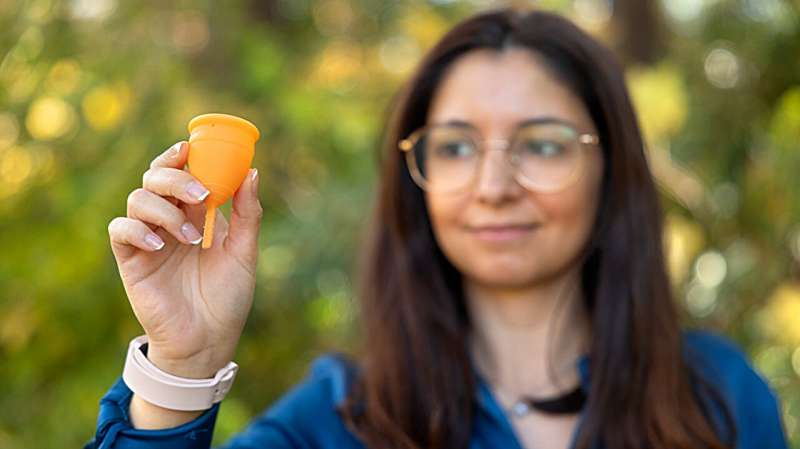
To address this challenge, the AstroCup team designed an experiment to test whether menstrual cups could withstand the physical stresses of spaceflight. Two medical-grade silicone menstrual cups manufactured by the Finland-based company Lunette were sent into space aboard an uncrewed rocket flight.
The menstrual cups were housed in a specially engineered container designed by aerospace engineers on the team. This container was equipped with sensors to record temperature, acceleration, and humidity throughout the flight. The rocket flight lasted approximately 9.3 minutes and exposed the payload to intense forces, especially during liftoff and again just before parachute deployment during descent.
Importantly, the forces experienced by the cups during this test were higher than those typically encountered on crewed space missions, providing a conservative assessment of their durability.
Results of the Spaceflight Experiment
After the rocket returned to Earth, the menstrual cups underwent a series of detailed tests. A water immersion test confirmed that the cups retained their structural integrity and showed no signs of deformation or damage. A second test using glycerol as a blood analog demonstrated that the cups also maintained their functional performance, including their ability to hold fluid as intended.
In simple terms, the menstrual cups behaved exactly as they would on Earth, despite being subjected to extreme acceleration and environmental stress. This result confirmed that a commercially available silicone menstrual cup can survive spaceflight conditions without losing functionality.
The findings were published in the peer-reviewed journal npj Women’s Health under the title “One Giant Leap for Womankind: First Menstrual Cups Tested in Spaceflight Conditions.” Beyond the physical results, the research also established a replicable methodology for testing menstrual and other health devices in space, which is especially important for future studies.
Health Autonomy and Choice for Astronauts
One of the most important implications of this research is the issue of health autonomy. Menstrual suppression has often been treated as the default option for astronauts, not because it is ideal, but because alternatives were never properly tested.
This study shows that astronauts could realistically have choices when it comes to menstrual care in space. For missions lasting five, ten, or even more years, having reusable options like menstrual cups could prevent the need to place reproductive health on indefinite hold.
There is also evidence that allowing astronauts to use their preferred health and hygiene methods can improve mental well-being, productivity, and overall mission performance, factors that become increasingly important as missions grow longer and more isolated.
Cleaning, Reuse, and Practical Considerations
While the results are promising, additional work remains. One key area for future research is cleaning and sterilization. On Earth, menstrual cups are typically cleaned with water and periodically sterilized using boiling water or portable sterilization kits commonly used by campers and hikers.
Researchers believe that similar portable sterilization solutions could be adapted for space use, though this will need to be tested in microgravity. Another related option is menstrual underwear, which aligns closely with current astronaut clothing practices. Astronauts aboard the International Space Station already wear single-use underwear, making this a potentially easy adaptation.
Testing Beyond the Rocket Flight
The AstroCup team has already begun moving beyond short rocket tests. In February, menstrual cups were included in the Hypatia II simulated Mars mission at the Mars Desert Research Station in Utah. During this mission, crew members provided feedback on usability and comfort in a Mars-like environment, offering valuable insights that cannot be captured through laboratory testing alone.
The team’s next major goal is to send menstrual devices of various kinds to the International Space Station, where long-term microgravity exposure can be studied directly. This step would bring menstrual health research fully into operational spaceflight.
A Broader Shift in Space Medicine
This research reflects a broader shift within space exploration toward designing systems that support diverse human bodies and long-term sustainability. As space agencies and private companies plan missions that could span decades, issues once considered minor are now recognized as mission-critical.
Menstrual health is not a niche concern—it affects a significant portion of the astronaut population and intersects with waste management, medical safety, psychological health, and ethical decision-making. The successful spaceflight test of menstrual cups demonstrates that these issues can be addressed with thoughtful engineering and rigorous science.
What This Means for the Future of Space Exploration
With this study, menstrual cups have moved from theoretical discussion to validated hardware. The research confirms that a standard, Earth-based menstrual product can function reliably in spaceflight conditions, clearing one of the major technical barriers to their use in orbit and beyond.
As humanity prepares to travel farther from Earth than ever before, this work represents a meaningful step toward ensuring that space is not just survivable, but livable. Giving astronauts practical, sustainable choices for managing their health is not only good science—it is essential for the future of long-duration human spaceflight.
Research Paper:
https://www.nature.com/articles/s44294-025-00112-9