AI-Guided Robot Astrobee Successfully Navigates the International Space Station Faster and Safer
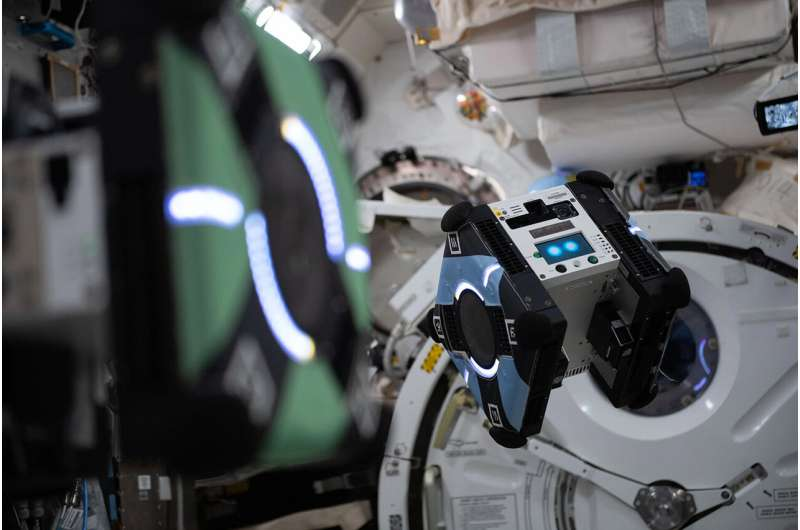
NASA’s toaster-sized free-flying robot Astrobee has just reached a major milestone in space robotics. For the first time ever, researchers have demonstrated that machine-learning-based control can safely guide a robot aboard the International Space Station (ISS). This achievement, led by researchers at Stanford University, marks a significant step toward more autonomous space missions where robots can operate efficiently with minimal human oversight.
Astrobee is not a new presence on the ISS, but what makes this development special is how it moves. Until now, most autonomous robotic navigation in space relied entirely on traditional control and optimization methods. Stanford’s work shows that AI can meaningfully assist these systems, making robotic motion planning faster while still preserving the strict safety standards required in orbit.
What Is Astrobee and Why It Matters
Astrobee is a cube-shaped, fan-powered robotic system developed by NASA to operate inside the ISS. Roughly the size of a small toaster, it floats through the station’s pressurized modules using internal electric fans. Its purpose is to help astronauts with routine but time-consuming tasks such as inventory management, environmental monitoring, inspections, and transporting small items.
Every minute of astronaut time is valuable, and robots like Astrobee are designed to take over repetitive duties. However, the ISS is a tight, cluttered, and constantly changing environment, filled with scientific equipment, cables, storage units, and human crew members. Safely navigating this space without collisions is a complex problem, especially when computing resources onboard the robot are limited.
Why Traditional Navigation Falls Short in Space
On Earth, many robots rely on powerful onboard computers or cloud-based systems to plan motion in real time. In space, that luxury does not exist. Space-rated hardware is resource-constrained, meaning it cannot easily run heavy computational algorithms. At the same time, the safety requirements are far stricter, because even a minor collision inside the ISS could damage critical equipment or endanger astronauts.
Traditional trajectory planning methods, while reliable, can be slow and computationally expensive. They typically start from scratch each time the robot needs to move, solving a complex optimization problem step by step. This is where Stanford’s new approach makes a difference.
How AI Helps Without Replacing Safety Systems
The Stanford team introduced a machine-learning-based “warm start” system to assist Astrobee’s navigation. Instead of asking the robot to compute every path from zero, the researchers trained a deep learning model on thousands of previously solved trajectories.
This trained model can recognize recurring patterns inside the ISS, such as where corridors usually exist, how obstacles are commonly arranged, and what types of maneuvers are often required. When Astrobee needs to move, the AI provides an informed initial guess for the path.
Crucially, the AI does not directly control the robot. The final trajectory is still computed using a mathematically rigorous optimization method called sequential convex programming, which enforces all physical and safety constraints. The AI simply gives the system a smarter starting point, allowing it to reach a safe solution much faster.
Real Testing on the International Space Station
Before sending the system to space, the researchers tested it extensively at NASA’s Ames Research Center. They used a special testbed where a robot floats on a cushion of air above a granite surface, simulating some aspects of microgravity. This step ensured the system behaved reliably before being approved for an actual ISS experiment.
The in-orbit experiment itself followed NASA’s crew-minimal philosophy. Astronauts were responsible only for setup and cleanup, while the robot operated autonomously during testing. Commands were sent from Stanford researchers to NASA’s Johnson Space Center in Houston, and then relayed to Astrobee onboard the ISS.
To ensure safety, the team used virtual obstacles instead of physical ones, maintained a backup robot, and allowed operators to immediately abort any run if something looked wrong.
Measurable Improvements in Speed and Efficiency
In total, the team tested 18 different trajectories, each lasting more than a minute. Every trajectory was run twice: once using the traditional cold start method, and once using the AI-assisted warm start.
The results were clear. With the AI warm start, Astrobee’s motion planning was 50 to 60 percent faster, especially in challenging situations. These included cluttered areas, narrow corridors, and paths that required rotation rather than straight-line movement. Importantly, the improved speed did not come at the cost of safety.
This demonstrated that AI-assisted planning can significantly improve efficiency while remaining trustworthy enough for real space operations.
A Major First for AI in Orbit
According to the researchers, this marks the first time AI has been used to help control a robot aboard the ISS. That distinction alone makes the work historically important. It also shows that machine learning can be integrated into space systems in a controlled, safety-focused way, rather than as a black-box replacement for proven methods.
One particularly meaningful aspect of the experiment was the involvement of astronaut Sunita Williams, who helped with setup and supervision. For the lead researcher, seeing Astrobee operate autonomously in orbit while astronauts floated by was a powerful validation of years of work.
Technology Readiness and Future Missions
After the successful ISS demonstration, the system achieved Technology Readiness Level 5 (TRL 5). This NASA designation means the technology has been validated in a relevant operational environment, making it low risk for future missions and experiments.
This matters because as NASA and other space agencies plan missions to the Moon, Mars, and beyond, robots will increasingly need to operate with limited or delayed communication with Earth. Real-time teleoperation will not always be possible, making autonomous decision-making essential.
Why Safety-Focused AI Is the Future of Space Robotics
The Stanford team emphasizes that autonomy alone is not enough. What matters is autonomy with built-in guarantees. By combining machine learning with classical optimization, this approach delivers both adaptability and reliability.
Future research will explore more powerful AI models, similar to those used in self-driving cars and modern language systems. These models could offer better generalization, enabling robots to handle even more complex and unpredictable environments in space.
As space missions become more frequent and cost-effective, robots like Astrobee will play a larger role in supporting astronauts, maintaining spacecraft, and conducting science. This work shows that AI can responsibly accelerate that future, one carefully planned trajectory at a time.
Additional Context: Why Free-Flying Robots Are So Valuable
Free-flying robots are uniquely suited for space stations because they can move without rails, arms, or tracks. This flexibility allows them to reach almost any location inside a spacecraft. As AI-enhanced navigation matures, similar robots could be deployed in future space habitats, orbital platforms, and deep-space vehicles, reducing workload and increasing mission safety.
Research Paper Reference:
Somrita Banerjee et al., Deep Learning Warm Starts for Trajectory Optimization on the International Space Station, arXiv (2025).
https://arxiv.org/abs/2505.05588