Scientists Have Finally Mapped Mars’ Massive Ancient Watersheds and the Results Change How We See the Red Planet
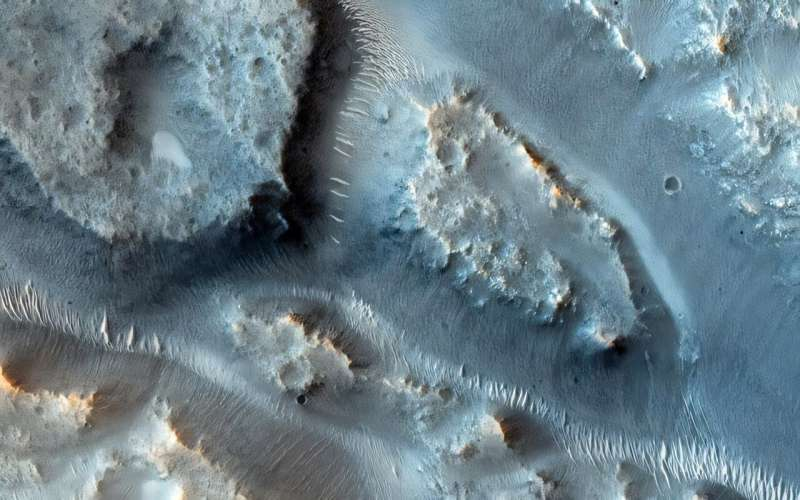
For decades, scientists have known that Mars once had flowing water. Images of dried-up valleys, channels, and lakebeds have made that clear. What remained uncertain, however, was whether these features were isolated events or part of something much larger and more organized. A new study has now provided a clear answer: ancient Mars hosted massive, interconnected drainage systems, similar in scale to some of Earth’s largest river basins.
Researchers from the University of Texas at Austin have completed the first comprehensive global mapping of Martian river basins, revealing how water once moved across the planet’s surface. Their findings show that a relatively small number of large drainage systems played a major role in shaping Mars’ landscape and transporting sediment across vast distances.
Mapping Mars Like Never Before
The study focused on identifying and mapping ancient Martian drainage systems, essentially the planetary equivalent of river basins on Earth. To do this, the researchers analyzed high-resolution datasets from two key instruments:
- The Mars Orbiter Laser Altimeter (MOLA), which flew aboard NASA’s Mars Global Surveyor between 1997 and 2006 and provided detailed elevation data for the planet.
- The Context Camera (CTX) on NASA’s Mars Reconnaissance Orbiter, which continues to deliver near-global coverage of Mars’ surface.
Using these datasets, the team employed ArcGIS Pro, a powerful geographic mapping software commonly used on Earth but increasingly applied to planetary science. By combining elevation data with visible surface features, they traced how ancient water likely flowed across Mars, identifying divides, flow paths, outlets, and sedimentary deposits.
To keep the study focused on major systems, the researchers only mapped drainage areas larger than 100,000 square kilometers, a threshold commonly used to define large river basins on Earth.
Sixteen Giant Drainage Systems With Outsized Impact
The results were striking. The team successfully identified 16 major drainage systems across ancient Mars. While these systems cover only about 5 percent of the planet’s ancient surface, they are estimated to have produced around 28,000 cubic kilometers of sediment.
That number matters because it represents roughly 42 percent of all sediment moved by flowing water on ancient Mars. In other words, a small number of very large river systems were responsible for nearly half of the planet’s fluvial sediment transport.
Even more intriguing, the study found that outlet canyons alone contributed about 24 percent of Mars’ global river sediment. These canyons likely formed when water escaped from lakes or subsurface reservoirs, carving dramatic channels as it flowed downhill.
This level of organization suggests that Mars’ water activity was not just a collection of short-lived floods, but in many places part of sustained, structured hydrological systems.
Why This Changes Our Understanding of Mars
Before this research, most evidence for Martian water came from disconnected features—valley networks here, lake deposits there, and scattered outflow channels elsewhere. While each feature pointed to water, they didn’t clearly show how everything fit together at a global scale.
This new mapping effort connects those dots. It shows that many of these features were once linked within enormous drainage basins, much like the Mississippi, Amazon, or Nile river systems on Earth.
This has major implications for how scientists think about Mars’ ancient climate. Large, integrated drainage systems are difficult to explain without long-lasting surface water, which may have come from rainfall, snowmelt, or repeated wet episodes rather than one-off catastrophic floods.
How Long Did Water Exist on Mars?
Mars formed around 4.5 billion years ago, at roughly the same time as the rest of the solar system. Scientists still debate how long liquid water persisted on its surface. Some argue for short, episodic wet periods, while others suggest longer, more stable conditions early in the planet’s history.
Adding to this discussion, a 2022 study proposed that liquid water may have existed on Mars as recently as 2 billion years ago. While the new drainage mapping does not directly date the rivers, the scale and organization of the systems strongly support the idea that water shaped Mars over extended periods.
Other Evidence That Mars Was Once Wet
The newly mapped watersheds join a long list of geological and mineralogical clues pointing to a watery Mars, including:
- Deltas, where rivers once emptied into lakes.
- Outflow channels, carved by massive releases of water.
- Gullies, some of which may have formed relatively recently.
- Coastal-like terraces, hinting at standing bodies of water.
- Clay minerals, which typically form in the presence of water.
- Sulfates and carbonates, indicating water-driven chemical processes.
- Hematite spherules, nicknamed “blueberries,” discovered by NASA’s Opportunity rover in 2004 and linked to groundwater activity.
Together, these features paint a picture of a planet that was once far more Earth-like than it is today.
What Happened to All That Water?
If Mars once had so much flowing water, where did it go? Scientists point to several likely causes.
One major factor is the loss of Mars’ magnetic field. Unlike Earth, Mars has a much smaller core, which cooled relatively quickly. As the core cooled, the planet’s magnetic field weakened and eventually dissipated. Without that protective shield, Mars’ atmosphere was exposed to solar wind and cosmic radiation, which gradually stripped it away.
With a thinner atmosphere, surface temperatures dropped and liquid water became unstable. Some water escaped into space, while scientists believe a significant amount may still be locked underground as ice or groundwater, or trapped in the planet’s polar regions.
Why These Watersheds Matter for Future Exploration
Large drainage systems are especially interesting for scientists searching for signs of ancient habitability. Where water flows for long periods, it interacts extensively with rock, creating chemical gradients and potentially concentrating organic material.
Because of this, the newly mapped watersheds could become high-priority targets for future Mars missions, particularly those focused on astrobiology. Understanding where sediment accumulated also helps researchers identify places where evidence of past life, if it ever existed, might be preserved.
A New Framework for Studying Planetary Rivers
Beyond Mars, this study also demonstrates a powerful new method for mapping ancient river systems on other worlds. By adapting Earth-based hydrological tools to planetary datasets, scientists can better reconstruct the environmental histories of planets and moons across the solar system.
In that sense, this research is not just about Mars’ past—it also opens doors to understanding how water shapes rocky planets everywhere.
Research paper:
https://www.pnas.org/doi/10.1073/pnas.2514527122