The Longest Gamma-Ray Burst Ever Recorded Is Forcing Astronomers to Rethink Cosmic Explosions
Gamma-ray bursts, commonly known as GRBs, are among the most extreme events in the universe. They are brief but incredibly powerful flashes of gamma radiation, releasing more energy in seconds than the Sun will emit over its entire lifetime. Astronomers have detected roughly 15,000 GRBs so far, with new ones discovered almost daily. Despite this large sample size, these events remain deeply puzzling. That uncertainty became even more obvious after the detection of GRB 250702B, the longest gamma-ray burst ever observed.
Detected on July 2, 2025, GRB 250702B lasted for an astonishing seven hours, nearly twice as long as the previous record holder. Most GRBs fade within milliseconds or minutes, and even the rare “long-duration” bursts usually last only a few minutes. A seven-hour gamma-ray signal is something astronomers had never seen before, and it immediately raised serious questions about how such an event could occur.
What Makes Gamma-Ray Bursts So Extreme
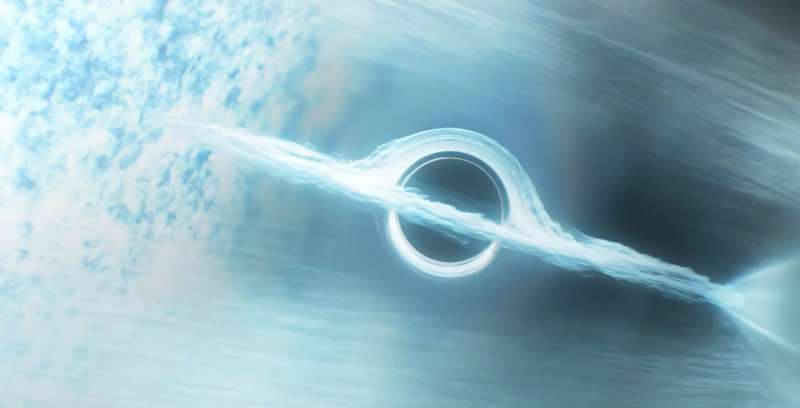
GRBs are the most luminous explosions known, typically originating in distant galaxies. The majority of long-duration GRBs are thought to form when a massive star reaches the end of its life, collapses under its own gravity, and forms a black hole. This process launches ultra-relativistic jets of material moving close to the speed of light. If one of these jets happens to be aimed toward Earth, we detect it as a gamma-ray burst.
Because these jets are tightly focused, most GRBs never point toward us and go completely unnoticed. All confirmed GRBs so far have occurred far beyond our galaxy, reinforcing how energetic and rare these alignments are.
A Burst That Wouldn’t End
GRB 250702B immediately stood out because of its duration. The burst lasted so long that no single space telescope was capable of observing it from start to finish. Instead, astronomers had to combine data from multiple spacecraft to piece together the full event.
Researchers described GRB 250702B as an ultralong gamma-ray and X-ray transient that does not fit neatly into any existing category of high-energy phenomena. This alone makes it scientifically valuable, because outliers often reveal gaps in our understanding of astrophysics.
Tracking Down the Source
To identify where the burst came from, astronomers turned to a wide range of ground-based and space-based observatories. Observations from Keck, Gemini, and the Very Large Telescope (VLT) indicated that the burst originated in a distant galaxy. The Hubble Space Telescope later confirmed this and revealed something unexpected about the host.
Instead of a small, faint galaxy—where most GRBs are typically found—this one appeared large, massive, and dusty. Hubble images suggested either two galaxies in the process of merging or a single galaxy with a thick dust lane splitting its core into two regions.
The James Webb Space Telescope (JWST) provided critical clarity. Using its NIRCam instrument, JWST showed that the burst’s light was shining through a dense dust lane within a single galaxy. The clarity of Webb’s infrared vision ruled out earlier uncertainties and revealed the host galaxy in remarkable detail.
Later in the summer, astronomers used JWST’s NIRSpec instrument alongside the VLT to measure the galaxy’s distance and age. They discovered that the burst occurred about 8 billion years ago, meaning its light began its journey long before our Sun and solar system even existed.
An Explosion of Almost Unimaginable Power
GRB 250702B was not just long-lasting—it was also extraordinarily energetic. The total energy released was equivalent to a thousand Suns shining continuously for 10 billion years. This places the event among the most powerful cosmic explosions ever recorded.
Unusual X-Ray Behavior
After the main gamma-ray emission faded, astronomers continued monitoring the burst using Swift, Chandra, and NuSTAR. These observatories detected rapid X-ray flares occurring up to two days after the initial burst, far longer than expected under standard GRB models.
Even more intriguing, astronomers found evidence of X-ray emission occurring before the gamma-ray burst itself. This early activity is highly unusual and suggests that matter was already accumulating around a black hole before the main explosion began.
A Surprisingly Massive Host Galaxy
Another surprise came from studying the host galaxy’s size. Most GRBs are associated with relatively small galaxies rich in star formation. In contrast, this galaxy turned out to be more than twice as massive as the Milky Way, making it a rare environment for such an event.
Possible Explanations for the Longest GRB
Astronomers have narrowed the likely causes of GRB 250702B to two main scenarios, both involving a black hole consuming a companion star.
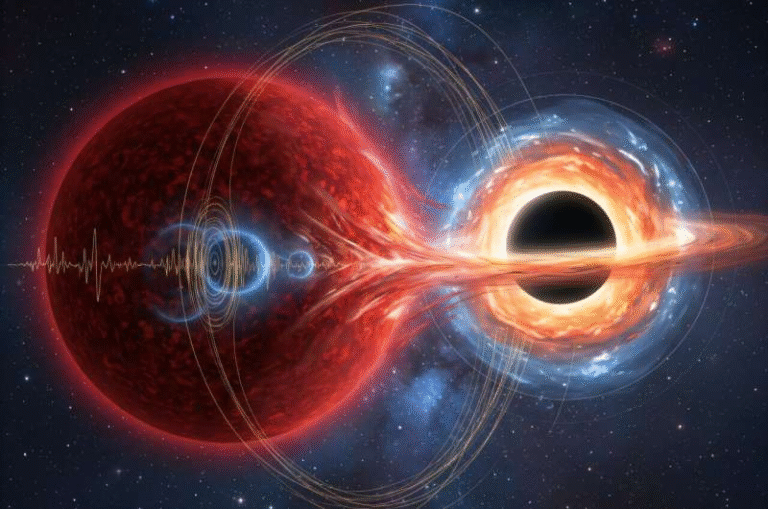
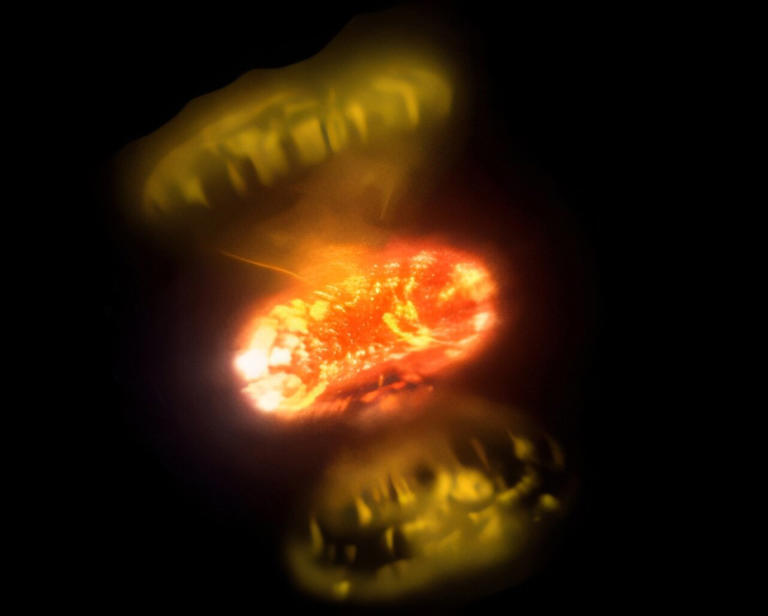
In the first scenario, an intermediate-mass black hole—with a mass of a few thousand Suns—tears apart a nearby star in a tidal disruption event (TDE). As the star is stretched and shredded, its material forms a disk around the black hole, producing intense radiation over an extended period.
The second scenario involves a stellar-mass black hole paired with a compact helium star. In this case, the black hole plunges directly into its companion. Once inside the star, it rapidly consumes material from within, sustaining gamma-ray emission for hours. Early X-rays would come from the forming accretion disk, while the later, more intense phase would produce the GRB itself.
Both scenarios explain the prolonged feeding of the black hole, which is necessary to keep the burst active for so long.
The Missing Supernova Puzzle
One complication with the second scenario is that it should produce a supernova explosion when the black hole merges with the star. No such explosion was detected. However, astronomers believe it could have been completely hidden by thick dust, even from JWST’s powerful infrared instruments.
Other explanations, including exotic collapsar models or smaller-scale tidal disruption events, are also being explored. For now, none can fully account for every observed feature.
Why This Discovery Matters
GRB 250702B highlights how much astronomers still have to learn about extreme cosmic events. Its multiwavelength signals, record-breaking duration, and unusual host galaxy challenge long-standing assumptions about how gamma-ray bursts form.
Events like this push scientists to refine existing models and consider entirely new mechanisms. As telescopes like JWST continue to observe the universe in unprecedented detail, astronomers expect more surprises—and more puzzles—like this one.
Research paper:
https://doi.org/10.3847/2041-8213/ae1741