A New Hypertropical Climate Is Emerging in the Amazon and It Could Reshape the World’s Largest Rainforest
The Amazon rainforest is undergoing a slow but deeply concerning transformation. Scientists now say the region is shifting toward an entirely new climate state—one that is hotter, drier, and far more stressful for trees than anything seen in millions of years. This emerging condition has been named the hypertropical climate, and if global greenhouse gas emissions continue at high levels, it could dramatically change how the Amazon functions by the end of this century.
This conclusion comes from a major new study led by researchers at the University of California, Berkeley, along with a large international team of scientists. Their work combines decades of on-the-ground measurements in the Amazon with advanced climate modeling, offering one of the clearest pictures yet of how climate change is pushing tropical forests beyond their historical limits.
What Scientists Mean by a “Hypertropical” Climate
The term hypertropical describes a climate regime that goes beyond what we currently define as tropical. According to the researchers, it refers to regions that are hotter than 99% of historical tropical climates, combined with more frequent and intense droughts.
This kind of climate does not exist anywhere on Earth today. However, it did exist millions of years ago, during periods when the planet was significantly warmer—roughly 10 to 40 million years ago. What makes this discovery alarming is not just the conditions themselves, but how quickly the Amazon appears to be moving toward them.
Global warming is lengthening the Amazon’s traditional July-to-September dry season and pushing temperatures higher at the same time. The result is an increase in what scientists call hot droughts, where extreme heat and low soil moisture occur together.
Why Hot Droughts Are So Dangerous for Trees
Hot droughts are especially deadly for rainforest trees because they stress multiple systems at once. The study found that when soil moisture drops below a critical threshold—about 0.32 to 0.33 by volume, meaning only one-third of the soil’s pores contain water—trees begin to struggle almost immediately.
At this point, trees face two devastating choices:
- They close their leaf pores to conserve water, which also shuts down carbon dioxide intake and essentially starves the tree.
- Or they continue drawing water upward, risking the formation of air bubbles in the xylem, the internal plumbing that moves water from roots to leaves. These bubbles, known as embolisms, block water flow and can lead to hydraulic collapse.
Either outcome can be fatal. Under hypertropical conditions, tree mortality increases by about 55% above normal levels, a striking jump for an ecosystem where annual tree death rates usually hover just above 1%.
Not All Trees Are Affected Equally
One of the study’s most important findings is that fast-growing, low wood-density trees are far more vulnerable to hot droughts than slower-growing species with denser wood.
These fast-growing trees are common in secondary forests, which regrow after logging or other disturbances. That means forests that have already been altered by human activity may be especially exposed to future climate stress.
As hot droughts become more common, the Amazon’s tree composition is likely to shift toward more drought-tolerant species—if the forest can adapt quickly enough. The concern is that climate change may be happening faster than ecosystems can reorganize, leading to widespread forest degradation or die-off.
Decades of Data From Deep Inside the Amazon
The conclusions of this study are grounded in more than 30 years of continuous field research. The lead scientist has been working in the Amazon since the early 1990s, much of that time in collaboration with Brazil’s Instituto Nacional de Pesquisas da Amazônia (INPA) near Manaus.
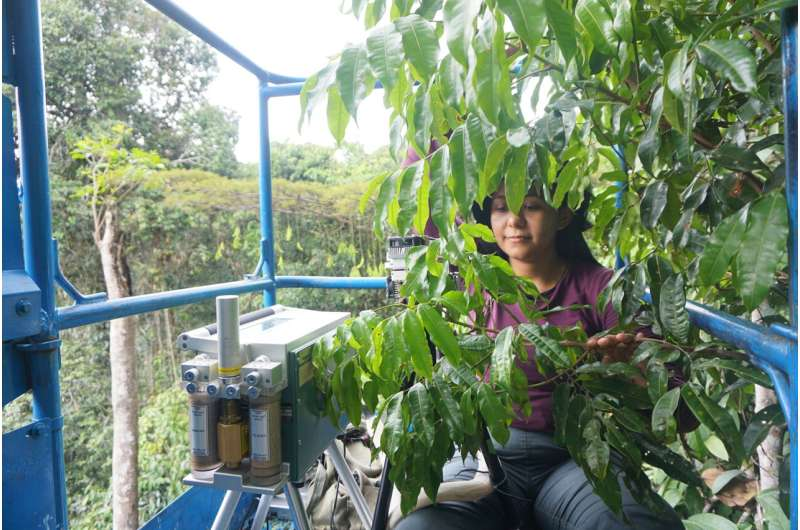
At two long-term research sites north of Manaus, scientists installed towering measurement platforms—each around 50 meters tall—to track temperature, humidity, sunlight, and soil moisture from the forest floor to the canopy. Sensors were also placed directly inside trees to measure sap flow, leaf temperature, water transpiration, and soil water potential, which indicates how hard trees must work to pull water upward.
These tools allowed researchers to closely observe how trees responded during major droughts, including those caused by El Niño events in 2015 and 2023. Remarkably, both sites showed nearly identical soil moisture thresholds at which tree stress sharply increased, despite differences in forest composition and drought timing.
Carbon Storage at Risk
The Amazon rainforest is one of the planet’s most important carbon sinks, absorbing more human-generated carbon dioxide than any other biome on Earth. Many Amazonian trees live for centuries—some for more than 1,000 years—making the forest a long-term storage system for carbon.
However, when hot droughts strike, carbon uptake slows or stops. Trees close their pores, photosynthesis declines, and dead trees release stored carbon back into the atmosphere. Recent observations already show spikes in atmospheric carbon dioxide following severe Amazon droughts, confirming that tropical weather has a measurable impact on the global carbon budget.
If hypertropical conditions become widespread, the Amazon’s ability to buffer climate change could be severely weakened, creating a dangerous feedback loop: warming causes forest stress, stressed forests absorb less carbon, and more carbon remains in the atmosphere, accelerating warming even further.
Looking Toward the End of the Century
Climate models examined in the study suggest that hot drought conditions could begin appearing regularly within the next 20 to 40 years, initially during the dry season. By 2100, however, the situation becomes far more severe.
Under high-emissions scenarios, the Amazon could experience up to 150 days per year of hot drought conditions. These extreme events would no longer be confined to the driest months but would increasingly occur year-round, even during what is currently the wet season.
Similar climate shifts are also projected for other tropical rainforest regions, including western Africa and Southeast Asia, suggesting that the emergence of hypertropical climates could become a global phenomenon.
Why This Research Matters Beyond the Amazon
This study does more than document a regional climate shift. It highlights how close Earth’s systems may be to crossing new ecological thresholds. The Amazon has long been considered resilient, but this research shows that resilience has limits—especially when heat and drought combine.
The authors describe present-day hot droughts as early warning signs, offering scientists a chance to understand how tropical forests respond before these conditions become the norm. What happens in the Amazon will influence global climate stability, biodiversity, and carbon cycling for generations to come.
Ultimately, the researchers stress that the future of the Amazon is not predetermined. The speed and severity of hypertropical climate emergence depend heavily on how quickly society reduces greenhouse gas emissions. The choices made now will shape whether this vast rainforest adapts, transforms, or declines.
Research paper:
https://www.nature.com/articles/s41586-025-09728-y