Medical Imaging Contrast Agents Are Quietly Becoming a Serious Environmental Pollution Problem
Medical imaging plays a critical role in modern health care, helping doctors diagnose everything from cancer and strokes to internal injuries and heart disease. But a new large-scale study has revealed a side of medical imaging that rarely gets attention: the massive environmental footprint of imaging contrast agents routinely used in CT and MRI scans.
According to newly published research in JAMA Network Open, millions of liters of contrast media used in medical imaging are entering the environment each year, accumulating in water systems and raising concerns about long-term ecological and public health consequences. The findings are detailed, data-driven, and hard to ignore.
How Much Contrast Media Are We Really Using?
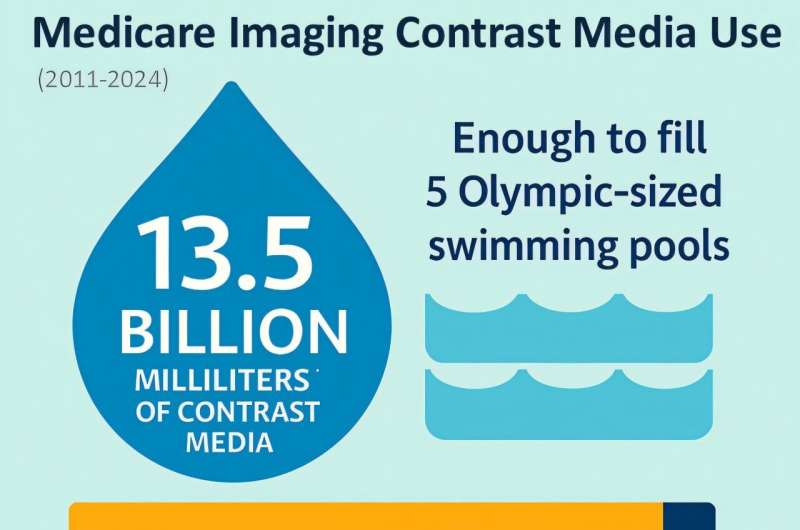
The study analyzed Medicare claims data spanning 13 years, from 2011 to 2024, making it one of the most comprehensive assessments of contrast media use in the United States to date. Over that period, Medicare patients alone received approximately 13.5 billion milliliters of medical imaging contrast agents.
To put that into perspective, that is 13.5 million liters of substances specifically designed to be visible inside the human body and then excreted into wastewater systems.
Researchers identified 169 million contrast-enhanced imaging procedures performed within the Medicare population during those 13 years. This includes contrast-enhanced CT scans, CT angiography, MRI, and MR angiography.
Iodinated Contrast Agents Dominate Overall Usage
One of the clearest findings from the study is that iodinated contrast agents account for the overwhelming majority of total contrast volume. These agents are primarily used in CT scans and CT angiography.
More than 95 percent of all contrast media volume, roughly 12.9 billion milliliters, consisted of iodinated contrast. Among CT procedures, abdominal and pelvic CT scans were the single largest contributors, using approximately 4.4 billion milliliters of iodinated contrast alone.
This concentration of use highlights a critical point: a relatively small set of imaging exams drives most contrast consumption. That insight could be important when designing strategies to reduce unnecessary contrast use without compromising patient care.
Gadolinium-Based Agents Still Add Up
While gadolinium-based contrast agents are used less frequently than iodinated agents, their total volume is still substantial. The study found that nearly 600 million milliliters of gadolinium-based contrast were administered during MRI and MR angiography exams.
Among MRI procedures, brain MRIs accounted for the largest share of gadolinium use, reflecting how frequently contrast-enhanced brain imaging is used for neurological conditions, tumors, and vascular abnormalities.
Gadolinium deserves special attention because it is a rare earth element, and its presence has already been detected in rivers, lakes, and even drinking water in various parts of the world.
Why Contrast Media Are an Environmental Concern
Medical imaging contrast agents are not like most pharmaceuticals. After serving their purpose in the body, they are excreted largely unchanged. Conventional wastewater treatment systems are not designed to fully remove iodine- or gadolinium-based compounds, allowing them to pass into natural water systems.
Once released, these substances can persist in rivers, oceans, groundwater, and drinking water supplies. Both iodine and gadolinium are nonrenewable resources, meaning their accumulation in the environment is not easily reversible.
Although the direct health effects of long-term, low-level environmental exposure are still being studied, researchers agree that persistent medical pollutants raise legitimate ecological and public health concerns.
Imaging Growth and Pandemic Effects
The study also tracked changes in contrast use over time. Between 2014 and 2019, contrast use rose steadily, reflecting broader growth in advanced medical imaging. Iodinated contrast use increased at an average annual rate of about 5 percent, while gadolinium-based contrast use grew by approximately 3 percent per year.
In 2020, imaging volumes temporarily declined due to the COVID-19 pandemic, as elective procedures were postponed and hospital access was limited. However, contrast use rebounded quickly in the years that followed, returning to — and in some cases exceeding — pre-pandemic levels.
A Small Number of Procedures Drive Most Usage
One of the most actionable findings from the research is that around 80 percent of all contrast media use comes from just a handful of imaging procedure types. This suggests that sustainability efforts do not need to overhaul the entire imaging system to make a difference.
Instead, focusing on high-volume contrast exams, such as abdominal CT scans and common MRI protocols, could significantly reduce overall contrast consumption while preserving diagnostic quality.
Practical Strategies to Reduce Environmental Impact
The researchers outlined several realistic and achievable mitigation strategies that imaging departments can implement.
One of the most important steps is ensuring that contrast-enhanced imaging is clinically appropriate. Following established guidelines, such as the American College of Radiology Appropriateness Criteria, can help avoid unnecessary contrast use when non-contrast imaging would suffice.
Another key approach is weight-based dosing. Many patients receive standardized doses that may exceed what is actually needed for diagnostic image quality. Tailoring doses more precisely can reduce waste without compromising results.
The study also highlights the potential role of multiuse vial systems and contrast recycling programs, which can significantly cut down on unused contrast that would otherwise be discarded.
Emerging Technologies That Could Help
Beyond operational changes, technology may offer longer-term solutions. Researchers point to ongoing work on biodegradable contrast agents, though these are still largely experimental and not yet widely available for clinical use.
Another promising area is artificial intelligence–based image enhancement. AI algorithms are increasingly capable of improving image quality, potentially allowing some scans to be performed with lower contrast doses or no contrast at all in certain clinical situations.
Why This Matters Beyond Radiology
Health care is increasingly recognized as a major contributor to global environmental emissions and pollution, and medical imaging is a growing part of that footprint. Contrast agent stewardship represents a measurable and impactful way to align high-quality patient care with broader sustainability goals.
This study makes it clear that environmental responsibility in health care does not require sacrificing diagnostic accuracy. Instead, it calls for thoughtful use, smarter protocols, and targeted innovation.
The Bigger Picture of Medical Imaging Contrast
Contrast agents have revolutionized diagnostic medicine, enabling early detection of disease and guiding life-saving treatments. But as imaging volumes continue to rise worldwide, the environmental consequences can no longer be treated as invisible.
The findings from this research serve as a reminder that even essential medical tools carry downstream impacts. Understanding those impacts is the first step toward managing them responsibly.
Research paper reference:
https://jamanetwork.com/journals/jamanetworkopen/fullarticle/2842400