Seeding Jet Exhaust With Ice-Nucleating Particles Could Significantly Reduce Aviation’s Climate Impact
Modern aviation has a climate problem that goes far beyond carbon dioxide emissions. Those thin white streaks you often see trailing behind airplanes—called contrails—play a much larger role in global warming than many people realize. New research now suggests a surprisingly simple idea could dramatically reduce their impact: adding tiny ice-nucleating particles to jet exhaust.
A recent study published in the journal ACS ES&T Air explores how carefully controlled seeding of aircraft exhaust could shorten the lifespan of contrails and sharply reduce their warming effect on the planet. The research was led by Fangqun Yu, a senior atmospheric scientist at the University at Albany’s Atmospheric Sciences Research Center, who has spent more than two decades studying atmospheric particles and contrail microphysics.
Why Contrails Matter More Than You Think
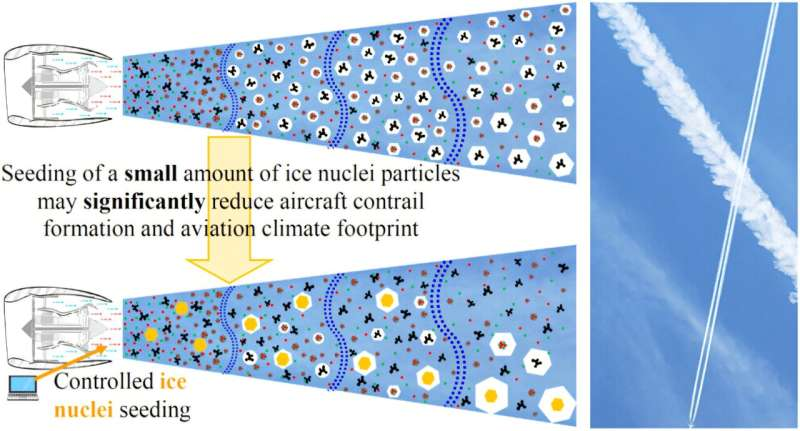
Contrails form when hot, moist jet exhaust mixes with extremely cold air at high altitudes. Under the right conditions, this mixture rapidly freezes into countless tiny ice crystals, creating long, thin clouds. Some contrails disappear quickly, but others can persist for hours, spreading out into cirrus-like clouds that trap outgoing heat.
Multiple studies have shown that contrails are not just a visual curiosity. One major analysis of aviation’s climate impact between 2000 and 2018 found that contrails were responsible for about 57% of the industry’s total warming effect, far exceeding the impact of aviation’s carbon dioxide emissions alone. This makes contrails one of the most important—and often overlooked—targets for climate mitigation in aviation.
The Core Idea Behind the New Research
Yu’s research focuses on how contrails form at the microscopic level. Traditional contrails contain enormous numbers of very small ice crystals. These tiny crystals stay suspended in the atmosphere for long periods, allowing the contrail to linger and trap heat.
The proposed solution is deceptively straightforward: introduce a very small amount of ice-nucleating particles into the exhaust stream of aircraft engines. These particles act as early “seeds” for ice formation. Instead of producing many tiny crystals, the exhaust plume would form fewer but much larger ice crystals.
Larger ice crystals behave very differently. They grow faster, fall out of the atmosphere sooner due to gravity, and cause the contrail to fade much more quickly, significantly reducing its warming effect.
What Are Ice-Nucleating Particles?
Ice-nucleating particles, often abbreviated as INPs, are microscopic substances that encourage ice formation at warmer temperatures than ice would normally form. In nature, they already exist in small amounts in dust, biological particles, and certain aerosols.
In Yu’s proposed method, engineered or selected materials with strong ice-nucleating properties would be added intentionally. The study discusses potential candidates such as silver iodide, bismuth triiodide, and other materials known to be effective at triggering ice formation while posing low environmental risk.
Testing the Concept With Advanced Modeling
To evaluate whether this idea could work in the real world, Yu and his team used an advanced simulation tool called the Aerosol and Contrail Microphysics model. This model tracks what happens inside an aircraft exhaust plume during the critical seconds immediately after it exits the engine—when contrails are born.
The results were striking. The simulations showed that controlled seeding with ice-nucleating particles could lead to as much as a 50-fold reduction in the number of ice crystals formed in contrails. With far fewer crystals and much larger sizes, the contrails dissipated far more rapidly than conventional ones.
How Much Material Would Be Needed?
One of the most encouraging aspects of the research is how small the required amount of material is. According to the study, the quantity of ice-nucleating particles needed would be comparable to—or even less than—the lubrication oil that aircraft engines already consume during normal operation.
Because the seeding would occur at high cruising altitudes and in extremely small quantities, early modeling suggests that the amount of material eventually reaching the ground would be negligible. Still, Yu emphasizes that further research is needed to fully understand how these added particles might interact with natural ice-nucleating particles, cloud formation, and precipitation processes.
Environmental and Safety Considerations
Any proposal involving deliberate particle release into the atmosphere naturally raises environmental questions. The study does not gloss over these concerns. While initial results indicate minimal environmental exposure, Yu and his team stress the importance of careful assessment before any real-world implementation.
Future work will focus on determining whether the added particles could alter natural cloud systems or weather patterns, even in subtle ways. Understanding these potential side effects is essential before moving beyond simulations.
What Comes Next for This Research?
The current study is based entirely on modeling and simulations, not real-world flight tests. The next steps include controlled laboratory experiments and eventually field measurements to validate the model’s predictions under real atmospheric conditions.
Yu also plans to conduct additional simulations to explore different materials, injection rates, and atmospheric scenarios. The goal is to refine the method and better understand its effectiveness across a wide range of flight conditions.
Collaboration With the Aviation Industry
This work does not exist in isolation. Yu is also collaborating with GE Research to study how clean aviation fuels and emerging engine technologies influence contrail formation. Sustainable aviation fuels, or SAFs, are already known to reduce soot emissions, which can also affect contrail properties.
By combining fuel innovations with targeted contrail mitigation strategies like ice-nucleating particle seeding, researchers hope to develop a multi-layered approach to reducing aviation’s climate footprint.
Why This Research Is Important
Aviation is one of the hardest sectors to decarbonize. While electric aircraft and hydrogen fuels may play a role in the future, they are unlikely to replace long-haul jet travel anytime soon. That makes near-term solutions especially valuable.
Contrail mitigation stands out because it could potentially deliver fast climate benefits without waiting decades for entirely new aircraft designs or infrastructure. If proven safe and effective, controlled contrail seeding could become a powerful complement to emissions reductions.
A Promising Idea With More Work Ahead
Yu’s research offers a compelling glimpse into how small, precise interventions could produce outsized climate benefits. While much testing remains before this method could ever be used on commercial flights, the early results suggest that contrails—one of aviation’s biggest climate problems—might be far more manageable than previously thought.
As research continues, this approach could help reshape how the aviation industry tackles its environmental impact, focusing not just on fuel burn but also on the invisible clouds left behind in the sky.
Research paper:
https://doi.org/10.1021/acsestair.5c00241