New Research Shows Current Methods May Overestimate Blue Carbon Stored in Coastal Wetlands
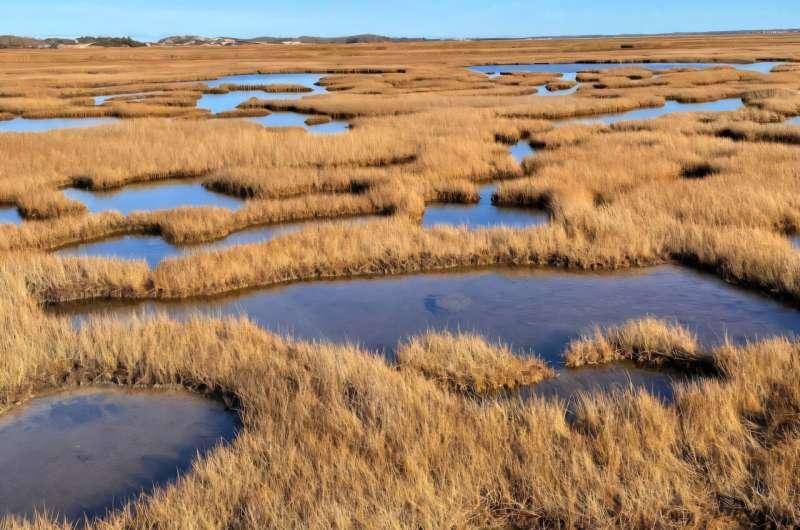
Coastal wetlands such as salt marshes play a crucial role in the global carbon cycle. These ecosystems help protect shorelines from erosion, support biodiversity, and quietly perform one of their most important services: trapping and storing carbon in their soils, a process commonly referred to as blue carbon sequestration. Because of their importance in climate mitigation and coastal resilience planning, scientists have long worked to measure how much carbon these wetlands store. Now, a new study suggests that some of those measurements may be significantly overestimated.
Researchers from the University of Rhode Island and the University of North Florida have identified a fundamental limitation in one of the most widely used methods for measuring organic carbon in flooded coastal sediments. Their findings point to a previously overlooked fraction of organic matter that does not actually contribute to sediment volume or marsh elevation, raising important questions about how blue carbon is quantified worldwide.
Why Blue Carbon Measurements Matter
Salt marshes and other coastal wetlands keep pace with rising sea levels by accumulating sediment and burying organic material over time. As plants grow and die, their remains are incorporated into the soil, locking away carbon that would otherwise end up in the atmosphere as carbon dioxide. This stored carbon can remain buried for centuries, making wetlands powerful natural climate regulators.
Accurate measurements of this buried carbon are essential. Scientists rely on them to assess marsh resilience, predict how wetlands will respond to sea-level rise, guide restoration projects, and inform carbon accounting frameworks that increasingly influence climate policy and carbon markets.
Until now, standard measurement techniques assumed that all organic matter found in wetland sediments contributes both to long-term carbon storage and to the physical buildup of the marsh surface. The new research challenges that assumption.
What the Study Found
The study was led by Erin Peck, an assistant professor at the University of Rhode Island’s Graduate School of Oceanography, and Serina Wittyngham, an assistant professor at the University of North Florida. Together with their collaborators, they examined data from more than 23,000 tidal marsh sediment samples collected across multiple marsh systems.
Their analysis revealed that not all organic matter in marsh sediments behaves the same way. Specifically, the researchers identified a category they describe as “volumeless” organic matter. This includes organic material that is dissolved in sediment porewater, loosely attached to sediment particles, or bound within the internal structure of clay minerals.
While these forms of organic matter still contain carbon, they do not contribute to the actual volume of the sediment. In other words, they add mass without helping build the physical structure of the marsh. This distinction turns out to be critical.
Because traditional methods count all organic matter as contributing to sediment volume and carbon burial, they can significantly overestimate both carbon storage and marsh elevation gains. The study found that this overestimation is especially pronounced near the surface of the marsh, where organic matter concentrations are highest.
In some cases, the overestimate of carbon storage in the upper layers of sediment reached several hundred percent. This means that commonly used methods may be painting an overly optimistic picture of how much carbon coastal wetlands can store and how resilient they are to rising seas.
How the Discovery Happened
Interestingly, the breakthrough did not come from a large field campaign or a new piece of technology. Instead, it emerged from a basic problem-solving exercise. While working on a project that involved converting sediment core data from mass to volume, the researchers found that the numbers simply did not add up.
The turning point came when they realized that some of the measured mass might not actually be contributing to volume at all. A simple analogy helped clarify the issue: when sugar dissolves in water, the mass increases, but the volume changes very little. The same principle applies to dissolved organic matter in sediments.
This insight led the team to reexamine long-standing assumptions in blue carbon science.
Implications for Global Carbon Estimates
The consequences of this finding extend far beyond individual marshes. Blue carbon estimates are used in global carbon budgets, climate models, and national greenhouse gas inventories. If these estimates are systematically too high, it could affect how scientists and policymakers evaluate the role of coastal wetlands in mitigating climate change.
Marsh elevation gain is another critical factor. Wetlands must build upward fast enough to keep pace with sea-level rise. If elevation gains have been overestimated, some marshes may be more vulnerable than previously thought.
That does not mean coastal wetlands are suddenly ineffective or unimportant. Instead, the study highlights the need for more precise measurement techniques that distinguish between organic matter that contributes to long-term sediment buildup and organic matter that does not.
The Value of Interdisciplinary Collaboration
One of the strengths of this research lies in its interdisciplinary approach. Peck is a geologist, while Wittyngham is an ecologist, and they worked closely with modelers, biogeochemists, and other specialists while developing their analysis.
By stepping outside the traditional boundaries of their fields, the researchers were able to spot a methodological gap that might otherwise have gone unnoticed. Their work underscores how collaboration across disciplines can lead to more robust and accurate scientific outcomes.
Improving Blue Carbon Science Going Forward
Rather than discarding decades of existing data, the researchers emphasize that their findings offer a path forward. They hope to develop correction factors that can be applied to previous measurements, allowing scientists to adjust estimates while preserving the value of already collected datasets.
The ultimate goal is to refine blue carbon measurement methods without making them overly complex or inaccessible. Maintaining open, usable techniques is especially important for global research efforts, where resources and technical capacity can vary widely.
By addressing this limitation, scientists can improve restoration planning, strengthen carbon accounting frameworks, and create more reliable predictions of how coastal wetlands will respond to environmental change.
A Closer Look at Blue Carbon in Coastal Wetlands
Beyond this specific study, blue carbon remains a rapidly evolving field. Coastal wetlands store carbon at rates that often exceed those of terrestrial forests, largely because waterlogged soils slow decomposition. However, these systems are also highly dynamic, influenced by tides, storms, sediment supply, and human activity.
Understanding exactly how carbon is stored, transformed, and retained in these environments is essential as coastal regions face increasing pressure from climate change and development. Studies like this one remind us that even well-established scientific methods benefit from periodic reexamination.
Why This Study Matters
At its core, this research is about accuracy and transparency in environmental science. As blue carbon becomes more central to climate mitigation strategies, the assumptions behind its measurement matter more than ever.
By identifying and explaining a key source of overestimation, the study strengthens the scientific foundation of blue carbon research. It also encourages a more nuanced understanding of how coastal wetlands function, helping scientists, policymakers, and conservationists make better-informed decisions.
Research paper: https://doi.org/10.1002/lol2.70077