Ancient Pottery Residues May Have Misled Archaeologists About Olive Oil for Decades
For decades, archaeologists studying ancient Mediterranean societies have treated olive oil as a near-constant presence in excavated pottery. The assumption made sense. Olive oil was central to food, trade, ritual, lighting, and even medicine across the ancient Mediterranean. If you found oily residues in ceramic vessels, olive oil often felt like the obvious answer.
A new interdisciplinary study from Cornell University, however, suggests that this long-standing assumption may be deeply flawed. According to the research, the soil chemistry of the Mediterranean actively degrades plant oil residues, making olive oil far harder to identify than previously believed. As a result, many past claims of olive oil discovery in archaeological ceramics may need serious re-evaluation.
Why Olive Oil Has Been So Important to Archaeology
Organic residue analysis is a specialized branch of archaeology that focuses on extracting and analyzing microscopic traces of food, oils, and other substances trapped in pottery pores. Over time, these molecular remnants help researchers reconstruct ancient diets, trade routes, and economic systems.
Olive oil has played an especially prominent role in these reconstructions because it was economically and culturally vital throughout ancient Greece, Rome, the Levant, and surrounding regions. When archaeologists detected molecular patterns resembling olive oil, the discovery often supported broader narratives about agricultural production, long-distance trade, and social organization.
But what if those molecular signatures were being misunderstood?
The Central Question Behind the New Study
The Cornell research team set out to examine a critical but often overlooked factor in residue analysis: environmental context, particularly soil chemistry.
Mediterranean soils are frequently calcareous, meaning they contain high levels of calcium carbonate and tend to be alkaline rather than acidic. Until now, there had been surprisingly little experimental work testing how these soil conditions affect the long-term survival of plant oil residues inside pottery.
The researchers wanted to know whether olive oil biomarkers actually survive well in these environments — or whether the soil itself could be destroying or altering the evidence.
How the Researchers Tested Ancient Conditions in the Lab
To answer this question, the team designed a controlled laboratory experiment that simulated archaeological burial conditions.
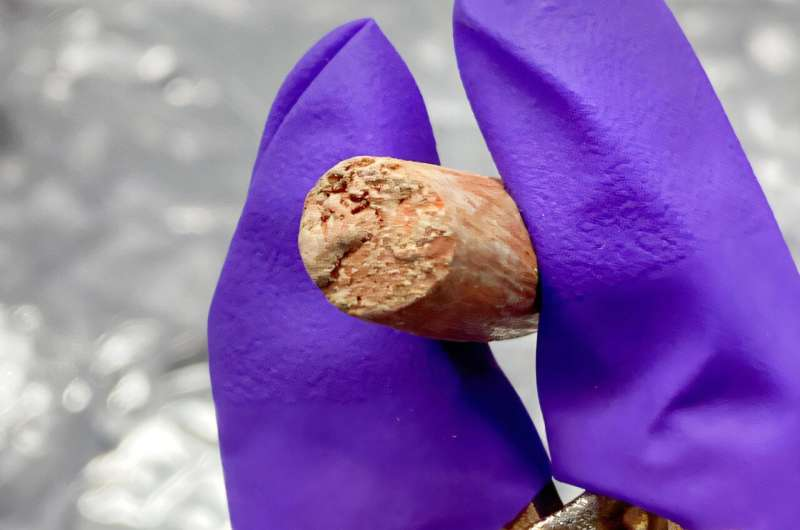
They created small ceramic pellets made from terracotta clay, similar in composition to ancient pottery. These pellets were fired in a furnace, soaked thoroughly in olive oil, and then buried in two different soil types:
- Calcareous soil from Cyprus, representative of common eastern Mediterranean archaeological contexts
- Mildly acidic agricultural soil from New York, used as a comparison environment
The samples were kept in incubators at 50 degrees Celsius for up to one year. This elevated temperature accelerated chemical reactions, allowing researchers to observe degradation processes that would normally take thousands of years in the ground.
Once the incubation period ended, the team extracted and analyzed the remaining organic residues using advanced chemical techniques.
What the Results Revealed
The findings were striking.
In the calcareous Mediterranean soil, olive oil residues showed significant degradation. The total amount of recoverable oil was lower, and — more importantly — key plant oil biomarkers were either heavily altered or completely lost.
One major issue was the disappearance of dicarboxylic acids, molecules that archaeologists commonly rely on to identify degraded plant oils. Without these markers, the chemical profile of olive oil begins to overlap with that of animal fats, making confident identification extremely difficult.
In contrast, olive oil residues buried in the mildly acidic New York soil preserved far better, retaining clearer molecular signatures.
Why This Matters for Past Discoveries
These results suggest that archaeologists working in Mediterranean contexts may have been facing a built-in preservation problem without realizing it.
When plant oils degrade in alkaline soils, their chemical fingerprints become less distinctive. This increases the risk of:
- Mistaking other plant oils for olive oil
- Misidentifying degraded plant oils as animal fats
- Over-reporting olive oil usage simply because it fits historical expectations
The study emphasizes that olive oil’s chemical composition already overlaps with many other plant oils. Once degradation begins, distinguishing between them becomes even harder.
The Role of Bias in Scientific Interpretation
The researchers also point to a subtle but important human factor: confirmation bias.
Because olive oil was so economically important in the ancient Mediterranean, archaeologists may have been more inclined to interpret ambiguous molecular data as evidence of olive oil. The presence of “olive-like” molecules often seemed sufficient, especially when the broader historical narrative supported that conclusion.
This study challenges that tendency and calls for greater caution when interpreting organic residue data without considering soil chemistry.
A Highly Collaborative Scientific Effort
One of the most notable aspects of this research is its interdisciplinary nature. The project brought together experts in:
- Classical archaeology
- Chemical and biomolecular engineering
- Food science
- Soil science
- Materials research
Facilities across Cornell University supported the work, including soil laboratories, isotope labs, materials research centers, and chemical engineering facilities. Undergraduate researchers also played a role, contributing to data analysis and laboratory work.
This collaborative approach allowed the team to combine archaeological questions with rigorous experimental chemistry, something that has been surprisingly rare in residue analysis research.
What This Means for Future Archaeology
The study does not claim that olive oil was absent from ancient Mediterranean societies. Rather, it argues that current methods may be insufficient for identifying it reliably in certain environments.
Going forward, archaeologists may need to:
- Develop new biomarker criteria that account for alkaline soil degradation
- Revisit earlier residue analyses with updated methods
- Avoid assuming olive oil presence based solely on partial molecular matches
- Place greater emphasis on environmental context when interpreting chemical data
This could lead to revised interpretations of ancient trade networks, agricultural practices, and even daily food consumption.
Understanding Organic Residue Analysis a Bit Better
Organic residue analysis works because pottery is porous. When food or oils are heated or stored inside vessels, fats and lipids seep into microscopic pores and can survive for millennia under the right conditions.
However, preservation depends heavily on factors such as:
- Soil pH
- Moisture levels
- Temperature
- Microbial activity
Alkaline soils, like those common in much of the Mediterranean, accelerate chemical reactions that break down fatty acids. This makes them particularly hostile to long-term lipid preservation.
The new study highlights that absence of evidence is not evidence of absence, and equally, that ambiguous evidence should not be over-interpreted.
A Turning Point for Biomolecular Archaeology
Beyond olive oil, the research has broader implications for biomolecular archaeology as a field. It demonstrates the need for experimental validation rather than relying solely on established assumptions.
By showing how environmental factors can reshape molecular evidence, the study opens the door to more accurate reconstructions of ancient life — even if that means letting go of some long-held beliefs.
In many ways, this research represents a methodological reset, reminding archaeologists that chemistry, environment, and human bias all shape what we think we know about the past.
Research Paper:
Overlooking environmental context causes misidentification of ancient Mediterranean plant oil in organic residues, Journal of Archaeological Science (2025)
https://doi.org/10.1016/j.jas.2025.106426