Scientists Discover How Statins Can Trigger Muscle Aches and What That Means for Millions of Patients
Statins are among the most widely prescribed medications in the world, taken by millions of people every day to lower cholesterol and reduce the risk of heart attacks and strokes. Yet despite their proven benefits, statins have a well-known downside: muscle aches, weakness, and fatigue. These symptoms are so common that they are one of the leading reasons people stop taking the drugs altogether. Now, a new study from researchers at Columbia University Irving Medical Center offers a detailed explanation for why this happens in at least some patients—and it does so at an almost atomic level.
The research sheds light on a long-standing medical mystery and opens the door to safer statins and possible treatments for people who struggle with statin-related muscle problems.
Why Muscle Pain Is Such a Big Issue With Statins
Statins have been prescribed since the late 1980s and are considered a cornerstone of modern cardiovascular medicine. In the United States alone, about 40 million adults take a statin. Estimates suggest that roughly 10% of statin users experience muscle-related side effects, ranging from mild soreness to significant weakness that interferes with daily life.
For many patients, these symptoms are not just uncomfortable—they are discouraging enough to make them abandon treatment. Clinicians have long known this problem exists, but until now, the precise biological mechanism behind statin-induced muscle pain has remained unclear.
A Closer Look Inside Muscle Cells
The new study, published in the Journal of Clinical Investigation, focuses on a specific statin called simvastatin, a commonly prescribed cholesterol-lowering drug. While statins are designed to block an enzyme involved in cholesterol production in the liver, they are also known to interact with other proteins in the body. These unintended interactions are often referred to as off-target effects.
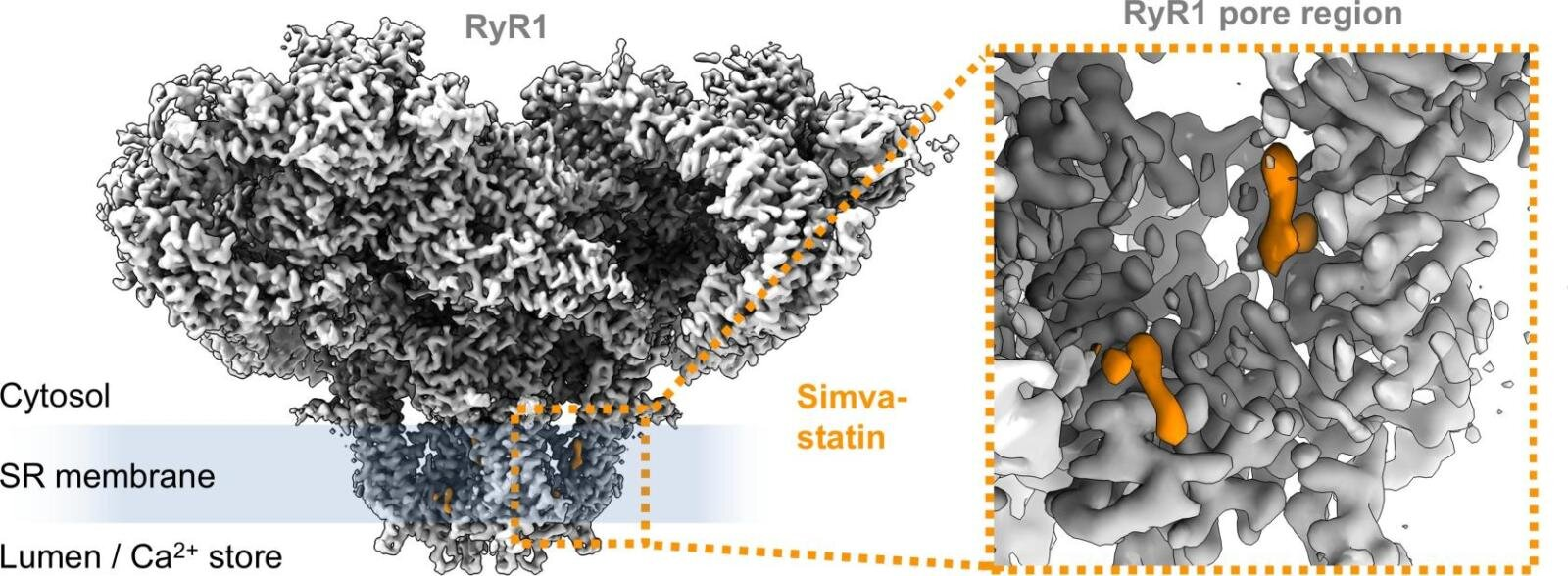
Using cryo-electron microscopy, a powerful imaging technique capable of visualizing molecules at near-atomic resolution, researchers examined how simvastatin interacts with muscle cells. What they found was striking.
Simvastatin binds directly to a protein called the ryanodine receptor, specifically the type found in skeletal muscle cells. This receptor plays a crucial role in muscle contraction by controlling the release of calcium ions inside muscle cells.
The Ryanodine Receptor and Calcium Leaks
Under normal conditions, the ryanodine receptor acts like a carefully regulated gate. It opens briefly to release calcium when muscles need to contract and then closes again. Calcium levels inside muscle cells are tightly controlled because even small imbalances can disrupt normal muscle function.
The researchers discovered that simvastatin binds to two distinct sites on the ryanodine receptor, causing the channel to remain open longer than it should. This leads to a calcium leak inside muscle cells.
Excess calcium can weaken muscle fibers directly, but it can also activate enzymes that begin breaking down muscle tissue. Together, these effects provide a compelling explanation for why some people experience muscle pain, weakness, and fatigue while taking statins.
Not Everyone Is Affected the Same Way
Importantly, the researchers emphasize that this mechanism is unlikely to explain all cases of statin-related muscle symptoms. Muscle pain associated with statins is complex and may involve multiple biological pathways.
However, even if this calcium-leak mechanism applies to only a subset of patients, it still represents a large number of people given how widely statins are prescribed. Understanding this pathway is a major step toward identifying who is most at risk and how to help them.
Evidence From Animal Models
To strengthen their findings, the research team tested their ideas in mice. In these experiments, statin-induced calcium leaks in muscle cells led to measurable muscle weakness. When the calcium leak was blocked using an experimental drug developed in the same lab, muscle function improved.
This drug belongs to a class of compounds designed to stabilize ryanodine receptors and prevent inappropriate calcium release. These compounds are already being tested in people with rare muscle diseases, making them especially interesting as potential treatments for statin-induced muscle problems.
Rethinking Statin Design
One of the most exciting implications of this study is what it means for the future of statin development. The high-resolution images produced by cryo-electron microscopy reveal exactly where and how simvastatin binds to the ryanodine receptor.
With this information, chemists may be able to redesign statins so they continue to lower cholesterol effectively but no longer interact with muscle calcium channels. In other words, it may be possible to create statins that keep their cardiovascular benefits while dramatically reducing the risk of muscle side effects.
Why Calcium Balance Matters in Muscles
Calcium is central to nearly every aspect of muscle function. When calcium levels rise, muscles contract. When levels fall, muscles relax. Persistent calcium leaks disrupt this balance, leading to inefficient contractions, muscle fatigue, and cellular stress.
Over time, elevated calcium can activate enzymes that damage proteins and cellular structures, contributing to muscle weakness. This explains why a seemingly small molecular interaction can have such noticeable physical consequences.
Statin Side Effects Beyond Muscle Pain
While muscle symptoms are the most talked-about side effect of statins, they are not the only ones. Some patients report digestive issues, changes in blood sugar levels, or liver enzyme abnormalities. Most of these side effects are rare or manageable, but muscle pain stands out because it directly affects quality of life and medication adherence.
The new findings suggest that muscle side effects may be more mechanical and biochemical than previously thought, rather than vague or unexplained reactions.
What This Means for Patients Today
For now, this research does not change current prescribing guidelines. Statins remain highly effective and life-saving drugs for many people. Patients experiencing muscle pain are still advised to speak with their healthcare provider rather than stopping medication on their own.
However, this study offers reassurance that muscle symptoms are real, measurable, and biologically grounded, not imagined or exaggerated. It also provides hope that future treatments or modified statins could make cholesterol management easier for those who currently struggle with side effects.
Looking Ahead
This research represents a major advance in understanding how statins interact with muscle tissue. By identifying a specific molecular mechanism involving calcium leaks through the ryanodine receptor, scientists now have a clear target for intervention.
Whether through new statin formulations, add-on therapies that block calcium leaks, or more personalized prescribing based on genetic risk, the findings bring medicine one step closer to solving a decades-old problem.
For millions of people who rely on statins—or want to but cannot tolerate them—this discovery could eventually make a meaningful difference.
Research Reference:
https://www.jci.org/articles/view/194490