Biodegradable Tableware Made From Wheat Can Transfer Gluten to Food and Create Hidden Risks for Gluten-Sensitive People
Biodegradable plates, cups, and straws are often seen as a safer and more eco-friendly alternative to plastic. Made from natural materials like bamboo, algae, or agricultural by-products, these items are increasingly common at home, in cafés, and at large events. However, new scientific research suggests that some biodegradable tableware may pose an unexpected health risk, especially for people with celiac disease or gluten sensitivity.
Researchers have found that certain biodegradable dishes made using wheat-based materials can contain gluten and, under realistic conditions, transfer that gluten into foods and drinks. The findings raise concerns because food-contact materials are not currently required to carry allergen warnings, leaving many consumers unaware of potential exposure.
Credit: Journal of Agricultural and Food Chemistry (2025)
Why Scientists Decided to Study Biodegradable Tableware
Biodegradable tableware is typically made from natural fibers and proteins. Common ingredients include bamboo fibers, algae-derived sugars, and proteins from milk, eggs, soybeans, or wheat. Wheat straw and wheat bran, both by-products of agriculture, are especially popular because they are inexpensive and readily available.
While food packaging is regulated for allergens, plates, cups, and straws fall into a regulatory gray area. These items come into direct contact with food, yet manufacturers are not required to label them for allergenic ingredients such as gluten. This gap prompted researchers to ask an important question: Can gluten migrate from biodegradable tableware into food?
For individuals with celiac disease or non-celiac gluten sensitivity, even trace amounts of gluten can trigger immune reactions, digestive distress, inflammation, and long-term health complications. Understanding whether food-contact materials can introduce gluten is therefore critical.
How the Study Was Conducted
The research team, led by Ángela Ruiz-Carnicer and Isabel Comino, examined commercially available biodegradable tableware. Their work was published in the Journal of Agricultural and Food Chemistry, a peer-reviewed journal of the American Chemical Society.
The researchers selected eight biodegradable items, including plates, cups, and straws. These products were marketed as biodegradable and made using wheat by-products or other materials that could potentially contain gluten.
Each item was first tested to determine whether gluten was present in the material itself. The results were revealing but also somewhat reassuring.
Only One Product Contained Detectable Gluten
Out of the eight tested items, only one plate showed detectable levels of gluten. This plate was made using wheat-based materials. The remaining items, including other dishes and straws, did not show measurable gluten levels during initial testing.
However, the presence of gluten in even a single product raised a critical follow-up question: Could that gluten transfer into food under normal usage conditions?
Testing Gluten Transfer Into Food and Drinks
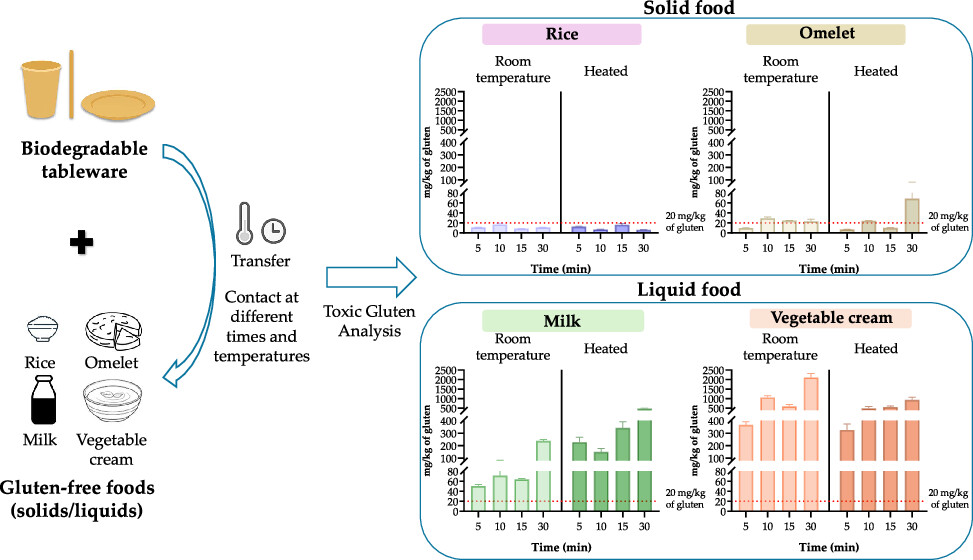
To answer this, the researchers designed 30-minute contact experiments meant to reflect real-world use. Gluten-free foods and drinks were placed directly onto the biodegradable tableware at room temperature.
The foods selected included both solid and liquid items, allowing the researchers to compare how gluten transfer differed between textures. After the contact period, the foods were tested for gluten content.
The results were then compared against established regulatory standards:
- Gluten-free threshold: less than 20 parts per million (ppm)
- Low-gluten threshold: less than 100 ppm
These thresholds are used by both the European Union and the U.S. Food and Drug Administration.
Liquids Absorbed Much More Gluten Than Solids
Only the wheat-containing plate transferred gluten into food, but the amount transferred varied significantly depending on the type of food.
Here are the measured gluten levels:
- Rice: up to 17 ppm, which is below the gluten-free threshold
- Omelet: up to 30 ppm, which exceeds the gluten-free limit but remains below the low-gluten threshold
- Milk: up to 240 ppm, well above the low-gluten threshold
- Vegetable cream: up to 2,100 ppm, an extremely high level far exceeding regulatory limits
One of the most important findings was that liquid and semi-liquid foods absorbed far more gluten than solid foods. Milk and vegetable cream, in particular, showed significant contamination. This suggests that gluten proteins dissolve and migrate more easily into liquids than into solid foods like rice or eggs.
For people who must strictly avoid gluten, these levels could be enough to cause serious reactions.
The Role of Heat and Microwaving
The researchers also explored whether temperature affected gluten transfer. In some cases, microwaving foods in the biodegradable plate reduced the amount of gluten contamination compared to foods left at room temperature.
The scientists believe this happens because heat can denature gluten proteins, altering their structure and reducing their ability to migrate into food. While this finding is interesting, it does not eliminate the risk entirely and should not be seen as a reliable safety solution.
Why This Matters for Gluten-Sensitive Individuals
For people with celiac disease, there is no safe level of gluten exposure. Even small amounts can damage the intestinal lining and trigger symptoms that range from digestive pain to neurological issues and fatigue.
The study highlights a hidden risk: someone could prepare completely gluten-free food, only to contaminate it unknowingly by serving it on biodegradable tableware made from wheat. Because these products do not require allergen labeling, consumers may have no idea they are at risk.
A Call for Mandatory Allergen Labeling
Based on their findings, the researchers strongly recommend mandatory gluten labeling for food-contact materials, especially biodegradable products made from agricultural by-products.
They also emphasize the need for further research to determine whether similar cross-contamination occurs with other allergens, such as milk, soy, or nut proteins. Gluten may not be the only hidden allergen migrating from eco-friendly tableware into food.
What Consumers Can Do Right Now
Until regulations catch up with the science, consumers—especially those with gluten-related disorders—can take steps to protect themselves:
- Check the materials used in biodegradable tableware, particularly for mentions of wheat straw or bran
- Be cautious when serving liquids or creamy foods in biodegradable dishes
- Consider alternatives made from materials less likely to contain allergens, such as palm leaf or sugarcane fiber
- When in doubt, use traditional ceramic, glass, or certified gluten-free servingware
The Bigger Picture: Sustainability and Food Safety
Biodegradable tableware plays an important role in reducing plastic waste, but this study shows that sustainability solutions must also be evaluated for food safety. Natural does not always mean harmless, especially when allergens are involved.
As eco-friendly products become more widespread, clear labeling and better regulation will be essential to ensure they are safe for everyone—not just environmentally responsible.
Research Paper Reference:
https://pubs.acs.org/doi/10.1021/acs.jafc.5c07516