Scientists Reveal How the Brain Turns Guilt and Shame Into Real-World Behavior
Feelings of guilt and shame are deeply familiar to most of us. They show up after we break a rule, hurt someone, or feel we’ve fallen short of moral or social expectations. While these emotions are often discussed together, psychologists have long known that they are not the same—and now, scientists have uncovered how the brain treats them differently and uses them to guide our behavior.
A new study published in the journal eLife offers one of the most detailed explanations yet of how guilt and shame emerge from specific cognitive processes and how they translate into actions like making amends, cooperating, avoiding others, or trying to save face. Using a combination of behavioral experiments, computational modeling, and brain imaging, researchers mapped the neural networks that link these emotions to decision-making.
Why guilt and shame matter in human behavior
Guilt and shame often arise together when someone believes they’ve done something morally wrong. Both emotions play an important role in discouraging harmful behavior and maintaining social norms. However, they differ significantly in how they affect mental health and social behavior.
Psychologically, shame is more strongly linked to negative outcomes such as anxiety, depression, and stress. Guilt, on the other hand, is often unrelated to these issues and can even show a protective effect. Behaviorally, guilt tends to push people toward altruistic actions—apologizing, offering compensation, or trying to fix the damage they caused. Shame is less likely to produce these outcomes and is more commonly associated with avoidance, withdrawal, evasion, or self-focused attempts at improvement.
Despite decades of research, scientists still lacked a clear explanation of what triggers guilt versus shame and how each emotion is converted into action at the neural level. This new study set out to fill those gaps.
The key questions behind the research
Previous research suggested that two main factors trigger guilt and shame: harm, meaning how severe the damage is, and responsibility, meaning how accountable a person feels for causing that damage. What remained unclear was whether these two factors influence guilt and shame differently, and whether guilt-driven and shame-driven behaviors rely on separate brain systems.
To answer these questions, researchers designed a carefully controlled experiment that allowed them to manipulate harm and responsibility independently while observing emotional responses, decision-making, and brain activity.
A novel experiment to study moral emotions
Participants took part in a specially designed decision-making game. In each round, a participant acted as one of four “deciders” performing a dots-estimation task. If any decider made an incorrect estimate, a “victim” would receive an electric shock. The intensity of the shock varied randomly.
Unbeknownst to the participant, the other deciders were actually confederates, and the victim was fictitious. This setup allowed researchers to precisely control two key variables:
- Level of harm, manipulated through the intensity of the electric shock on a scale from one to four
- Level of responsibility, manipulated by varying how many deciders made incorrect estimates, also on a scale from one to four
After each outcome, participants decided how much financial compensation to offer the victim.
During the compensation phase, participants underwent functional MRI (fMRI) scanning. After completing the task, they also filled out surveys rating their feelings of guilt and shame and their perceived responsibility for each outcome.
What the results revealed about guilt and shame
The findings showed a clear separation between the two emotions.
- Harm had a stronger influence on guilt. The more severe the harm caused to the victim, the more guilt participants reported.
- Responsibility had a stronger influence on shame. Participants felt more shame when they believed they were personally responsible, regardless of harm severity.
These emotional differences translated directly into behavior. Guilt strongly predicted compensation, reinforcing the idea that guilt motivates reparative and prosocial actions. Shame, by contrast, was less efficient in driving compensation and appeared to require more cognitive effort to influence behavior.
How the brain integrates harm and responsibility
Using computational modeling, the researchers found that participants combined harm and responsibility in a way that reflected responsibility diffusion. When decisions were shared among a group, individuals felt less personal responsibility, which affected both their emotional responses and compensation choices.
The brain imaging data showed that this integration process was encoded in specific regions:
- The posterior insula, associated with processing inequity and unfairness
- The striatum, involved in value computation and decision-making
Together, these regions formed a neural representation of how harm and responsibility combine before influencing emotional experience and behavior.
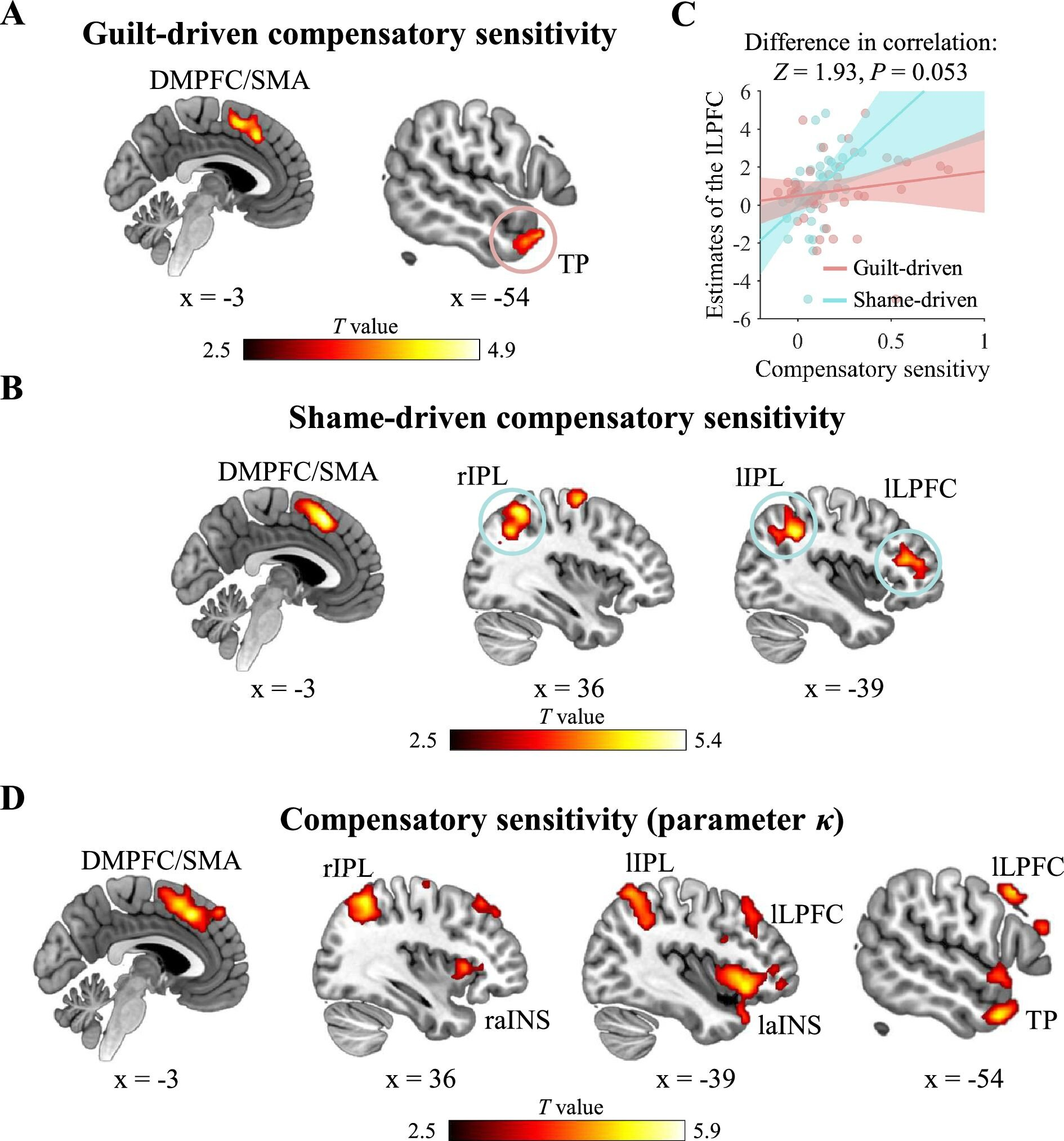
Different neural pathways for guilt-driven and shame-driven actions
One of the most striking findings was that guilt and shame rely on distinct neural circuits when guiding behavior.
Guilt-driven compensation engaged brain systems linked to valuation and social concern. Shame-driven decisions, however, showed stronger activity in the lateral prefrontal cortex, a region associated with cognitive control and effortful regulation. This suggests that acting on shame requires more deliberate control, whereas guilt translates into action more naturally.
This neural distinction helps explain why guilt so often leads to apologies and reparations, while shame can result in avoidance or strategic self-management instead.
Why these findings matter
The implications of this research extend far beyond the lab. By showing how guilt and shame arise from different cognitive inputs and rely on different brain systems, the study provides a more precise framework for understanding moral emotions.
This knowledge could be especially valuable in mental health contexts. Excessive or maladaptive guilt and shame play a role in conditions such as depression, anxiety disorders, and social withdrawal. Understanding how these emotions are processed in the brain may help guide future therapeutic approaches aimed at regulating them more effectively.
The findings are also relevant to psychology, neuroscience, public policy, and even ethics, offering insight into how people respond to wrongdoing and how responsibility is experienced in group settings.
Limits of the study and what comes next
While the study offers robust evidence, it also has limitations. fMRI can reveal correlations between brain activity and behavior, but it cannot establish causality. The researchers suggest that future studies using techniques such as transcranial magnetic stimulation (TMS) could help clarify whether specific brain regions play a causal role in guilt- and shame-driven behaviors.
Still, by combining behavioral data, computational modeling, and neural evidence, the study represents a major step forward in understanding how the human brain turns moral emotions into action.
Extra insight: why guilt and shame are not interchangeable
Although people often use the words guilt and shame interchangeably, this research reinforces why the distinction matters. Guilt is about actions, focusing on what was done wrong and how to fix it. Shame is about the self, focusing on how one is seen by others. These differences shape not only how we feel, but how we behave—and now we can see those differences reflected directly in the brain.
Understanding this distinction can also improve how we approach conflict resolution, parenting, education, and even organizational leadership, where encouraging guilt-based reflection may be more constructive than inducing shame.
Research paper:
Ruida Zhu et al., Human neurocomputational mechanisms of guilt-driven and shame-driven altruistic behavior, eLife (2025).
https://elifesciences.org/articles/107223