MXene-Based E-Tattoos Can Harvest Energy From the Human Body While Monitoring Health in Real Time
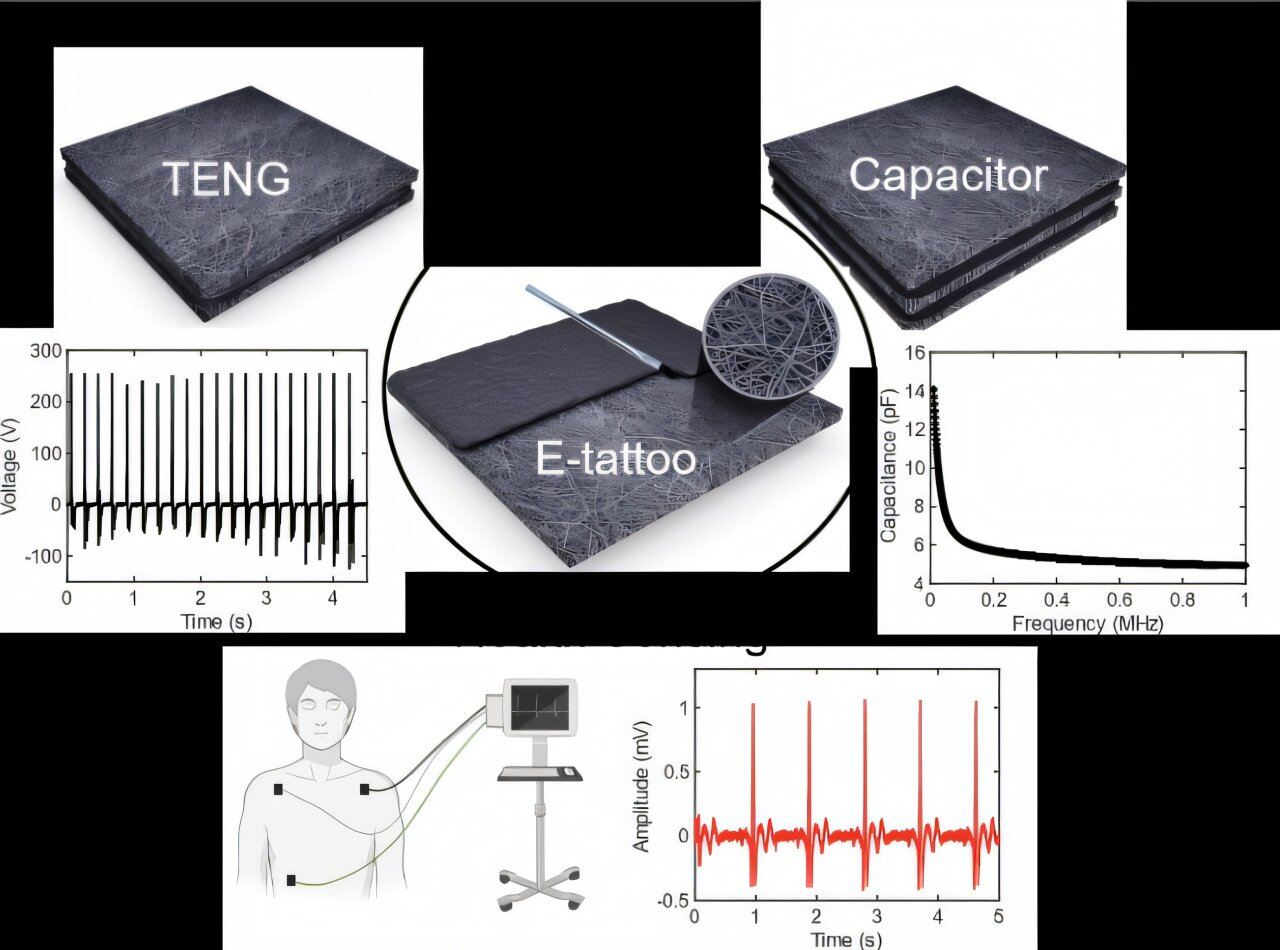
Researchers at Boise State University have developed a new kind of wearable technology that pushes electronic tattoos well beyond simple sensing. Their latest work introduces a multifunctional e-tattoo that can harvest energy, store it, and monitor vital health signals, all while remaining thin, flexible, and comfortable on the skin. The study shows how advanced materials, especially MXenes, can help create self-powered wearable electronics that do not rely on bulky batteries or rigid components.
This research was led by Ajay Pratap, a Ph.D. student at Boise State University, under the supervision of Professor David Estrada from the Micron School of Materials Science and Engineering. The findings were published in the peer-reviewed journal Advanced Science, highlighting a significant step forward in the field of skin-conformal electronics.
What Makes This E-Tattoo Different
Electronic tattoos, or e-tattoos, are ultra-thin electronic devices designed to adhere directly to the skin. Unlike smartwatches or chest straps, they move naturally with the body and maintain close contact with the skin, which is critical for accurate signal detection. What sets this new e-tattoo apart is its ability to integrate three key functions into a single system: energy harvesting, energy storage, and real-time biometric sensing.
Most wearable health devices today depend on external batteries, rigid circuit boards, or conductive gels. These elements add bulk, reduce comfort, and limit how long the device can be worn. The Boise State team focused on solving these limitations by building the entire system from soft, flexible, and biocompatible materials that work together seamlessly.
The Materials Behind the Technology
At the heart of the e-tattoo is a composite made from electrospun PVBVA fibers coated with Ti₃C₂Tₓ MXene. PVBVA, short for poly(vinyl butyral-co-vinyl alcohol-co-vinyl acetate), provides a lightweight and flexible fiber network that conforms easily to the skin. MXenes, on the other hand, are a family of two-dimensional materials known for their high electrical conductivity, mechanical flexibility, and surface functionality.
By coating the electrospun fibers with MXene, the researchers created a material that is conductive, durable, and scalable, while still being soft enough for skin contact. This combination allows the same material platform to perform multiple roles within the device, reducing complexity and improving reliability.
Harvesting Energy From Human Motion
One of the most impressive features of this e-tattoo is its ability to generate electricity directly from human movement. The device uses a triboelectric nanogenerator (TENG), which produces electrical energy through contact and separation between materials with different electrical properties. Everyday motions such as walking, bending, or muscle contractions are enough to drive this process.
The reported performance is notable for a device of this size and thickness. The triboelectric system demonstrated a peak power density of approximately 250 milliwatts per square meter, with an open-circuit voltage of around 250 volts and a short-circuit current close to 2.9 microamperes under optimized conditions. This level of output is sufficient to power low-energy wearable electronics and sensors without relying on external power sources.
Unlike thermoelectric generators, which depend on temperature differences, or solar cells, which require light, triboelectric nanogenerators work purely from mechanical motion. This makes them especially suitable for wearables that need to function indoors, under clothing, or during continuous movement.
Built-In Energy Storage
Harvesting energy is only part of the challenge. To make the system practical, the energy also needs to be stored and released in a controlled way. The researchers integrated a parallel-plate capacitor directly into the e-tattoo using the same PVBVA/MXene materials.
This capacitor demonstrated a capacitance of approximately 14 picofarads at 10 kilohertz and 5 volts, making it suitable for short-term energy storage and low-power touch sensing. While this is not meant to replace large batteries, it is sufficient for smoothing power delivery and enabling short bursts of activity in self-powered systems.
Monitoring ECG and EMG Signals
Beyond power generation and storage, the e-tattoo also functions as a health monitoring device. The team demonstrated real-time recording of electrocardiogram (ECG) signals, which track the electrical activity of the heart, and electromyography (EMG) signals, which measure muscle activity.
Thanks to its tight skin conformity, the e-tattoo showed clear signal quality with minimal degradation, even during movement. The device maintained strong adhesion and consistent performance during stretching, twisting, and compression, all of which are common challenges for wearable sensors.
Importantly, the system does not rely on conductive gels or rigid electrodes, making it more comfortable for long-term wear and potentially more suitable for continuous health monitoring.
Mechanical Comfort and Durability
Wearable electronics must balance performance with comfort, and this study paid close attention to mechanical properties. The e-tattoo remained breathable, flexible, and lightweight, allowing it to be worn for extended periods without irritation. Tests showed that the device maintained functionality under repeated mechanical stress, which is essential for real-world use.
The electrospun fiber structure also contributes to skin breathability, reducing the risk of moisture buildup and discomfort during prolonged wear.
Why MXenes Matter in Wearable Electronics
MXenes have become increasingly popular in energy and sensing research due to their atomically thin structure and tunable surface chemistry. In wearable applications, these properties allow MXenes to deliver high electrical performance while remaining mechanically soft. This study adds to a growing body of work showing that MXene-polymer composites can serve as a foundation for multifunctional wearable systems.
The Boise State team has previously demonstrated eco-friendly printed triboelectric nanogenerators and scalable MXene inks for energy storage, and this e-tattoo builds directly on those earlier advances. Together, these efforts outline a clear research trajectory toward fully integrated, self-powered wearable technologies.
Broader Applications and Future Potential
The implications of this work extend beyond health monitoring. Self-powered e-tattoos could play a role in human-machine interfaces, allowing skin-based controls for robotics, virtual reality, or assistive technologies. They could also be used in rehabilitation, sports performance tracking, and remote patient monitoring, where continuous data collection is valuable.
While this research is still at the experimental stage, it demonstrates that energy autonomy and advanced sensing can coexist in a single, skin-conformal device. As materials and fabrication methods continue to improve, similar systems could become practical tools in everyday healthcare and wearable technology.
Research Reference
Ajay Pratap et al., “Multifunctional E-Tattoos Based on Electrospun PVBVA Fibers Coated with Ti₃C₂Tₓ MXene for Energy Harvesting, Energy Storage, and Biometric Sensing,” Advanced Science (2025).
https://doi.org/10.1002/advs.202518697