Parked Electric Vehicles Could Power Homes, Cut Bills, and Slash Emissions Across the U.S.
Electric vehicles are usually discussed in the context of cleaner transportation, but new research shows their impact could go much further. According to a detailed study from the University of Michigan in collaboration with Ford Motor Company, EVs could play a major role in powering homes, reducing electricity costs, and cutting greenhouse gas emissions—all while sitting parked in a garage.
The idea centers on a technology known as vehicle-to-home charging, commonly shortened to V2H. Instead of using an EV only as a way to get from point A to point B, V2H allows the car’s battery to supply electricity back to a house when needed. In simple terms, a parked EV can act like a large, mobile battery that supports household energy use.
The research, published in the journal Nature Energy, takes a deep, data-driven look at how V2H could work in real-world conditions across the United States, and the results suggest both financial and environmental benefits that are hard to ignore.
What Vehicle-to-Home Charging Actually Does
With V2H, electricity flows both ways. An EV charges when electricity is cheap and clean, such as during sunny afternoons when solar power is abundant. Later, when electricity prices rise or the grid becomes more carbon-intensive, that stored energy can be used to power household appliances, heating, or cooling.
This setup essentially places the EV battery between the home and the grid, giving households more control over when and how they use electricity. Instead of drawing power at peak times, homes can rely on their EVs as an energy buffer.
The researchers liken this to having a generator in the garage—except it doesn’t burn fuel or emit pollution. It simply reuses electricity that was already pulled from the grid at a better time.
How Much Money Could EV Owners Save?
One of the standout findings of the study is the potential for significant cost savings. Over the lifetime of a vehicle, V2H could reduce EV charging costs by 40% to 90% compared to standard charging methods.
In real numbers, that translates to approximately $2,400 to $5,600 in lifetime savings for EV owners. In some parts of the country, particularly areas with high electricity price fluctuations like California and Texas, the savings can be so substantial that they more than cover the electricity used to drive the vehicle.
This flips the common perception of EV charging as a financial burden. With V2H, charging becomes an economic asset, not just an expense added to the monthly electric bill.
A Bigger Impact on Greenhouse Gas Emissions
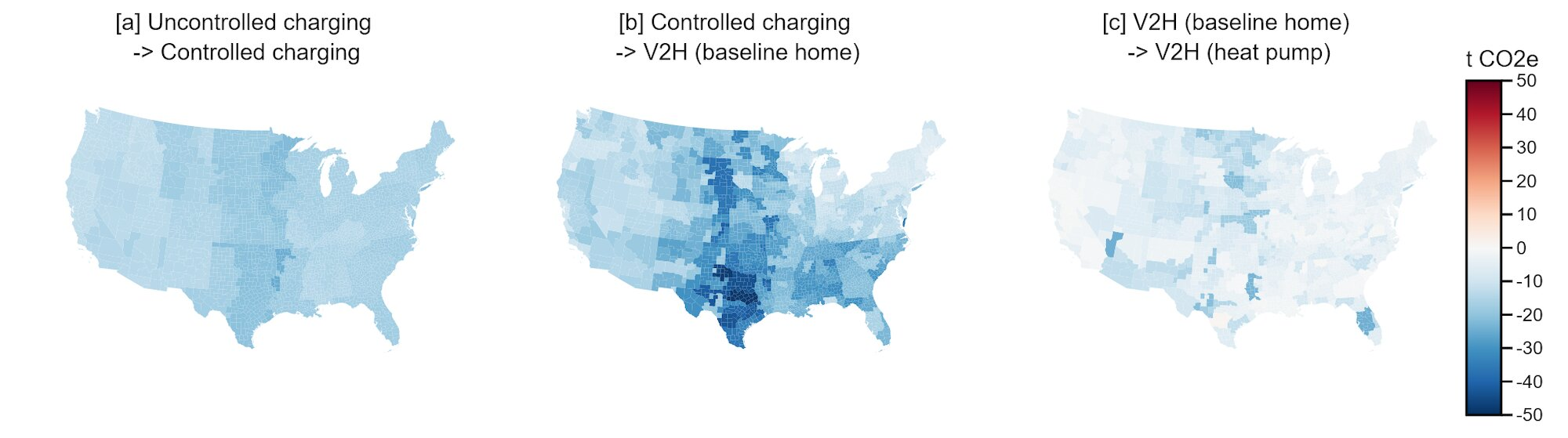
The environmental results are just as striking. The study estimates that using V2H can reduce lifecycle greenhouse gas emissions from household electricity use by 70% to 250%.
The idea of reductions exceeding 100% may sound strange, but it means that the emissions avoided by smart energy use can outweigh the emissions generated by charging and driving the vehicle. In effect, the EV helps clean up not only transportation emissions but also emissions from the building and electricity sectors.
Over a vehicle’s lifetime, this reduction amounts to 24 to 57 metric tons of carbon dioxide per household. To put that into perspective, it’s roughly equivalent to driving a small gasoline SUV for 80,000 to 190,000 miles, or taking 80 to 190 one-way flights between New York and Los Angeles.
Why Location Matters So Much
Not every part of the country sees the same benefits, and the researchers were careful to account for this. The team divided the contiguous United States into 432 distinct regions, each defined by shared climate conditions, electricity prices, grid emissions, and housing characteristics.
They evaluated V2H using a representative mid-sized electric SUV, modeling how it would perform under different local conditions, including temperature, grid cleanliness, and household energy demand.
The results showed that V2H-enabled emissions reductions fully offset charging-related emissions in regions covering about 60% of the U.S. population. Areas with cleaner grids and high solar penetration generally see the greatest environmental gains, while regions with volatile electricity pricing tend to benefit most financially.
What Happens in Fully Electrified Homes?
The study also explored scenarios where homes are fully electrified, meaning they rely on technologies like electric heat pumps instead of gas furnaces or water heaters. In these cases, V2H becomes even more powerful.
By pairing EV batteries with electrified heating and cooling systems, households can dramatically cut emissions while maximizing the value of stored electricity. This approach aligns with broader efforts to decarbonize both transportation and buildings at the same time.
The Technology Is Promising, but Not Fully Ready Yet
Despite the impressive findings, the researchers emphasize that V2H is still a work in progress. While the hardware and software exist, the technology is not yet fully plug-and-play across the U.S.
Utilities, automakers, and regulators are actively testing V2H systems in select markets. One key challenge is developing smart charging controls that optimize when the battery charges and discharges without degrading battery life.
Battery longevity is a major concern, and the study acknowledges that careful management is essential. Ongoing demonstrations aim to strike the right balance between maximizing savings and preserving battery health.
The long-term goal is full automation. Ideally, drivers would simply park and plug in their EVs, while background systems handle all charging and discharging decisions based on grid conditions, electricity prices, and household needs.
Why EVs Make Sense as Energy Storage
Cars spend the vast majority of their time parked, often at home. From an energy systems perspective, this makes EVs a largely untapped distributed energy storage resource.
Traditionally, grid decarbonization efforts rely on stationary battery installations. While those are important, EVs offer a unique advantage: the storage is already being paid for as part of the vehicle.
In other words, EV batteries could help stabilize the grid and support clean energy adoption without requiring as much additional infrastructure. They just happen to have wheels attached.
What This Means Going Forward
This research provides policymakers, utilities, automakers, and homeowners with a clearer picture of whether investing in V2H infrastructure is worthwhile. The answer, according to the data, is yes—especially in regions with high electricity costs or cleaner grids.
More broadly, the study encourages a shift in how people think about electric vehicles. EVs are not just transportation tools. They are energy assets that can support homes, reduce emissions, and play a role in the transition to a cleaner electricity system.
As utilities continue to modernize and V2H technology matures, parked EVs could become an everyday part of how households manage energy—quietly saving money and cutting pollution while waiting for the next drive.
Research Reference:
https://www.nature.com/articles/s41560-025-01894-7