3D-Printed Helical Metamaterials Could Finally Unlock Practical Terahertz Optics
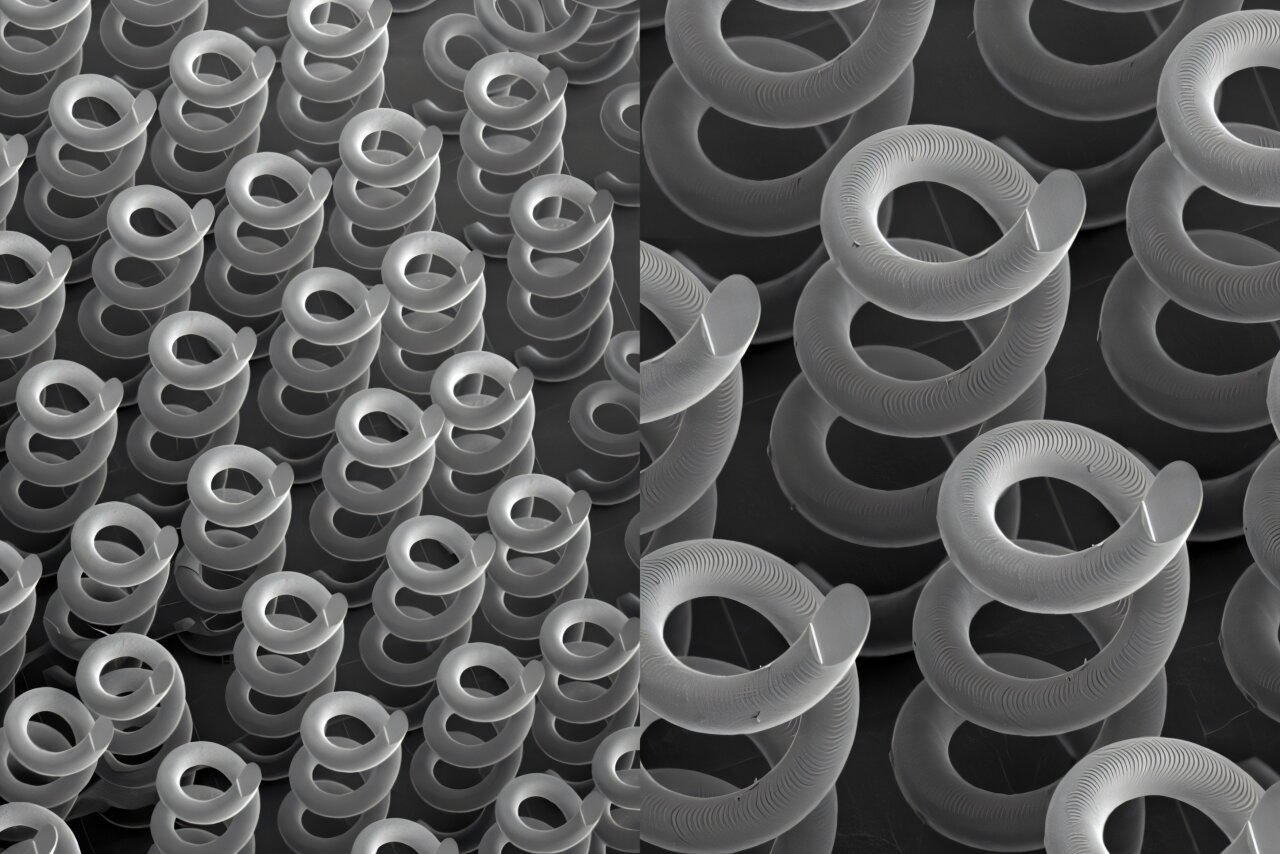
Researchers at Lawrence Livermore National Laboratory (LLNL) have taken a major step toward solving one of modern photonics’ most stubborn problems: how to reliably control light in the terahertz (THz) frequency range. By carefully designing, optimizing, and 3D-printing microscopic helical structures, the team has demonstrated optical materials that can generate and manipulate circularly polarized THz waves with a level of control that has not been possible before.
This work is important because the THz region of the electromagnetic spectrum sits in an awkward middle ground. Its frequencies are too high for conventional electronics to handle efficiently, yet its wavelengths are too long for traditional optical materials and fabrication methods. As a result, many of the basic optical components that exist for visible or infrared light—such as waveplates, lenses, and polarization filters—are either extremely limited or completely unavailable at THz frequencies.
The LLNL team’s approach, published in Advanced Science, shows how 3D-printed helical photonic metamaterials can fill this long-standing technology gap and open the door to new applications in telecommunications, security, sensing, and biomedical research.
Why the Terahertz Frequency Range Matters
The THz region plays a growing role in emerging technologies. It underpins the physical foundations of 5G and future 6G wireless communication, where higher frequencies promise faster data rates and greater bandwidth. Beyond communications, THz waves are attractive because they are non-ionizing, meaning they can probe materials without the risks associated with X-rays or gamma rays.
THz radiation is also uniquely sensitive to molecular vibrations and long-range atomic interactions, making it useful for chemical identification, biological sensing, and non-destructive evaluation. Substances such as explosives, pharmaceuticals, and biological tissues all have characteristic signatures in this frequency range.
Despite these advantages, practical THz systems have lagged behind because of the lack of reliable optical components. One particularly missing piece has been the ability to generate circularly polarized THz beams, which are essential for advanced spectroscopy and chiral sensing.
Using Helical Structures to Create Chirality
To address this challenge, the LLNL researchers focused on helical geometries, which naturally introduce a property known as chirality, or handedness. A right-handed helix and a left-handed helix are mirror images that cannot be superimposed, much like human hands.
In optics, chiral structures can impart handedness to light, producing circular polarization. Circularly polarized waves rotate as they propagate, either clockwise or counterclockwise, and this rotation direction carries valuable information when interacting with chiral molecules such as DNA, proteins, and amino acids.
Creating circular polarization typically requires a quarter-wave plate, an optical component that introduces a precise 90-degree phase shift between two perpendicular components of an electromagnetic wave. While such devices are common at shorter wavelengths, they are extremely difficult to fabricate for THz frequencies using conventional materials.
Precision 3D Printing at the Microscale
The breakthrough came from combining electromagnetic simulations with two-photon polymerization (2PP), an ultra-high-resolution 3D printing technique. At THz wavelengths—around 300 micrometers—2PP is particularly well suited, allowing researchers to fabricate complex three-dimensional shapes with exceptional precision.
The team systematically optimized key geometric parameters of the helices, including radius, height, number of turns, spacing, and handedness. This detailed parametric analysis enabled them to fine-tune the structures so that they interact strongly with THz waves across a broad frequency range.
Once printed, the microscale helices demonstrated robust and broadband circular polarization, producing reliable results across many orientations and angles. Importantly, individual helices showed distinct left-handed or right-handed optical responses, confirming that the geometry directly controlled the polarization behavior.
From Individual Helices to Functional Arrays
The researchers did not stop at single structures. By arranging the helices into carefully designed arrays, they discovered coupling effects that enhanced the optical response even further. The collective behavior of the array amplified the polarization control compared to isolated helices.
This insight led to one of the most intriguing outcomes of the study: the creation of the world’s first chiral QR code. In this system, right-handed helices act as one type of pixel and left-handed helices act as another. Instead of encoding information through brightness or contrast, as conventional QR codes do, this design encodes data through polarization phase.
The result is a QR code that is invisible or meaningless unless it is viewed with the correct THz frequency and the correct polarization-sensitive detector. This adds a powerful physical layer of encryption, making the information inaccessible to unauthorized readers.
Potential Uses of Chiral QR Codes
Chiral QR codes could be useful in environments where both convenience and security are critical. Because the information is encoded in polarization rather than intensity, it cannot be easily copied with standard imaging systems.
Possible applications include secure identification systems, medical records in hospitals, financial authentication, and defense-related technologies. The concept also demonstrates how polarization-based encoding can go beyond traditional digital methods, blending physical design with information security.
High-Throughput Manufacturing with Metalenses
Another important aspect of the work lies in how the helices were manufactured. The LLNL team employed a parallel 2PP printing technique using advanced optical components known as metalenses. These metalenses can split and focus a laser beam into tens of thousands of focal points simultaneously.
This approach effectively turns 3D printing into a microscale assembly line, dramatically increasing throughput. The system can selectively turn focal spots on or off, allowing different helices—left-handed or right-handed—to be printed in precise locations within the same structure.
Such scalability is crucial if THz metamaterials are to move beyond laboratory demonstrations and into real-world devices.
Broader Applications of THz Helical Metamaterials
The implications of this research extend well beyond QR codes. The optimized helical structures could serve as band-pass filters, polarization controllers, and waveplates for next-generation THz communication systems.
In sensing and spectroscopy, circularly polarized THz beams can enhance the detection of chiral molecules, offering new ways to study biological systems, diagnose diseases, and identify hazardous substances. In astronomy and materials science, improved THz optics could enable more sensitive instruments for studying cosmic dust, superconductors, and complex materials.
Why This Research Stands Out
What makes this work particularly significant is that it represents the first full parametric optimization of helical photonic structures specifically designed for THz frequencies. By combining simulation-driven design, advanced fabrication, and experimental validation, the researchers demonstrated a practical path toward customizable THz optical components.
The study also highlights the growing role of additive manufacturing in photonics, showing that 3D printing is no longer limited to mechanical parts but can now produce functional electromagnetic devices with carefully engineered properties.
Research Paper Reference
Helical Photonic Metamaterials for Encrypted Chiral Holograms – Advanced Science (2025)
https://doi.org/10.1002/advs.202507931