Europa Clipper’s Ultraviolet Instrument Captures a Rare and Detailed View of Interstellar Comet 3I/ATLAS
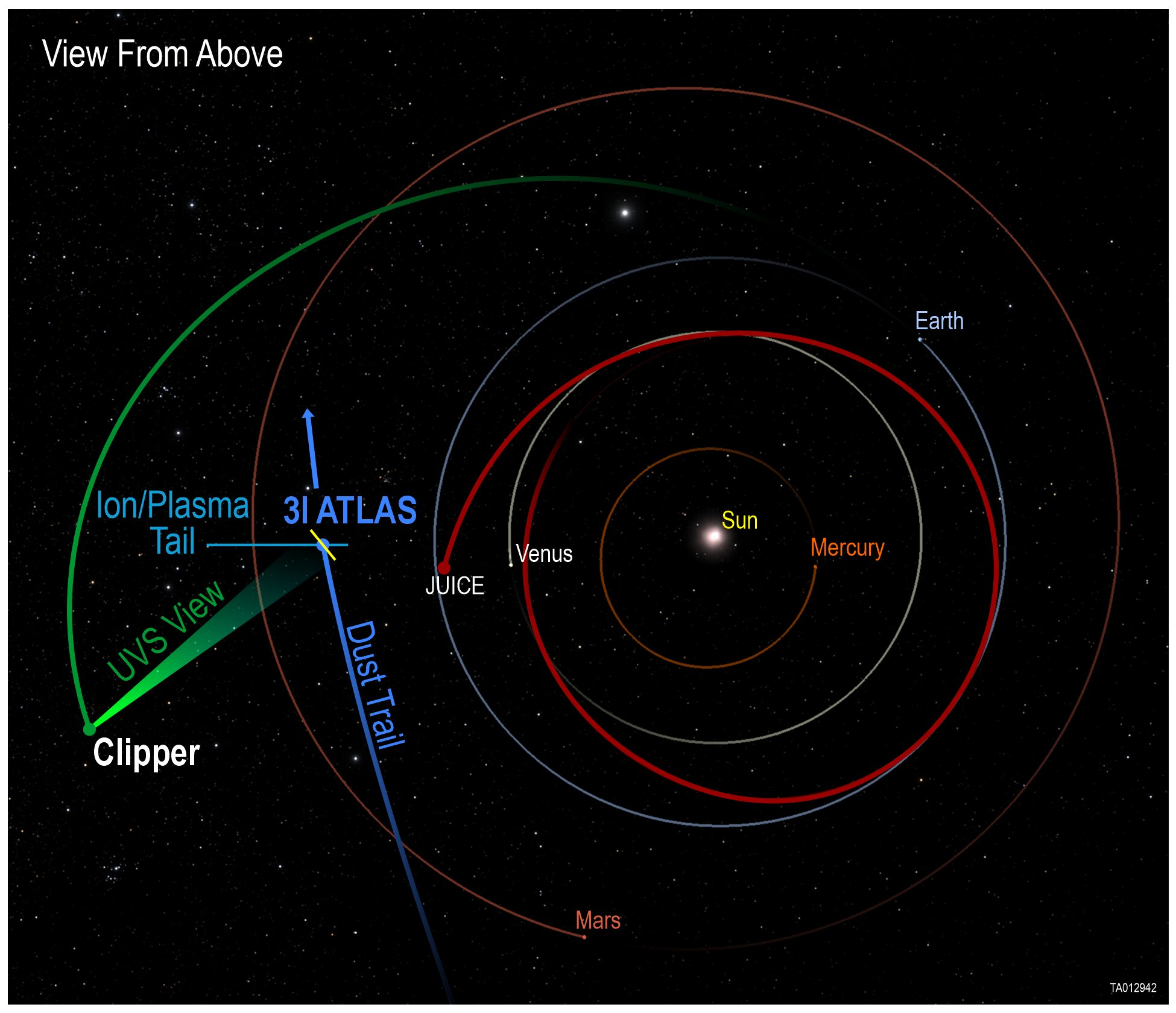
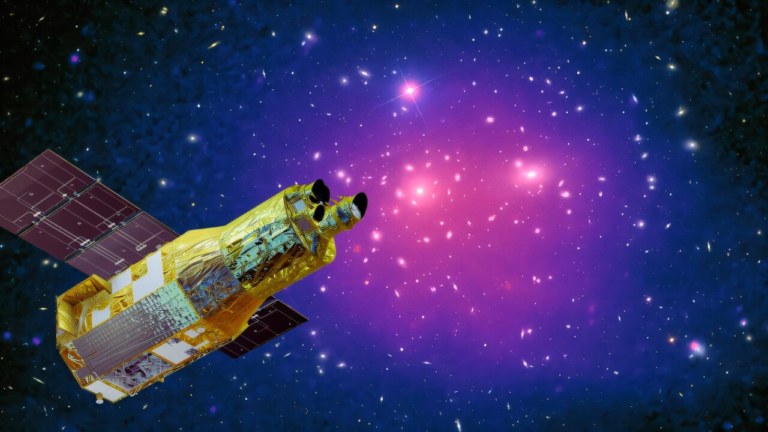
NASA’s Europa Clipper spacecraft, currently cruising through deep space on its long journey to Jupiter, has pulled off an unexpected scientific bonus. One of its instruments, the Ultraviolet Spectrograph (UVS), managed to observe interstellar comet 3I/ATLAS, offering scientists a rare and valuable ultraviolet view of an object that originated beyond our solar system.
This observation stands out not just because 3I/ATLAS is an interstellar visitor, but because the timing and geometry made it extremely difficult to observe from Earth or Mars. Europa Clipper happened to be in exactly the right place at the right time, giving researchers a perspective they simply could not get any other way.
A Rare Visitor From Beyond Our Solar System
Comet 3I/ATLAS became the third officially recognized interstellar object ever detected passing through our solar system. It was discovered in July 2025 by the ATLAS (Asteroid Terrestrial-impact Last Alert System) survey. Like its predecessors, 1I/ʻOumuamua and 2I/Borisov, this comet follows a hyperbolic trajectory, meaning it is not gravitationally bound to the Sun and will eventually leave our solar system forever.
What makes 3I/ATLAS particularly interesting is that it behaves like a classic comet, complete with a coma (a cloud of gas around its nucleus) and two distinct tails—one made primarily of dust and another composed of ionized gas, also known as a plasma tail. Studying such features in an interstellar object gives scientists a rare opportunity to compare material formed around another star with comets born in our own solar neighborhood.
Europa Clipper’s Unexpected Opportunity
Europa Clipper launched in 2024 and is scheduled to arrive in the Jovian system in 2030, where it will orbit Jupiter and perform 49 close flybys of Europa, one of the most promising places to search for extraterrestrial life. Along the way, its instruments are routinely tested and calibrated, but they are also occasionally used for opportunistic science.
Within a week of 3I/ATLAS being discovered, trajectory analysts at NASA’s Jet Propulsion Laboratory (JPL) realized that Europa Clipper’s flight path would give it a chance to observe the comet in November 2025. This window was especially valuable because Earth-based observations were largely blocked by the Sun’s position, and Mars-based views had already passed their optimal period.
In short, Europa Clipper could see what no one else could.
A Unique Ultraviolet Perspective
The Europa-UVS instrument, led by the Southwest Research Institute (SwRI), is designed to collect ultraviolet light to study Europa’s thin atmosphere and icy surface. Ultraviolet wavelengths are especially good at revealing fundamental atomic and molecular processes, such as how water molecules break apart into hydrogen and oxygen.
During the November observation window, Europa Clipper found itself in an unusual geometry relative to the comet and the Sun. The spacecraft was positioned so that the comet passed between Europa Clipper and the Sun, allowing UVS to observe the comet from a sunward viewpoint.
This resulted in a rare downstream view of both comet tails, essentially looking “from behind” the dust and plasma tails back toward the comet’s nucleus and coma. Most comet observations are made from the opposite direction, looking away from the Sun, which makes this dataset especially valuable.
What the Instrument Detected
Europa-UVS detected clear signatures of hydrogen, oxygen, and dust-related features in the comet’s ultraviolet emissions. These detections strongly support other observations indicating that 3I/ATLAS experienced a period of intense outgassing shortly after its closest approach to the Sun.
Outgassing occurs when solar heating causes volatile materials—especially water ice—to sublimate, releasing gas and dust into space. In ultraviolet light, scientists can directly observe the atomic fragments produced when water molecules break apart, providing a more detailed look at the comet’s activity than visible-light images alone.
Because Europa-UVS is particularly sensitive to fundamental atomic transitions, it can measure how efficiently gases are being released and how they evolve as the comet moves through space.
Coordinated Observations With Other Spacecraft
Europa Clipper’s data does not stand alone. At nearly the same time, the European Space Agency’s Jupiter Icy Moons Explorer (JUICE) spacecraft also observed 3I/ATLAS using its own ultraviolet instrument, also led by SwRI.
While Europa Clipper viewed the comet from a sunward, downstream angle, JUICE observed it from a more typical anti-sunward perspective. Combining these two viewpoints allows scientists to reconstruct the three-dimensional geometry of the comet’s tails, improving models of how dust and plasma interact with solar radiation and the solar wind.
Together with Earth-based telescopes and other spacecraft data, these observations are helping researchers build the most complete picture yet of an interstellar comet in action.
Why Interstellar Comets Matter
Interstellar objects like 3I/ATLAS are scientifically priceless because they are natural samples from other planetary systems. Unlike meteorites or comets formed around our Sun, these objects preserve information about the chemical and physical conditions near entirely different stars.
By studying their composition, scientists can explore questions such as:
- How common are water and other volatiles in other star systems?
- Do comets elsewhere form through processes similar to those in our own solar system?
- How do interstellar objects evolve during their long journeys through the galaxy?
The detection of hydrogen and oxygen in 3I/ATLAS suggests that water-rich bodies may be common beyond our solar system, reinforcing the idea that the building blocks of planets and potentially life are widespread in the Milky Way.
Europa Clipper’s Broader Scientific Role
Although observing 3I/ATLAS was not part of Europa Clipper’s original mission plan, it perfectly demonstrates the spacecraft’s scientific versatility. The same instrument designed to study Europa’s surface chemistry and tenuous atmosphere can also provide critical insights into distant comets.
When Europa Clipper reaches Jupiter, Europa-UVS will be used to study plumes, surface frost, and the interaction between Europa’s atmosphere and Jupiter’s powerful magnetosphere. The experience gained from observing 3I/ATLAS helps validate the instrument’s performance and expands its scientific legacy even before the spacecraft arrives at its primary destination.
A Small Window With Big Scientific Value
Interstellar comets pass through our solar system quickly, and observation windows are often short and challenging. Europa Clipper’s successful ultraviolet observation of 3I/ATLAS shows how important it is to take advantage of unexpected opportunities in space exploration.
Each new interstellar visitor adds another piece to the puzzle of how planetary systems form and evolve across the galaxy. Thanks to Europa Clipper and its ultraviolet spectrograph, scientists now have a uniquely detailed look at one more messenger from beyond our cosmic neighborhood.
Research reference:
https://science.nasa.gov/mission/europa-clipper/observations-of-interstellar-comet-3i-atlas