NASA’s SPHEREx Telescope Completes the First Full-Sky Infrared Map in 102 Colors
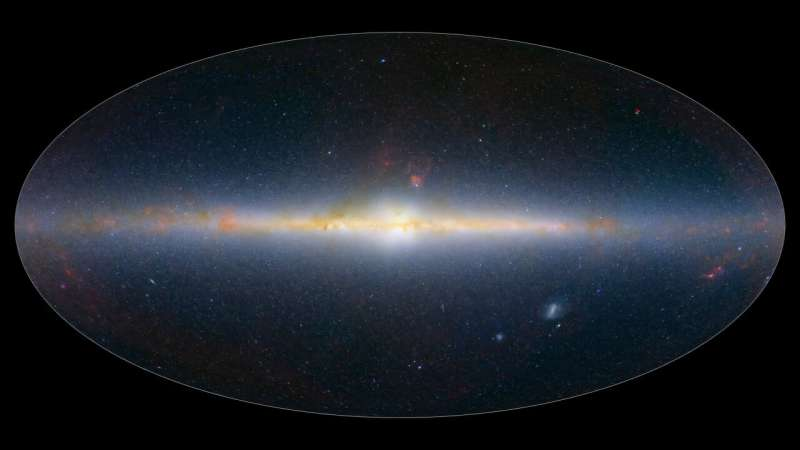
NASA’s SPHEREx space telescope has reached a major milestone by completing its first full-sky map of the universe, capturing the entire cosmos in 102 different infrared colors. Launched in March 2025, the observatory spent about six months scanning the sky in every direction, delivering a dataset unlike anything astronomers have had access to before. This achievement marks the beginning of a new era of wide-field infrared astronomy, combining depth, scale, and spectral detail on a truly cosmic level.
At its core, SPHEREx is designed to look at the universe in ways human eyes simply cannot. The 102 infrared wavelengths it observes are invisible to us, but they are everywhere in space. These wavelengths carry information about stars, galaxies, gas, dust, and even the chemical building blocks that may be linked to life. By mapping the entire sky in these colors, SPHEREx gives scientists a powerful new tool to explore how the universe formed, how it evolved, and what it is made of today.
What Makes the SPHEREx Map So Special
Many space telescopes have surveyed the sky before, but SPHEREx stands apart because of how much spectral information it collects over such a large area. Each of the 102 colors corresponds to a specific wavelength of infrared light, and each wavelength highlights different physical properties of cosmic objects. Some wavelengths reveal hot hydrogen gas, others trace cold cosmic dust, and still others are dominated by light from stars and galaxies.
The result is not just one map, but 102 overlapping maps of the entire sky, each revealing unique details. Dense dust clouds where stars and planets form may glow brightly in one wavelength and disappear entirely in another. Distant galaxies can be identified, classified, and measured based on how their light spreads across the infrared spectrum.
How SPHEREx Scanned the Entire Sky
SPHEREx orbits Earth in a polar, Sun-synchronous orbit, circling the planet about 14.5 times per day. As it travels from north to south over Earth’s poles, it scans narrow circular strips of the sky. Each day, the telescope captures roughly 3,600 images, carefully building up coverage as Earth moves around the Sun.
Over the course of six months, this scanning strategy allows SPHEREx to view every direction in space, covering the full 360 degrees of the sky. The mission began regular sky mapping in May 2025 and completed its first all-sky mosaic in December 2025. This process will repeat three more times during the mission’s planned two-year primary phase, with each new scan improving sensitivity when combined with previous data.
The Technology Behind 102 Infrared Colors
The telescope achieves its remarkable color coverage using six detectors, each paired with a specially designed filter. Every filter contains a gradient of 17 infrared bands, meaning that a single exposure already includes multiple wavelengths. Multiply those 17 bands by six detectors, and every SPHEREx image contains data in 102 distinct infrared colors.
This approach allows SPHEREx to perform a form of low-resolution spectroscopy across the entire sky. While telescopes like the James Webb Space Telescope can analyze light in much finer spectral detail, they do so over very small areas. SPHEREx trades extreme detail for massive coverage, making it uniquely powerful for studying large-scale cosmic patterns.
Building a 3D Map of the Universe
One of SPHEREx’s most important scientific goals is to measure the distances to hundreds of millions of galaxies. Although many galaxies have already been mapped in two dimensions, knowing their distances allows astronomers to build a three-dimensional map of the universe.
By analyzing how galaxy light shifts across the 102 infrared wavelengths, SPHEREx can estimate how far away those galaxies are. This 3D map will let scientists study how galaxies are clustered and distributed on the largest scales, revealing subtle patterns imprinted early in cosmic history.
Probing the Universe’s Earliest Moments
Those large-scale patterns are closely tied to an extraordinary event known as cosmic inflation. Inflation refers to a brief moment, occurring a tiny fraction of a second after the Big Bang, when the universe expanded at an unimaginable rate—by a trillion-trillion times in size. Although inflation ended almost instantly, it left behind ripples that shaped how matter eventually formed galaxies and cosmic structures.
SPHEREx’s galaxy maps will help scientists test models of inflation by measuring how matter is distributed across vast regions of space. This makes the mission directly relevant to some of the deepest questions in cosmology, including how the universe began and why it looks the way it does today.
Tracking Galaxy Evolution Over 14 Billion Years
Beyond inflation, SPHEREx will help researchers understand how galaxies have changed over nearly 14 billion years. By observing galaxies at different distances—and therefore at different points in cosmic time—the mission provides a timeline of galaxy growth, star formation, and chemical enrichment.
Infrared light is especially valuable for this work because it can pass through dust that blocks visible light. This allows SPHEREx to see star-forming regions and hidden structures that would otherwise remain invisible.
Searching for Life’s Key Ingredients in the Milky Way
SPHEREx is not only about distant galaxies. Within our own Milky Way, it will map the distribution of water ice, organic molecules, and other life-related compounds. These substances are found in cold clouds of gas and dust where stars and planets form, and understanding their abundance and distribution helps scientists piece together how habitable environments may arise.
By combining SPHEREx data with observations from other missions, astronomers can identify promising regions for future, more detailed studies.
Open Data for the World
All of SPHEREx’s data is being made freely available to scientists and the public. This open-access approach ensures that researchers around the world can explore the dataset, combine it with other surveys, and uncover discoveries that may not have been anticipated when the mission was first designed.
Managed by NASA’s Jet Propulsion Laboratory in Southern California, SPHEREx is a mid-sized mission delivering outsized scientific impact. Its combination of full-sky coverage, 102-color infrared vision, and repeated scans over time makes it one of the most ambitious sky surveys ever attempted.
As additional all-sky maps are completed over the coming months, SPHEREx is expected to become a foundational resource for astronomy, guiding future observations and reshaping how we understand the universe on its largest scales.
Research paper reference:
https://arxiv.org/abs/2103.01970