Massive Stars Leave Their Signature in a Stunning Hubble View of the Dwarf Galaxy Markarian 178
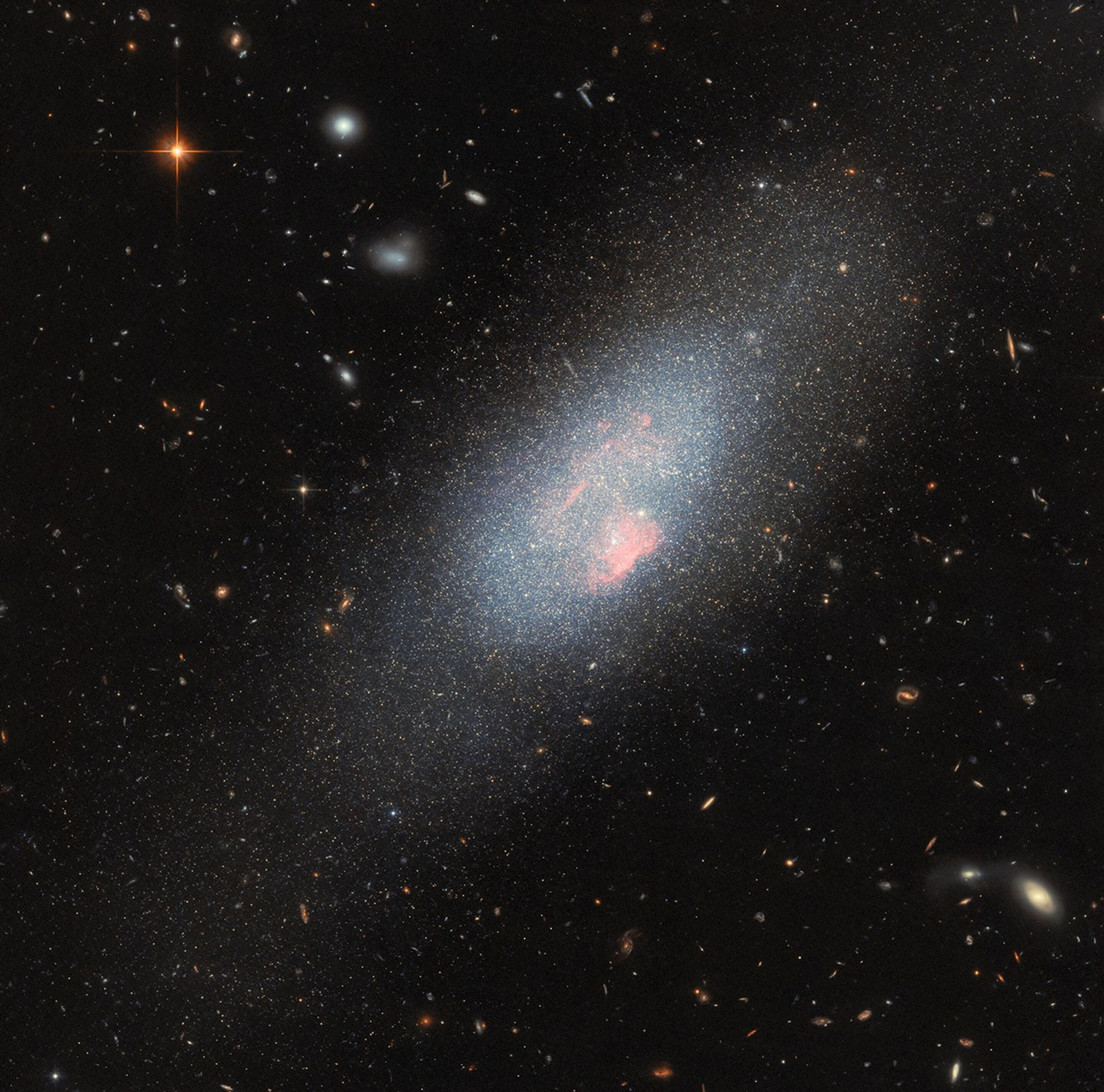
A newly released image from the NASA/ESA Hubble Space Telescope is offering astronomers and space enthusiasts a fresh look at how massive stars can dramatically shape a galaxy’s appearance. The image focuses on a small but active galaxy called Markarian 178, often shortened to Mrk 178, and it packs a surprising amount of scientific insight into a single frame.
Markarian 178 is classified as a blue dwarf galaxy, meaning it is far smaller than spiral galaxies like our Milky Way but still actively forming stars. This particular galaxy lies about 13 million light-years away from Earth in the constellation Ursa Major, also known as the Great Bear. Despite its modest size, Mrk 178 stands out because of the intense activity taking place within it, much of which is driven by some of the most powerful stars known to science.
The Hubble image shows Mrk 178 shimmering against a deep cosmic backdrop filled with distant galaxies of many shapes and sizes. Some of those background galaxies are even visible through the faint outer edges of Mrk 178, highlighting how diffuse and lightweight this dwarf galaxy really is compared to larger, denser systems.
Why Markarian 178 Is Special
Markarian 178 belongs to a larger family of objects known as Markarian galaxies. There are more than 1,500 galaxies in this group, all named after Benjamin Markarian, an Armenian astrophysicist who identified them during a survey in the mid-20th century. These galaxies caught astronomers’ attention because they appeared unusually bright in ultraviolet light, a strong clue that they contain large numbers of young, energetic stars.
In the case of Mrk 178, that ultraviolet brightness comes largely from its abundance of hot, young stars that have formed relatively recently in cosmic terms. These stars burn at extremely high temperatures and emit intense blue light, which explains why most of the galaxy appears blue in the Hubble image.
However, blue is not the only color on display.
The Red Glow That Caught Astronomers’ Attention
One of the most intriguing features in the image is a reddish region near the edge of the galaxy. This area is not caused by dust, as might be expected in larger galaxies, but instead comes from a rare and short-lived class of stars known as Wolf–Rayet stars.
Wolf–Rayet stars are massive, evolved stars that represent one of the final stages in stellar evolution for the heaviest stars in the universe. These stars are incredibly hot and powerful, and they lose mass at an astonishing rate. Their intense stellar winds strip away their outer layers, throwing vast amounts of material into space.
As this expelled gas becomes energized, it produces bright emission lines, especially from ionized hydrogen and oxygen. In the Hubble image, these emission lines appear as a reddish glow, making the Wolf–Rayet population in Mrk 178 stand out clearly from the surrounding blue regions.
What makes this especially noteworthy is how concentrated these Wolf–Rayet stars are. They are clustered in the brightest, most reddish part of the galaxy, suggesting a localized and intense episode of star formation.
A Brief but Important Phase of Stellar Life
Wolf–Rayet stars are fascinating not only because of their power but also because of their extreme rarity and short lifespans. This phase lasts only a few million years, which is a blink of an eye on cosmic timescales. After this stage, these stars are expected to collapse in dramatic fashion, forming either black holes or neutron stars, often accompanied by powerful supernova explosions.
Because Wolf–Rayet stars exist for such a short time, their presence in Mrk 178 tells astronomers something very important: star formation must have occurred quite recently in this galaxy. The stars we are seeing have not had time to age significantly, meaning whatever triggered their birth happened in the relatively recent past.
What Triggered the Starburst?
This is where the mystery deepens.
In many galaxies, bursts of star formation are triggered by gravitational interactions with neighboring galaxies. Close encounters or mergers can compress gas clouds and ignite waves of new star birth. But Markarian 178 appears to be isolated, with no obvious nearby galactic neighbors that could have caused such a disturbance.
Astronomers are therefore exploring alternative explanations. One possibility is that a cloud of gas from intergalactic space collided with Mrk 178, injecting fresh material and compressing existing gas enough to spark new star formation. Another idea is that the intergalactic medium itself disturbed the galaxy’s gas as Mrk 178 moved through space, creating internal shocks that led to the formation of massive stars.
Both scenarios would help explain why a small, seemingly quiet galaxy suddenly lit up with such powerful stellar activity.
Why Dwarf Galaxies Matter
Although dwarf galaxies like Mrk 178 are small, they play an outsized role in astronomy. These galaxies are thought to resemble some of the earliest galaxies in the universe, making them valuable laboratories for studying how stars formed in the distant past.
Because dwarf galaxies have relatively low amounts of dust and heavy elements, astronomers can more easily observe the raw processes of star formation within them. Studying systems like Mrk 178 helps scientists understand how massive stars influence their surroundings, shape galaxy evolution, and enrich space with heavier elements through stellar winds and supernova explosions.
The Role of Hubble in Modern Astronomy
This image is also a reminder of the continued importance of the Hubble Space Telescope, even decades after its launch. Hubble’s ability to capture fine details across multiple wavelengths allows astronomers to distinguish between different stellar populations and identify features like Wolf–Rayet stars that might otherwise be missed.
By combining visual detail with spectral data, Hubble provides insights not just into how galaxies look, but what physical processes are actively shaping them.
Looking Ahead
Future observations, including follow-up studies with both Hubble and next-generation telescopes, will help astronomers build a clearer picture of Markarian 178’s star formation history. By analyzing the ages, distribution, and composition of its stars, researchers hope to determine exactly what sparked this recent burst of massive star formation and how long it might last.
For now, this image stands as a vivid reminder that even the smallest galaxies can host some of the universe’s most powerful and influential stars.
Research reference:
https://ui.adsabs.harvard.edu/abs/2013A%26A…559A..90A/abstract