Hubble Takes Another Close Look at Interstellar Comet 3I/ATLAS as It Heads Out of the Solar System
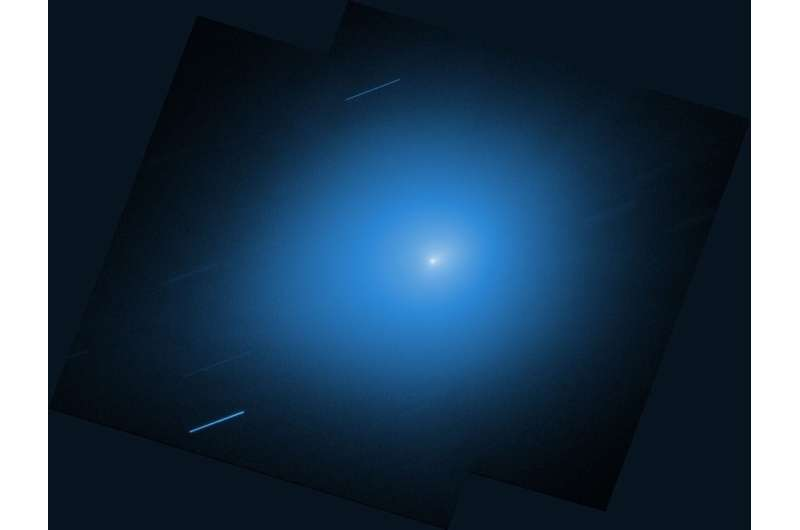
The story of 3I/ATLAS, only the third interstellar object ever detected passing through our solar system, continues to unfold—and it keeps getting more interesting. First spotted on July 1, 2025, this visitor from beyond our cosmic neighborhood has since become one of the most closely monitored small bodies in modern astronomy. Recent observations from the NASA/ESA Hubble Space Telescope have now provided fresh insights into its behavior, composition, and future trajectory as it prepares to leave the solar system for good.
Discovery of a Rare Interstellar Visitor
3I/ATLAS earned its name because it is the third confirmed interstellar object (ISO) detected by astronomers, following the famous ʻOumuamua in 2017 and 2I/Borisov in 2019. Its discovery was made possible by automated sky-survey systems, which flagged the object due to its hyperbolic orbit—a clear indicator that it did not originate from our solar system and will not remain bound to it.
Soon after the alert, astronomers at the European Space Agency (ESA) began coordinating rapid follow-up observations using observatories across Hawaii, Chile, and Australia. The goal was simple but urgent: gather as much data as possible before the object moved too far away or became obscured by the Sun.
Hubble’s Latest Observations
After spending several months hidden behind the Sun from Earth’s perspective, 3I/ATLAS re-emerged in early November 2025, allowing astronomers to resume detailed observations. One of the most significant follow-ups came on November 30, when the Hubble Space Telescope once again turned its attention toward the interstellar comet.
Using its Wide Field Camera 3 (WFC3), Hubble tracked 3I/ATLAS from a distance of about 286 million kilometers (178 million miles). These observations were timed strategically, as the object is approaching its closest pass to Earth, expected around December 19, 2025. At that point, it will come within 269 million kilometers (167.1 million miles)—roughly 1.798 times the distance between Earth and the Sun.
While that may sound far, in astronomical terms it is close enough to allow extremely detailed imaging and spectroscopy using space-based observatories.
A Comet With Growing Activity
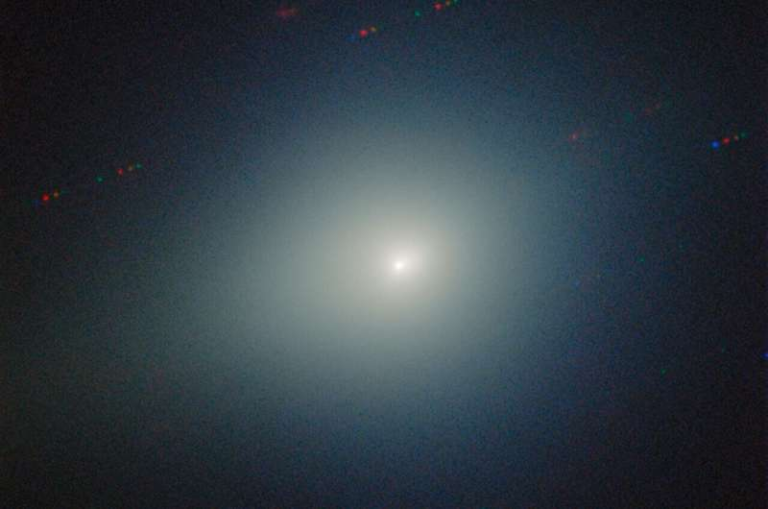
One of the most notable findings from the latest observations is the increase in outgassing activity. As 3I/ATLAS warmed while moving through the inner solar system, frozen materials within its nucleus began to sublimate, producing a visible coma and jets of gas and dust—hallmarks of a comet.
These observations have firmly confirmed that 3I/ATLAS is a comet, not a rocky asteroid or inert body. However, it is far from ordinary.
Unusual Chemical Composition
Data collected by Hubble and other observatories have revealed several unusual chemical traits that set 3I/ATLAS apart from many comets formed within our solar system.
Key findings include:
- A high abundance of carbon dioxide (CO₂) relative to water vapor
- Surprisingly low concentrations of water, compared to typical solar system comets
- The presence of atomic nickel vapor, a rare detection in cometary atmospheres
These chemical signatures suggest that 3I/ATLAS likely formed in a very different stellar environment, possibly around a star with different temperature conditions or chemical abundances than our Sun.
Shape, Size, and Trajectory
Beyond chemistry, astronomers have also noted that 3I/ATLAS is relatively large compared to earlier interstellar visitors. Its size, combined with its near-ecliptic trajectory—meaning its path roughly aligns with the plane of the solar system—initially raised eyebrows among researchers.
However, detailed modeling shows that while these traits are uncommon, they still fall within the known range of comet behavior. In other words, 3I/ATLAS may be unusual, but it does not violate established physical laws or cometary models.
A Global Observing Campaign
The ESA has taken a particularly active role in monitoring 3I/ATLAS, deploying nearly every available observatory and mission capable of contributing useful data. This effort has included:
- ESA’s XMM-Newton, observing high-energy emissions
- JAXA’s X-Ray Imaging and Spectroscopy Mission, adding complementary X-ray data
- Ground-based telescopes across multiple continents
- Contributions from other space observatories, including those operated by NASA
This coordinated campaign has allowed scientists to study the comet across multiple wavelengths, from visible light to X-rays, offering a more complete picture of its physical and chemical properties.
Where Is 3I/ATLAS Headed Next?
After its close pass by Earth, 3I/ATLAS is now on an outbound trajectory, accelerating away from the Sun and the inner solar system. Current projections indicate that it will:
- Cross Jupiter’s orbit in the spring of 2026
- Gradually fade as its activity decreases with distance from the Sun
- Become out of range for Hubble and the James Webb Space Telescope (JWST) by the end of 2028
Once it leaves observational reach, 3I/ATLAS will continue drifting through interstellar space, likely never to be seen again.
Why Interstellar Comets Matter
Interstellar objects like 3I/ATLAS are natural time capsules from other planetary systems. Unlike comets formed around the Sun, they carry information about:
- The chemical makeup of distant star systems
- Conditions present during planet formation elsewhere in the galaxy
- How common certain materials are beyond our solar system
Each new ISO provides a rare opportunity to test and refine our understanding of planetary formation on a galactic scale.
How 3I/ATLAS Compares to Earlier Interstellar Objects
Compared to ʻOumuamua, which showed no obvious coma, and 2I/Borisov, which looked more like a traditional comet, 3I/ATLAS appears to sit somewhere in between. It behaves like a comet, but with chemical ratios and emission features that challenge existing assumptions.
This diversity suggests that interstellar objects are not a uniform population, but instead represent a wide range of formation histories and environments.
What Comes Next for Interstellar Object Research
Astronomers are already preparing for the future. With upcoming facilities like the Vera C. Rubin Observatory, the detection rate of interstellar objects is expected to increase dramatically. Instead of once every few years, scientists may soon detect multiple interstellar visitors annually, allowing for broader statistical studies rather than one-off investigations.
3I/ATLAS, in that sense, serves as both a fascinating subject and a preview of what’s to come.
Research Reference:
https://arxiv.org/abs/2508.18209