NASA Astronauts Spotlight a Crucial Hatch Thermal Cover Protecting the International Space Station
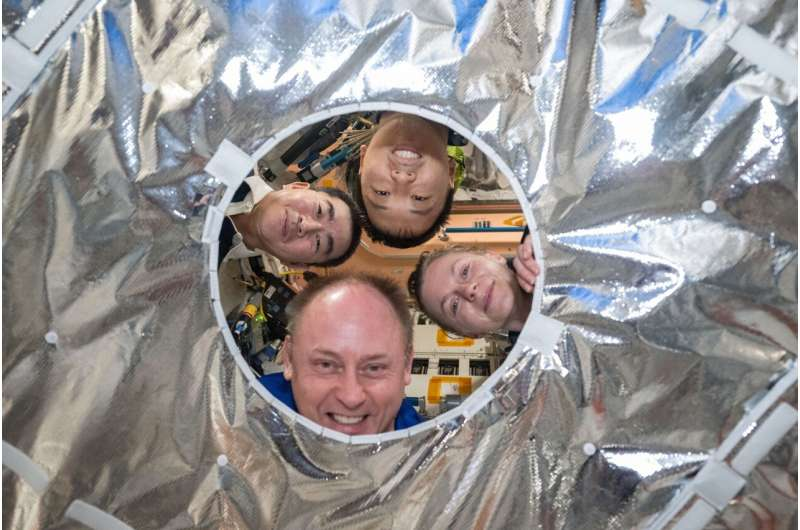
A recently released NASA image has drawn attention to a small but extremely important piece of hardware aboard the International Space Station (ISS): a hatch thermal cover that protects the vestibule between the station and a visiting cargo spacecraft. While the photograph itself feels lighthearted, featuring four astronauts peering playfully through a circular opening, the technology behind it plays a serious role in keeping the orbital laboratory safe, clean, and fully operational.
The image was captured on September 18, 2025, and shows JAXA astronaut Kimiya Yui alongside NASA astronauts Jonny Kim, Zena Cardman, and Mike Fincke. They are positioned around a circular access port built into the thermal cover, which was installed between the ISS and Northrop Grumman’s Cygnus XL cargo spacecraft. The photo was taken by Jonny Kim and later released by NASA as part of its routine documentation of life and work aboard the station.
At first glance, the image looks like a moment of fun during a demanding mission. But behind that moment is a carefully engineered system designed to address several critical challenges of operating in low Earth orbit.
What the Hatch Thermal Cover Actually Does
The hatch thermal cover serves as a protective barrier in the vestibule, the small pressurized space between the ISS hatch and the hatch of a docked or berthed spacecraft. This vestibule is opened when astronauts begin cargo transfers or maintenance operations, making it a sensitive and vulnerable area.
One of the cover’s most important jobs is providing micrometeoroid and orbital debris (MMOD) protection. Even tiny fragments of debris can travel at speeds exceeding 7 kilometers per second, making them capable of puncturing spacecraft structures. The thermal cover adds an extra layer of shielding to reduce the risk of damage in this critical junction.
The cover also helps maintain cleanliness inside the vestibule. Spacecraft arriving at the ISS can carry particulate matter or residues from launch and spaceflight. By isolating the vestibule and keeping it sealed until inspections are complete, the cover helps preserve the ISS’s tightly controlled internal environment.
Another key function is maintaining pressure integrity. Before a hatch is opened, astronauts must ensure that pressure levels between the ISS and the visiting spacecraft are equalized. The thermal cover supports this process by allowing controlled access to valves and seals while minimizing risk.
Why There’s a Circular Opening in the Cover
The circular opening featured in the photo is not just for fun or visibility. It is a functional design element that allows astronauts to perform several essential tasks.
Through this opening, crew members can visually confirm proper hatch alignment between the ISS and the Cygnus XL spacecraft. Misalignment, even by a small margin, could compromise the seal or damage mechanical components.
The opening also provides access to the hatch handle and the pressure equalization valve, both of which are crucial during berthing and unberthing operations. Additionally, it allows cameras or sensors to monitor the interface, giving mission controllers and onboard crew real-time confirmation that everything is functioning as expected.
In short, the opening balances safety and accessibility, allowing astronauts to inspect and interact with the hatch without removing the entire protective cover.
The Cygnus XL Cargo Spacecraft Connection
The hatch thermal cover shown in the image was installed at the interface with Northrop Grumman’s Cygnus XL, an upgraded version of the Cygnus cargo spacecraft. The XL variant is designed to deliver larger payloads and increased internal volume, supporting NASA’s Commercial Resupply Services missions.
Cygnus spacecraft are not designed to return to Earth. After completing their mission, they are loaded with waste and safely burned up in Earth’s atmosphere. During their time attached to the ISS, however, they function as essential lifelines, delivering food, scientific experiments, spare parts, and other supplies.
The vestibule between Cygnus XL and the ISS becomes a busy workspace during these missions, which makes the role of the hatch thermal cover especially important. Any compromise in that area could delay cargo transfers or pose safety risks to the crew.
The Astronauts in the Image and Their Roles
At the time the photo was taken, all four astronauts were active members of the ISS crew.
Jonny Kim, who captured the image, recently returned to Earth after spending 245 days in space aboard the ISS. His mission involved a mix of scientific research, station maintenance, and operational support for visiting spacecraft.
Kimiya Yui, representing the Japan Aerospace Exploration Agency (JAXA), remains aboard the station, contributing to international research efforts and day-to-day station operations.
Zena Cardman, a NASA astronaut and geobiologist, continues her work on scientific experiments that explore how living systems respond to the space environment.
Mike Fincke, a veteran astronaut with multiple spaceflights to his name, is currently serving as commander of the International Space Station, overseeing crew safety and mission objectives.
Their presence together in the image highlights the international nature of ISS operations, where astronauts from different agencies work seamlessly as a single team.
Why Small Hardware Matters in Space
It’s easy to focus on rockets, spacecraft, and dramatic spacewalks, but much of spaceflight safety depends on smaller components like this hatch thermal cover. In orbit, systems must perform flawlessly in an environment defined by vacuum, radiation, extreme temperatures, and constant exposure to debris.
The vestibule area is especially sensitive because it is one of the few places where the station’s internal environment directly interfaces with visiting vehicles. Any failure there could lead to pressure loss or contamination, both of which pose serious risks.
By combining thermal insulation, debris shielding, and operational access, the hatch thermal cover exemplifies how space engineering prioritizes redundancy and practicality.
Broader Context: Micrometeoroids and Orbital Debris
Micrometeoroid and orbital debris protection is a constant concern for the ISS. The station regularly performs avoidance maneuvers to steer clear of tracked debris, but smaller fragments cannot always be predicted.
Hardware like hatch thermal covers complements larger shielding systems, such as Whipple shields, by adding localized protection where it is most needed. Over decades of ISS operations, this layered approach has proven highly effective.
As more spacecraft and satellites are launched into low Earth orbit, the importance of MMOD mitigation technologies will only increase.
A Snapshot of Everyday Space Operations
While the image may appear playful, it offers a genuine look at the everyday reality of life aboard the ISS. Astronauts work long hours maintaining complex systems, conducting experiments, and ensuring that every component, no matter how small, functions exactly as designed.
Moments like these serve as reminders that space exploration is not just about grand achievements, but also about careful attention to detail and constant vigilance.
Research Reference
NASA Technical Memorandum on Micrometeoroid and Orbital Debris Protection for Human Spaceflight Systems:
https://ntrs.nasa.gov/citations/20170005866