Redefining Who Counts as a Real Chemist and Why the Field Needs It Now
The image of a chemist has long been stuck in a narrow frame. For many people, it still brings to mind an older man in a lab coat, standing alone at a bench, surrounded by glassware and chemical reactions. While that stereotype is slowly fading, new research suggests that the definition of a chemist inside the field itself may still be surprisingly rigid—and that rigidity could be costing chemistry its future talent.
A recently published study in JACS Au, led by Sonia Underwood, an associate professor in the Department of Chemistry and Biochemistry, takes a close look at what it means to be considered a “real” chemist. The research, conducted with graduate student Giselle Castano as part of Florida International University’s STEM Transformation Institute, explores how professional identity in chemistry is shaped, who gets recognized as legitimate, and who is quietly pushed to the margins.
At the heart of the study is a simple but powerful idea: when a field defines itself too narrowly, it risks excluding people who already belong—and discouraging many more from ever joining.
The Shrinking Chemistry Pipeline
This research arrives at a critical moment. Chemistry as a discipline is facing a sharp decline in student participation. Over the past five years, chemistry majors have dropped by 25%, a figure that stands out starkly when compared to the roughly 3% decline across other STEM fields. These numbers, reported by the American Chemical Society’s C&EN News, point to a problem that goes beyond curriculum difficulty or job prospects.
According to Underwood’s analysis, part of the issue lies in how chemistry presents itself—both to students and to professionals already working in the field. When only a narrow set of roles is viewed as legitimate, many people struggle to see where they fit, even if they use chemistry every day in their work.
The Idea of the “Pure Chemist”
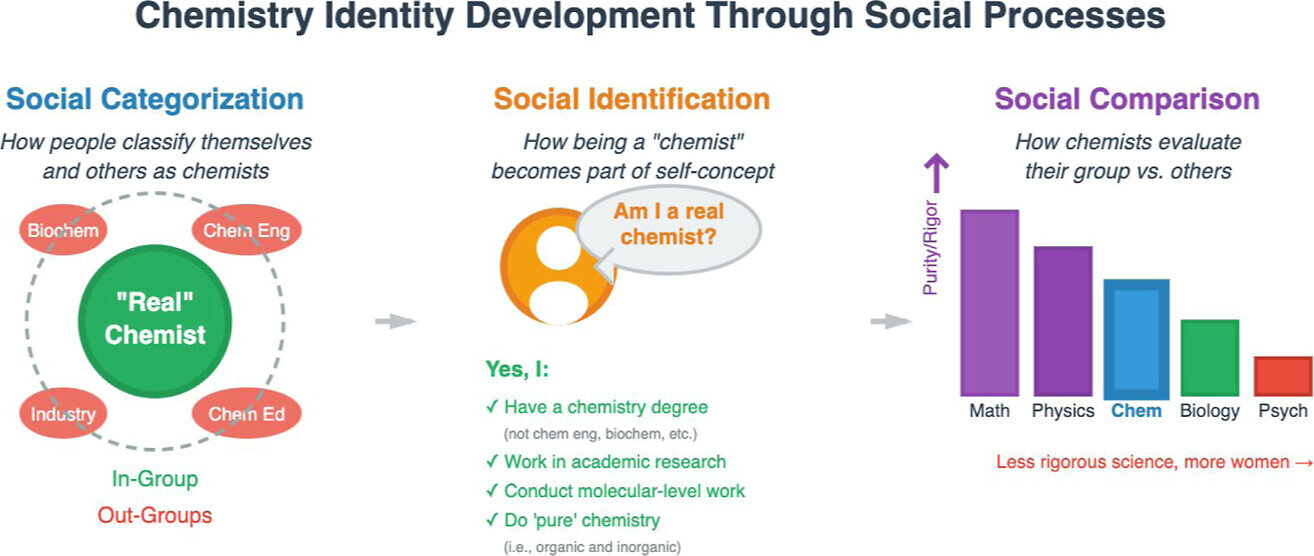
One of the most striking findings of the study is the persistence of what participants called the “pure chemist” stereotype. When asked to describe what makes someone a chemist, many participants pointed to an idealized figure: a person with a chemistry degree conducting molecular-level research in an academic setting, often in organic or inorganic chemistry.
Notably, this definition often excluded entire groups of professionals. Biochemists, chemistry education researchers, industrial chemists, chemical engineers, and applied scientists were frequently described as something adjacent to chemistry—but not quite chemistry itself. Even when their work relied heavily on chemical knowledge, they were seen as operating outside the core of the field.
What makes this stereotype especially influential is not just that it exists, but that it functions as a benchmark for legitimacy. Academic bench research becomes the standard against which all other chemistry-related work is measured.
How Hierarchies Take Shape in Science
The study highlights how this narrow definition creates a hierarchy within chemistry. At the top sits theoretical and academic research, particularly work done in university labs. Below that are applied fields, interdisciplinary roles, industry positions, and education-focused careers.
This hierarchy has real consequences. Participants in the study described how career choices outside academia were sometimes viewed as a step down or a sign of not being “serious” enough about chemistry. In some cases, fitting the mold of a pure chemist appeared to matter more than the quality, impact, or societal value of the work being done.
These dynamics influence who receives recognition, respect, funding opportunities, and career advancement. They also shape how individuals see themselves. Chemists who do not match the traditional image often report feeling like outsiders in a field they have trained extensively to join.
Why This Matters Beyond Academia
Chemistry is deeply woven into everyday life. It plays a role in developing paints, creating flavors and fragrances, improving fertilizers, manufacturing medicines, designing materials, and producing countless consumer and industrial products. Much of this work happens outside university labs, carried out by professionals whose roles are applied, interdisciplinary, or industry-focused.
When these contributions are undervalued, the field sends an implicit message: some chemistry matters more than others. According to Underwood and Castano, this message can erode a sense of belonging, especially for those from underrepresented backgrounds or nontraditional career paths.
Broadening the definition of who counts as a chemist is not just about fairness—it is about retention, innovation, and sustainability. A field that fails to recognize the full range of its practitioners risks losing talented people who no longer feel seen or valued.
Identity, Belonging, and Retention
The research draws on concepts from social identity theory, which examines how group membership and perceived norms shape personal identity. In chemistry, the strong association between legitimacy and academic bench work creates barriers to identification and belonging.
When people do not see themselves reflected in the dominant image of a chemist, they are less likely to persist in the field. This dynamic may help explain why chemistry struggles more than other STEM disciplines to retain students and professionals, even as demand for chemical expertise remains high.
Underwood argues that expanding the definition of a chemist allows people across all career paths to feel that they genuinely belong. That sense of belonging is crucial for maintaining a diverse and motivated workforce capable of addressing complex global challenges.
Signs of Change, and the Work Ahead
The study does not suggest that change will happen overnight. Cultural shifts in science tend to move slowly, shaped by long-standing traditions, incentive structures, and institutional norms. However, there are signs of progress.
Some institutions are beginning to emphasize collaboration across disciplines, recognizing that modern scientific problems rarely fit neatly into one category. Industry-academia partnerships, interdisciplinary research centers, and broader career preparation for students are all steps in the right direction.
The research paper itself includes reflection questions designed to spark honest conversations within departments and professional communities. These questions encourage chemists to examine how value is assigned, whose work is celebrated, and whether current standards align with the inclusive and interdisciplinary future the field claims to want.
Chemistry’s Identity in a Changing World
As science continues to evolve, so too must the way fields define themselves. Chemistry is no longer confined to isolated labs or single-discipline problems. It intersects with biology, engineering, environmental science, medicine, and data science in increasingly complex ways.
Recognizing this reality means acknowledging that a chemist can be someone who teaches, someone who works in industry, someone who designs products, or someone who applies chemical principles in unexpected contexts. Expanding the definition does not dilute the field—it strengthens it.
The central message of this research is clear: chemistry thrives when it makes room for everyone who contributes to it. By questioning old stereotypes and redefining what it means to be a real chemist, the field has an opportunity to become more inclusive, more resilient, and better equipped for the challenges ahead.
Research Paper:
Identity Development in Chemistry: The Social Functionality and Moral Significance of Being (Considered) a “Real” Chemist
https://pubs.acs.org/doi/10.1021/jacsau.5c00769